Monday, 27 June 2011

A person doesn't change just because you find out more.

No 21 - The Third Man
Director - Carol Reed

The film noir. The Murder Mystery. A great framework for a film, and one that is done amazingly well. The story is the simple tale of a suspicious death and a man's journey to get to the bottom of it, yet it is a story made all the richer by the surroundings it is in. The weird oppression and military nightmare of post-war Vienna makes this film a lot more tense, a lot more paranoid. Paranoia which is brilliantly depicted through the use of camera angles. Maybe they filmed a lot on hills. Or maybe the tripod's third man was a bit too short....

I don't mean to sound like I'm belittling it... the camera work is probably the most impressive thing in the whole film. Either in the angles and shot or in the transitions. There are some amazing fades or some great early examples of quick editing which help make the film feel a lot more ominous and shady throughout. The mystery of Harry Lime is rich and captivating, so much so that some of the peripheral characters feel like a nuisance, they're important to the main plot, but their sub-plots are just getting in the way of the real story. Yeah... I'm talking to you Anna Schmidt.

The film is really waiting for Orson Welles to appear and explain the mystery of Harry Lime. Welles is a delight throughout this film, for a lot of the film he has this permanent arrogant smirk as if he's just pissing himself in his glorified cameo. But actually, despite his brief appearances (both in number of times, and how long he's on screen) he manages to fill Harry with a lot of complex nuances. I love watching the arc of emotion Welles portrays. Particularly the moments when he feels betrayed or worried. In fact, as the net tightens and Harry gets progressively ruffled you see his fall from grace. The cocky smirker becomes bug eyed, gasping and crawling through a sewer. Its a remarkable journey and you can see what attracted Orson Welles to the part.
The camera also seems to love Welles, with loads of wonderful lingering shots over the enigmatic Harry Lime. But nothing will ever beat the character's introduction. As a light is cast over Lime's smiling face it seems like a two-tiered TA DAH. Firstly... at last! We get to see Harry Lime, the man we've heard so much. But secondly... at last! I was wondering when Orson Welles was appearing. Just look at that moment... he's either channelling some serious smugness with Harry Lime or he knows that he is pretty much the shit.

But the final point, which I'm repeating from earlier, is that even with great acting and a super story, the film's real triumph is how it looks. This is a beautifully shot film. This is not a spoilery scene... but watch the framing in the film's last shot, as Anna Schmidt walks out of the protagonist's life forever....

Beautiful


Have you been drinking?

No 270 - Moartea Domnului Lazarescu (The Death of Mr Lazarescu)
Director - Cristi Puiu

My knowledge of Romania is not massive, and mainly stems to a 10 day holiday romance with a girl called Jo which I had on a school trip to France aged 17 and a bottle of homebrew which I drank on the same school trip. It looked like Ribena and tasted like meths. The man that gave it to me delivered it with the greatest quote ever.

In our country we drink this in winter to stay warm....
and we drink it in summer.... to stay warm.

Jo taught me that Romanian is surprisingly similar to Italian (enough that she was able to translate an Italian play for me) - that homebrew taught me that Romanians drink savage savage shit. And it is that point which is at the heart of The Death of Mr Lazarescu.

This film is classed as a comedy, and if you get your chuckles from watching an old man slowly die, you are in for a treat! There are some little moments which made me smile (mainly down to the few bearable members of medical staff) but most of this film frustrated me. An old man (older than his years) is ill and is caught in some kind of bureaucratic nightmare as he moved from hospital to hospital and from unit to unit.
Some of these doctors are nice. I particularly like the couple who seem to be involved in the second hospital. I like their shameless and borderline unprofessional flirting and how they get distracted having little domestics. They are a sweet couple and (most importantly) they are worried about Mr Lazarescu. Whereas other hospitals are wrapped up in admin or refuse to treat him as he has alcohol on his lips....

It does paint the Romanian health service in a terrifying light, as it seems very easy for people to just die. Just die.

Now.... I don't want to focus on how much the story annoyed me and how much I wanted to punch some of the doctors throughout. I presume that that was kind of the point. What I wanted to highlight was the amazing performance from Ion Fiscuteanu as the titular Mr Lazarescu. From the start of the film you can see the depth and layers within the character. Here is a man who is clearly unhappy and clearly lonely. He isn't that close to anyone (he has some kind of strained relationship with his brother in law as witnessed in a phone call) apart from the stray cats which he takes in.
But the really impressive nature is that as the film progresses, Lazarescu's health massively deteriorates. What starts as him being obnoxious, becomes a tired, confused and scared man before finally he is just gone. No longer understanding the questions asked of him nor understanding where he is.

This is not a comfortable watch, and despite the occasional smile-inducing moment, there is no way I'd call it a comedy, or even a comedy-drama. It is really a bleak look at bullying doctors, bullshit bureaucracy and the dangers of drinking too much alcohol.

Perfect film for a nice summer's day.


If I could find a souvenir, just to prove the world was here.

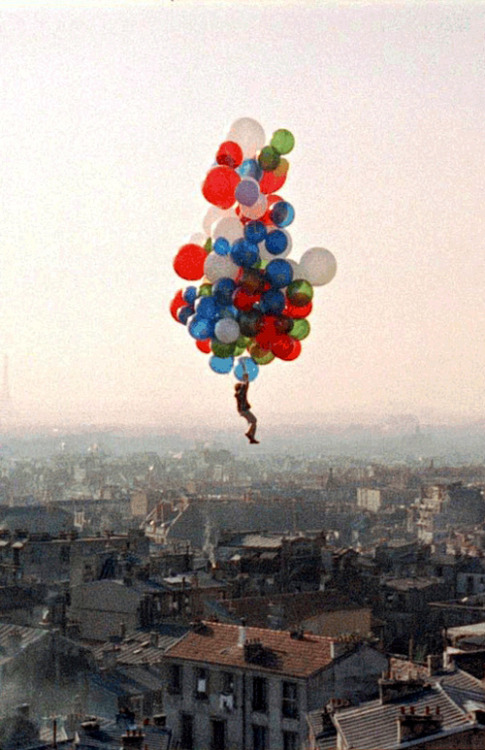
No 294 - Le Ballon Rouge (The Red Balloon)
Director - Albert Lamorisse

This is a short little fantasy tale about a boy who befriends a red balloon and the journey the two go on. Not to be mistaken with Billy's balloon, which was my only prior source of information on this kind of subject.


The relationship with Pascal and his balloon is much sweeter. The boy untangles the balloon from a lamp-post and the balloon subsequently follows Pascal around - much to the annoyance of the adults and jealousy of his peers.

The balloon is an incredible character (and believe me, it is a character) - Firstly, the colour.... compared to the drab greyness of post-war Paris, the balloon seems unreal. A redness so bright that it appears almost CGI. Of course, that's impossible, so it is an impressive feat on the behalf of the film makers. I don't think it is down to lenses either, I just think Paris was a lot greyer back then.


The balloon also seems to emote (certainly, it acts much better than some of the smaller roles throughout) - you get to see a happy balloon, an interested balloon, a scared balloon, a yearning balloon.

It really helps to make a rich relationship between Pascal and his balloon, which means you care about their fate. So the persecution of the balloon becomes really sad to watch.

The film's ending is bittersweet, but after focusing on this beautiful relationship and as it reaches its natural conclusion, we get the final shot. An impressive and utterly beautiful final shot.

So beautiful, that I don't want to ruin it by showing you it. But you can click here to see it.

Sunday, 19 June 2011

Zed's dead, baby. Zed's dead

No 9 - Pulp Fiction
Director - Quentin Tarantino

This is the film that really showcases Tarantino's dialogue (and it is his dialogue which is his true strength). He is very good in situations where he has several stories going on at once - this is a classic example of a successful use of chapter based storytelling, accompanied by incredible performances and a totally boss soundtrack.

If you have to find a central point to the film, it probably falls on Vincent Vega (John Travolta) and Jules Winnfield (Samuel L Jackson) - 2 heavies who work for a mobster called Marsellus Wallace (Ving Rhames). They might not be the protagonist for every chapter (Bruce Willis' boxer Butch also takes the spotlight at times) appear in all of the stories and are pivotal to the tale.

I'm not going to go into detail on all of these chapters, as they have all been assessed to the hilt. However, I just want to talk about a few factors of the film.

This film drips with effortless cool. So effortless that it seems lazy. The film manages to be cool without really trying. This is probably helped by the music throughout (after all - anything would look cool when paired with Neil Diamond.... even though its actually a cover by Urge Overkill in the film). But what is impressive is that elements that shouldn't work at all, end up working. Just look at the picture of John Travolta above - taken from the film's single coolest moment: the twist competition at Jack Rabbit Slims. Firstly, he has lank and greasy slicked back hair and secondly he has the most 90's suit ever seen.... and yet he remains cool.
Same with Jackson, he appears wearing a bloody PERM and yet he still looks too badass for words.
As I've already mentioned, the film's coolest moment is the Twist scene... It manages to be almost nonchalant in the dance, a very cool scene which is now iconic. The nonchalance is important. There are a lot of films out there which are self conscious in their drive to be cool. Obviously Tarantino tries hard to make sure his movies come out as stylish, but it never feels forced. That is an impressive feat and ties me into my next part.


Tarantino has always been lauded for his dialogue, and throughout the film you can see why. The casual conversation occurring through out scenes was pretty revolutionary at the time. Whilst most people discuss the famous Royale with Cheese conversation, I'm much more impressed by Tim Roth and Amanda Plummer's conversation about the intricacies of bank robbery. It is all discussed in a matter of fact and straightforward manner. He also manages to make believable characters with distinctive voices.
Whether it is Fabienne's stilted dialogue with her adorable use of words or L Jackson and Rhames speaking with distinctively 'black' dialogue (whatever the hell that means). He also knows how to lift his quotes. Is there anything more chilling then L Jackson quoting the bible?(then again, he can say anything and sound badass)

There are some moments which don't quite work (Christopher Walken will never be a convincing kindly child friendly character), but the worst is Tarantino himself with his character of Jimmy. A man who grates throughout (I'm not a fan of Tarantino's voice or delivery and find him jarring in every one of his cameos) but who mainly makes me feel uncomfortable through his excessive use of the N word (a word which is liberally used throughout the film, but notably only by black characters). By having Jimmy use it so casually (rather than as a racist insult) it leaves a strange taste in my mouth and is the only part of the film which draws me out of the world.


This is a dark film. A film which successfully shows drug use (and subsequent overdose). Shows an awful lot of violence and an awful lot of abuse. Yet, The Simpsons decide to parody a dark film's darkest moment. Where two men are gagged and bound in order to be subsequently tortured, raped and (it is hinted) killed by a redneck, Dorien Tyrell and a gimp.

It is such an odd choice for a Simpsons reference. What the fuck?!


Throughout the film we spend time with Wallace, the true central crux of the film and a mysterious (and possibly paranormal?) thread throughout it all. After all.... why has Wallace got a plaster on the back of his neck? What is in the suitcase?

Quite the mystery...

A fabulous fabulous film.


Saturday, 11 June 2011

What happened between Mrs. Robinson and me was nothing. It didn't mean anything. We might just as well have been shaking hands.

No 62 - The Graduate
Director - Mike Nichols

I give up trying to apologise for the recent lax behaviour on this blog. My life has got distressingly hectic and LoveFilm are sending me all sorts of fascinating films which are decidedly NON-LIST. But I'm keeping at it.... and will continue here. Have no fear.

There are a lot of nice little bits I wish to talk about in The Graduate. The beautiful soundtrack, for example and that I really love The Sound of Silence, even after hearing a hundred times over the film.

The Sound of Silence by Simon and Garfunkle - just beautiful


Then there is the great acting. Namely, the two central roles.
I am a massive fan of Dustin Hoffman. He pretty much makes every thing he is in better. Whether its a serious role, what seems like a cash in, or just a cheeky cameo.... he is brilliant. No exception here. Ben is a great character. A bundle of nerves and angst, filled with worry and self loathing. He stays utterly fascinating and believable throughout. Not only that, but as you watch his mannerisms, and listen to how he speaks, you realise that he may have been influential to a certain long lasting comedy:

Hoffman's Ben works brilliantly against the icy cool Mrs Robinson, played marvellously (and at times terrifyingly) by Anne Bancroft. At its heart is a story of love, lust, emptiness, confusion and self loathing. All of these emotions are made brilliant clear through the work of one man:


Surtees, as cinematographer, managed to shoot the film in a way that makes every frame a screen shot. Shots which convey loneliness far more elegantly than any monologue could. From the beautiful, simple title sequence through to the end, each shot is a delight. Shots which show anger, passion, betrayal, despair and shots which are just incredibly iconic.

A film which is just beautiful to look at.


Tuesday, 31 May 2011

You want to explain the math of this to me? I mean, where's the sense in risking the lives of the eight of us to save one guy?

No 156 - Saving Private Ryan
Director - Steven Spielberg

Saving Private Ryan is known (and really, is remembered) for one thing. One epic battle on the shores of Omaha Beach in Normandy. It is so ingrained as THE memory of the film that it eclipses everything else. I was so convinced that this was how the film truly began that I was surprised to see a little old James Ryan shuffle along to the Normandy American cemetery and Memorial. But it is old Ryan which bookends the film (indeed the fade out at the end from young Ryan to old is masterful) before we hit the full horrors of war.

The opening sequence is incredible. Shaky cameras which seem to be documenting evidence rather than filming fiction, mud, blood, entrails and futility are all captured on screen. It is deliberately chaotic, the camera almost seems like an additional character as it looks around the beach trying to find moments of action to focus in on. Throughout this mess we lose track of characters and can barely hear what is being shouted over the bombs and blasts. But that is not the point. This is not there to boost a character arc or to progress the plot. This is there for one reason. It shows you that war is a horrible brutal place and it shows you just how fragile and fleeting life can be. In that job, it succeeds triumphantly. It is a tough and painful bit of cinema - incredibly visceral, and unnerving in how 'in your face' it all is. It stands alone (and it is, really, separate from the rest of the film) and should be watched. Or.... experienced.


Only after subjecting us to a good 15 minutes of brutal warfare do we begin to actually mention the plot and the strange ruling which sees Tom Hanks and a small unit sent to rescue Private James Ryan (a point which is contested throughout the film) - during this, the group coincide with other groups performing their own missions and we get to see a barrage of familiar faces. Spielberg putting together a marvellous (and somewhat surreally diverse) cast.

Ted Danson?!
Daniel from Lost?
Vin Diesel in a role written specifically for him?!

The main focus though (and the drive of the film) is the relationship between the soldiers as they suffer in a horrible situation - a theme Spielberg continues to explore in Band of Brothers and The Pacific. The film really allows the characters to breathe and shows a depth and three-dimensional nature which still isn't massively common in films. See the way they struggle with their morality and their hatred of the Nazis. Rather big themes are lightly touched as parts of the war, rather than parts of the story. I for one found the scene in which Goldberg's Stanley Mellish declares his Jewish faith to the German POWs very powerful. For him, this is more than just a job. This is a battle against people which have persecuted and vilified everything that he stands for. This is a moral quest for justice. Yet, the film never expands on it... it is just part of the day to day nature of the war.

The film continues in this way.... setting up minor events which test and explore the group's characters until we come to the major event of meeting the titular James Ryan and one last big action scene. It is a film which doesn't shy away from death but which also tackles some interesting, and far tougher, themes such as survivors guilt.

A big and powerful film, which I'm going to undermine by linking to an Adam and Joe sketch:


Monday, 23 May 2011

Blessed be the one who sits down.

No 213 - Songs from the Second Floor
Director - Roy Andersson

It takes a good 30 minutes before anything bordering a narrative structure creeps into Songs from the Second Floor. Initially it seems that we're dealing with sketches. Returning characters with their own returning issues. Weird little middle aged members of middle management and their weird little life problems. The scenes don't seem particularly linked. We watch a magician fail to saw a man in half and that man subsequently be rushed to hospital. We see a man get fired and beg for his job. We see a man get viciously attacked as he searches for someone. The scenes seem barely interlinked, ranging from the weird staccato delivery of Lynch at his most inaccessible to the weirdness of Monty Python.


And yet, as the film progresses, you realise that there is something happening. It may not be a story in any shape or form, but it is still a cinematic study and something very beautiful. There are scenes which are massively symbolic, The traffic which hasn't moved for hours as everyone is going the same way (and later the mass of people struggling with their baggage) is a sign of our own progress, likewise the old people sacrificing youth and still not getting what they want... it all seems to have a massive message of the futility and shallowness of our own times. How our common quest for progress leaves us standing still. How we destroy the young to get something... some gain.
How we sell hope and beliefs for a cheap buck.

Whilst this sounds very bleak, bare in mind that this is only MY interpretations, and the film itself is darkly funny and at times incredibly beautiful. Songs from the Second Floor revels in the mundanity in which these surreal exchanges and events take place. A suburban dystopian nightmare. But ones where there are moments of utter beauty.
I want to focus on two moments - both of which are musical. Its the music which really makes these moments shine. But it is also the simple, understated way in which they're presented. For me, the most incredible moment was the 'Silent Song' - an operatic frame within a commuter train service.


It is just a lovely moment. The second moment is when one of the characters plays the recorder with his girlfriend. Again... it is simple, and beautiful.

The film claims to be a filmic representation of poetry by César Vallejo - and there is much talk of poetry, and many repeated lines throughout. I have to admit, I don't know the fella's poems so I can't really comment. What I can say is that the film is haunting, beautiful, at times hilarious and always always perplexing.

Basically this is everything I hoped The Temptation of St Tony was going to be when I sat down to watch it. I was severely disappointed by old Tones. So this was a welcome joy when it comes to surrealist cinema.