No 96 - American Beauty
Director - Sam Mendes
And so continues my tiny run of 'films narrated by dead characters'. Here we get to enter the gloriously misanthropic, seedy underbelly of suburbia. This is a film that celebrates the fact that nobody really likes anybody, including themselves. It is a film which has a great story, wrapped around a terrific cast. Even the tiny roles are exciting. See the likes of Scott Bakula, Allison Janney and Peter Gallagher crop up for mere minutes (if that) of screen time. It is a delight.
Then there are the larger supporting roles, and of those my favourite must be Thora Birch. Recently watching Ghost World (and then this) has rekindled a feeling I had about her for a while - she is just brilliant.
In both films she perfectly displays the self-loathing and exasperation of being a teenager, of being misunderstood. In this film she is just brilliant, especially when compared to Mena Suvari's character Angela Hayes.
Angela Hayes just bugs me. She may be pivotal to the story - the catalyst - and she may have a wonderful scene in which her character becomes richer, deeper, more interesting. But really, for the majority of the film I just find her really annoying. You can cover her in iconic rose petals as much as you want but it won't change a thing. She bugs me.
But she is the inspiration for this awesome bedspread. And I want this awesome bedspread!
What I think I like the most about Thora Birch - and more specifically her character of Jane Burnham - is her relationship with Ricky, her neighbour. They seem to share a romance which feels genuinely sweet and hopeful in a film which relishes the bleak and hopeless. Ricky is initially portrayed as weird but as you get to see more of him you realise he is a sweet man, a hopeless romantic and a desperate poet (though his 'most beautiful thing I've ever seen' video flirts with the wrong side of pretentious). His character is highlighted as even softer and more beautiful when compared to the walking coil of hate and vitriol which is his father. Colonel Frank Fitts is a horrible man - violent and aggressive, and a sickening bigot. But even he isn't allowed to be a two dimensional character, and Chris Cooper plays him beautifully. By the end of the film, the absolute breakdown which Frank Fitts goes through makes him the most important supporting character of the whole film.
He has a wonderful arc - even though most of it happens very quickly in the final ten minutes.
However, there is one mid-life crisis, one breakdown which is at the heart of the story. Which is the story. Lester Burnham - played by the mighty Kevin Spacey. As the film begins (after his death, with Spacey providing a voice over), I was reminded of something I'd first noticed with The Usual Suspects... Kevin Spacey just has a wonderful voice. It is the kind of voice that you can just listen to for hours. It is a perfect narrator's voice. Which is good, as here it is used to narrate.
What I love is the gradual shift in Lester's priorities. So he begins with a very general malaise about the futility of his life, but after an office blackmail scene (a sexually-themed stylistic echo of the violent Fight Club office blackmail scene) shifts his priority to lust, through the medium of under-age cheerleaders and crappy CGI rose petals. This in turn gradually leads to his realisation that life should be about the simple joy of being happy. Of having no responsibility.
And yes... whilst it isn't good to ditch everything and do whatever you want when you have a family and house etc, I have to admire that extreme level of selfishness for pure personal enjoyment. I think that if you are in a time of your life when you can do that (without hurting anybody else) then frankly you should.
It is that self-entertainment which then slowly moves towards nihilism - not in the same way as Fight Club (and I do think those two films make strangely fitting bedfellows) - but on a smaller, more personal level. All Lester wants is to work out and get stoned. His family is falling apart around him, their respective worlds are collapsing. But he doesn't care because HE is happy.
Considering how selfish he is for the entire film - and considering this is a story which hangs around his selfishness - it is quite nice to have a moment where he slips away from that. The moment where he almost sleeps with Angela shows him at his best. He is kind and compassionate.
And in the end, just before he dies, he is happy.
And as Elliott Smith's utterly beautiful cover of Because trickles over the end credits, that last happy moment of Lester's life leaves me feeling oddly hopeful, in what is essentially a very bleak film.
Showing posts with label thora birch. Show all posts
Showing posts with label thora birch. Show all posts
Wednesday, 18 August 2010




Friday, 2 July 2010
I can't relate to 99% of humanity
No 266 - Ghost World
Director - Terry Zwigoff
As comic book films become more popular and as every comic book ever becomes a film, it is only natural that the less usual comics become films too. However, I am surprised that this film made it so high up the list, and that the more exciting and daring types of films didn't get onto the list at all - I don't think this film is quite as good as American Splendour for example (though that may stem from a huge admiration of Paul Giamatti).
So, here we have a film which relishes in the fact that not much happens. A film about isolation and a film about growing up. A film, in which the protagonist is really really annoying. For whilst we may follow both Enid (Thora Birch) and Rebecca (Scarlett Johansson) - Rebecca kind of fades out of the equation and it is Enid who is the key character in this film. She is also a bit of a twat.
The problem with Enid is that she believes herself to be better than everyone and her superiority manifests itself in a number of horrible ways. Firstly, although she is fascinated with outsiders she seems to get down hearted when things work out for them. She wants other people to be miserable so that she can feel better - her friendships seem to stem from a high level of Schadenfreude. Secondly she is deliberately confrontational. She mocks people with regularity and she starts fights or arguments equally frequently.
Check out her withering asides "He might die of AIDS when he date rapes her".
At the beginning of the film Enid and Rebecca are deliberately alienating themselves from their high school - admiring the weirdos and berating the popular kids from afar. However after graduation, Rebecca begins to assimilate with the real world: saving money, looking for a house, getting a job.
All of this seems alien to Enid who wants to continue to live out life in her little bubble. And so Enid's alienation becomes real - a side effect of her (quite horrible) character, rather than a deliberate part of her superiority.
Enid's descent into isolation also ropes in the film's best characters. Firstly Seymour - played by Steve Buscemi. I've spent the last blog talking about the fact that I think Buscemi is excellent, and I still do. Seymour is just a normal person - a bit nerdy, a bit depressed, but utterly unremarkable. His love for blues and his awkwardness with his friendship with Enid (I think he feels uncomfortable being friends with a 17 year old girl) is wonderful. You kind of hope that things will go well for Seymour. That he will be happy. That he will move away from his weird circle of friends (though it does include the ever-awesome cameo king that is David Cross... oh and his house-mate Kenny from Frasier) and settle down. However, like everyone in the film, his life is made worse by Enid turning up and claiming ownership on Seymour and his emotions. She may claim to love him and that he is her hero, but she still messes him around so much that he ends up even more of a wreck than he used to be.
It is in Enid's art classes that she begins to realise that actually alienation isn't that good - mainly because the art teacher is a bit of a prick and a snob. Her view on what makes art and what isn't allowed (illustrations can't be art) just shows her as this horribly pretentious elitist wanker. When Enid is made to face up to the art teacher (who is, essentially, an even more OTT version of Enid herself) it causes Enid to realise that she needs to be determined and make something of her life.
It also opens up a wonderful sub-plot (the best bit of the film) about the controversial past of Cook's Chicken (a nearby KFC-type restaurant) - which I won't go into, but which brings up issues of acceptability and how far Art can go to push the envelope.
All in all though - the film is as aloof as its protagonists. Which isn't really a good thing.
Director - Terry Zwigoff
As comic book films become more popular and as every comic book ever becomes a film, it is only natural that the less usual comics become films too. However, I am surprised that this film made it so high up the list, and that the more exciting and daring types of films didn't get onto the list at all - I don't think this film is quite as good as American Splendour for example (though that may stem from a huge admiration of Paul Giamatti).
So, here we have a film which relishes in the fact that not much happens. A film about isolation and a film about growing up. A film, in which the protagonist is really really annoying. For whilst we may follow both Enid (Thora Birch) and Rebecca (Scarlett Johansson) - Rebecca kind of fades out of the equation and it is Enid who is the key character in this film. She is also a bit of a twat.
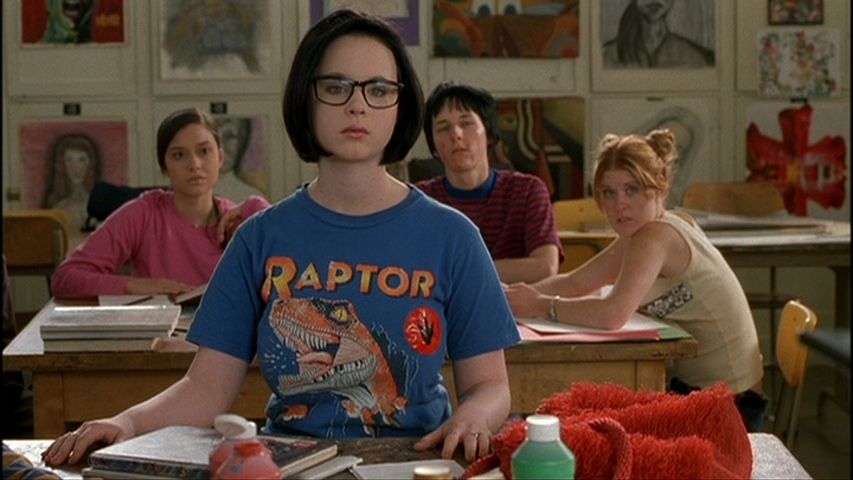

The problem with Enid is that she believes herself to be better than everyone and her superiority manifests itself in a number of horrible ways. Firstly, although she is fascinated with outsiders she seems to get down hearted when things work out for them. She wants other people to be miserable so that she can feel better - her friendships seem to stem from a high level of Schadenfreude. Secondly she is deliberately confrontational. She mocks people with regularity and she starts fights or arguments equally frequently.
Check out her withering asides "He might die of AIDS when he date rapes her".
At the beginning of the film Enid and Rebecca are deliberately alienating themselves from their high school - admiring the weirdos and berating the popular kids from afar. However after graduation, Rebecca begins to assimilate with the real world: saving money, looking for a house, getting a job.
All of this seems alien to Enid who wants to continue to live out life in her little bubble. And so Enid's alienation becomes real - a side effect of her (quite horrible) character, rather than a deliberate part of her superiority.
Enid's descent into isolation also ropes in the film's best characters. Firstly Seymour - played by Steve Buscemi. I've spent the last blog talking about the fact that I think Buscemi is excellent, and I still do. Seymour is just a normal person - a bit nerdy, a bit depressed, but utterly unremarkable. His love for blues and his awkwardness with his friendship with Enid (I think he feels uncomfortable being friends with a 17 year old girl) is wonderful. You kind of hope that things will go well for Seymour. That he will be happy. That he will move away from his weird circle of friends (though it does include the ever-awesome cameo king that is David Cross... oh and his house-mate Kenny from Frasier) and settle down. However, like everyone in the film, his life is made worse by Enid turning up and claiming ownership on Seymour and his emotions. She may claim to love him and that he is her hero, but she still messes him around so much that he ends up even more of a wreck than he used to be.


It is in Enid's art classes that she begins to realise that actually alienation isn't that good - mainly because the art teacher is a bit of a prick and a snob. Her view on what makes art and what isn't allowed (illustrations can't be art) just shows her as this horribly pretentious elitist wanker. When Enid is made to face up to the art teacher (who is, essentially, an even more OTT version of Enid herself) it causes Enid to realise that she needs to be determined and make something of her life.
It also opens up a wonderful sub-plot (the best bit of the film) about the controversial past of Cook's Chicken (a nearby KFC-type restaurant) - which I won't go into, but which brings up issues of acceptability and how far Art can go to push the envelope.
All in all though - the film is as aloof as its protagonists. Which isn't really a good thing.
Subscribe to:
Posts (Atom)