Showing posts with label jimmy stewart. Show all posts

Wednesday, 17 March 2010

Why would a man leave his apartment three times on a rainy night with a suitcase and come back three times?

No 103 - Rear Window
Director - Alfred Hitchcock

I had watched this film before, a few years back, and I thought I knew pretty much what was happening. Especially towards the end. However, I'm embarrassed to admit that at times, what I've done is mix this film with the Simpson's episode lampooning it.
My mind appears to be a whirling blender of pop culture. Sometimes I'm not very good at sifting it.

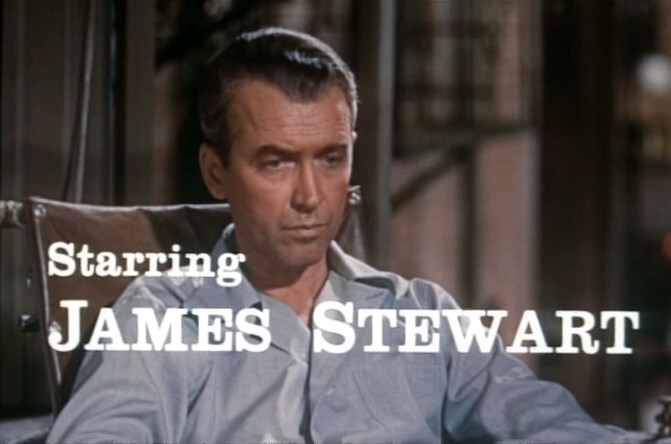
On the plus side, it meant I was constantly being surprised by a film who's actual plot I had forgotten. The plot it self is delightfully simple. L.B 'Jeff' Jeffries (played by the always brilliant Jimmy Stewart) witnesses his neighbour acting very suspiciously and is gradually convinced that he has witnessed a murder. What is impressive is that Hitchcock leaves you guessing throughout the film. After all there are a lot of reasons why Jeff could be wrong, most of which are pointed out before the 'crime' is committed. It is unfeasibly hot and Jeff is in plaster and unable to move around. He is grouchy, bored, irritable, hot and just desperate for a distraction. If you look at the degree his curiosity turns into an all out obsession you can see just how desperate he is for something to focus on.
Gradually, during his obsessive pursuit, he manages to convert his nurse Stella (Thelma Ritter) and his girlfriend Lisa (Grace Kelly - which, tragically, made me instantly think of the Mika song) and the three of them spend days watching their mysterious neighbour Lars Thorwald as he acts all mysteriously.

When you think about it, the crime that Thorwald is accused of by the trio of busybodies is pretty horrific. Not only has he murdered his wife, he has subsequently used a knife and a saw to hack her up into lots of little pieces. He has then transported those pieces out of his house, using his suitcase. In installments.
Throughout this process Lars continues to stay calm and calculated. If Jeff is correct then this isn't an act of passion, this is a cold and calculated killing with a lot of planning - it is this that starts to concern Jeff, the sheer cold heartedness and meticulousness of the crime. Made worse that nobody else believes him.
This is embodied by Jeff's convenient friend Lt Thomas J Doyle (Wendell Corey) who not only refuses to join in with the paranoia but who offers sound alternative theories and sometimes actual proof as to what could have happened. In fact he hardly gets roped in at all until the end. But it means nothing, Jeff, Lisa and Stella still have their obsession and focus on their theories, rather than anything which contradicts. Even the all out evidence is ignored. After all, you can prove anything with facts. If anything, this film is a tribute to all the curtain twitchers who are being paranoid, judgemental busybodies. One day you will have your moment of triumph.
However, oddly for such a taut and well made thriller, the story isn't the most exciting bit. Well, not for me. This film excited the design geek that lives inside my jaded heart due to the fantastic way it uses and films its set.
The set is immense. It is nice to think that a film which is almost entirely set in one corner of one room has such a massive sprawling and complicated set. Hitchcock built an entire street scene which his neighbours (at times little more than glorified extras) could live in. He even built a massive complicated lighting rig so that he could instantly flip to different points in the day. It makes me think of Synechdoche New York, but it also makes me think of theatre. It is very rare that a film is made in one setting, let alone one physical set. If the massive street could be replicated on stage, then a play of the film would easily work. We, don't get the freedom to explore this amazing set though, we're confined to view the lives of its inhabitants from Jeff's rear window. We're only allowed more clarity when Jeff decides to crack out the binoculars or his long zoom lens. Then we get to see their worlds in a little bit more detail, but we're still confined to the limitations of Jeff's viewpoint. It is a very brave move and one that helps make sure the audience is clamouring for information and verification, as they're in the same boat as the protagonist.
The one time that the rule is broken, doesn't really add anything to the film, but it does finally allow us to see up close the people we've been watching from afar. Their lives feel real, they seem to have real issues and in some ways I find the the endings to Miss Lonelyheart's arc and to Miss Torso's arc more satisfying than the ending to the main plot itself. But then they all add up together to show an overall happy ending for that community.

Monday, 28 December 2009

Strange, isn't it? Each man's life touches so many other lives. When he isn't around he leaves an awful hole, doesn't he?

No 195 - It's a Wonderful Life
Director - Frank Capra


This is a film I've been meaning to watch for years. However I keep missing it at Christmas, and it is a film so ingrained into the season that it seems strange watching it when it isn't Christmas.
So finally I got round to watching it (in original black and white rather than new and coloured in). I was surprised by two things:
Firstly this is a REALLY long film, running in at over two hours.
Secondly, the first 90 minutes has nothing really to do with Clarence and what is typically known as the story of 'It's a Wonderful Life'.


Instead we begin with some people praying for George Bailey (the always wonderful Jimmy Stewart) and (in my personal favourite moment) angels, represented by stars, having a little chat about what they should do to answer all these prayers.
So, in order for Clarence the angel to know how to save George Bailey, we must know his story. This is the majority of the film, the life of George Bailey.

What I like is the weird blend of tragedy and comedy in this film. George is a tragic character. Nothing he hopes for ever works out. We essentially watch 90 minutes of his dreams being crushed and his aspirations cancelled out by his kindness.
He is however a very well loved and popular man, and whilst fate pisses all over him, the film never fails to show how loved he is. From his family (who are chaotic, hilarious and feel like a real family) through to his many friends around the town.
Incidentally, two of George's friends form a nice little double act. Bert, the policeman and Ernie the cabby... Bert and Ernie aye? Well... alas Henson dismissed it as coincidence, but I think we all know that Frank Capra's well directed buddies were probably the influence for the best muppets on Sesame Street.

On top of his friends, George has his relationship with Mary. From her first beautiful confession into his deaf ear all the way up their wedding and subsequent family, Mary is a vital support to poor little George.
As the film plunges further into heart breaking doom and gloom, it also allows the films' few moments of balls out comedy. Nothing could be better than the bonkers anarchy of their first date at Harry Bailey's graduation.
We get some funky Charleston dancing from Jimmy Stewart as the least convincing 20 year old EVER, then everyone falls into a pool and Mary ends up naked in a bush.
It is all a bit of bizarre nonsense but it is the little moments like that that pepper the film with lightness.

Because the rest of the film is so sad. Mr Potter, a man who owns most of the town and who is trying to bankrupt George is such a boo hiss baddy that it slightly belittles his plots, but the effect they have on George is heartbreaking.
George goes out of his way to help so many people. He gives up his dream of travelling, his dream of university, his honeymoon... just so he can help people out.
He is so so so so nice and yet nothing nice ever happens to him.
So gradually as the years go by and George becomes more and more flustered and stressed, you really empathise with him. By the time Potter makes his evil cackling declaration "You're worth more dead than alive" which fills George's head with dark thoughts you just want him to be happy. For once, you want things to really go his way.

So finally we come to what the film is famous for. George, about to jump off a bridge, is stopped by Clarence and shown what life would be like if he had never been born.
What is impressive is the way that it showcases the difference one man can make. The fact that one single person can do so much for the people around him and change so much.
Considering I thought this was the entire film, I was surprised to see the parallel world section only lasting around 30 minutes. Enough to show the degree of death and misery which stemmed from there being no George Bailey in the world. However the evil version of the town does seem fun. Full of bars and casinos and brothels. It is a hot bed of liquor, women and VICE. Much more interesting than the boring town he grew up in....
George spends an awful lot of time unable to compute that HE ISN'T BORN. So he tends to find someone he knows, talk to them, get angry that they don't know him and move on to another person he knows.
Once it finally twigs, Clarence sends George back and George is just delighted to be home...

It is here that Finally we have the big uplifting ending. In the same way that Slumdog Millionaire is a bleak film with a big uplifting ending, so to is It's a Wonderful Life. But by the time the film ends you've been following George for over two hours.
You'll be so happy to see something going in George's favour that there won't be a dry eye in the house.

Thursday, 16 July 2009

Scottie, do you believe that someone out of the past - someone dead - can enter and take possession of a living being?

No 40 - Vertigo
Director - Alfred Hitchcock

This film made me feel stupid. I went in with very little knowledge of the plot, I only knew it had a dream sequence designed by Dali (another memory carefully stored from my wonderful times at MOMI). It DOESN'T have a dream sequence designed by Dali! Spellbound does.... and Spellbound isn't even on the ruddy list.

So, as I didn't know the plot of the film I was very surprised when it is unveiled that Gavin Elster would like retired detective John 'Scotty' Ferguson to follow his wife because he thinks she is possessed by a suicidal ghost.
That is a bit of a bonkers plot. It certainly isn't what I was expecting from a Hitchcock film.

Now yes, there is a twist that explains it all in a logical way. It also cancels out the main crux of my bugbear with this film.... However, as the twist isn't revealed till about 20 minutes before the end, I have lots and lots of notes which talk about one thing:

Jimmy Stewart is a bastard! I like Jimmy Stewart, how can you not... he is Elwood.... but, in this film he is just a horrible man.
I want to focus on his mission:

He follows Miss Madeleine Elster (played by the lovely Kim Novak - hooray for Hitchcock's obsession with glamorous blondes) and even saves her life. However an attraction forms and soon Scotty is courting her, kissing her, in love with her!
Now this is wrong for a number of reasons. Well, 2 big reasons which I have decided to focus on:

Firstly.... it is just wrong! Scotty was hired in a professional capacity by an old friend to watch someone. Someone who is clearly going through some form of mental trauma and is clearly vulnerable (she is suicidal... which I think makes it fair for me to jump to these conclusions).
So, what does he do? He courts her. Invites her out for dinner. Slowly the pair fall in love. That is not only terrible professional misconduct but what a shitty way to treat a friend.
Gavin must be sat at home worried about his poor wife who may be possessed with a ghost or just have a strange mental condition. Who could commit suicide at any point. All the while she is getting it off with old Jimmy Stewart.

As I have mentioned, there is a big reveal near the end that makes the above argument a bit of a moot point, however.... my second point still stands firm:

The age difference. There is one hell of an age difference there. Kim Novak was 26 when this film came out, and the film states that her character is 25. Now I'm not sure how old Scotty is meant to be but Jimmy Stewart was a nice neat 50 by the time the film came out.
He is looking good for his age, but he isn't looking so good that he can pass off as someone half his age... Regardless of how he looks - that is one big old age gap.

It is made worse when we know about Midge. Poor sweet lovely Midge. Firstly, Barbara Bel Geddes is 11 years closer to Jimmy Stewart's age than Kim Novak. So already, we're looking at a more reasonable age gap. But also... Midge is clearly so in love with Scotty. She drops hints all the time, she is constantly trying to organise a date. All to no avail.

Initially I hoped she would triumph and get her man. That Scotty would see the error of his ways and go back to Midge (it is implied that they dated... or at least were drunkenly engaged). However by about half way through the film I'd completely changed my mind. "Move on Midge" I thought "You're better than that cheating bastard, find yourself a nice man who'll treat you well and appreciate your skills in painting and bra design!".

You see... I got a bit distracted by the romance subplot and the mystery element went on the back burner as I obsessed over the way the women are badly treated.

However the film continues and the plot thickens and tragically Scotty is unable to stop Madeleine from committing suicide, just like Carlotta, the ghost that possessed her.

Now, we find out that all of this is a load of bollocks (and whilst I may be heavily implying everything I don't want to tell you exactly what happens. I'm not Lord Henry Spoiler after all.) and although Scotty is plunged into depression at losing his true Love (though she was Gavin's true love first) he soon meets the scarily identical Judy Barton (also played by Kim Novak).

The final third of the film is about Scotty trying to overcome losing Madeleine. He sees Judy as a big part of that. Dressing her in Madeleine's clothes... taking her to the same places he took Madeleine.
Judy realises and gets more and more distressed. She finally stands up to him when he asks her to dye her hair blonde. Here Scotty replies with no logic at all:
"I need this Judy, it can't matter to you". I'd argue that it very easily could matter. Firstly she has to dye her hair - that is a semi permanent change that she might not want. Secondly she has to dye her hair so that she looks like the dead ex girlfriend of the man she loves.

That is pretty fucked up.

And Jimmy Stewart shows no remorse or even thanks at the sacrifices Judy has gone through.
When Judy has finally been tweaked and adjusted and changed so that she looks like Madeleine, and the music swells and they kiss. It feels like the film is telling me "This is a Happy Ending" but it isn't. I felt heartbroken to see Judy's soul utterly destroyed. To see her broken down and rebuilt in the image of a man's obsession. It is tragic.

Despite (or maybe because of) the tragedy, the film is amazing and I specifically want to mention the Vertigo shots.
Scotty has Vertigo. That is why he retires from the police force and is hired as a free lance detective. That is why he can't save Madeleine (she throws herself off a church tower and Scotty freaks out half way up) - it is the perfect weakness for his character and the dolly zooms (I think that is the name of the effect) are beautiful.

It may be a bit of a cliche these days. But it is just a nice cool effect and Hitchcock shows how it can be done to masterly perfection!

And after watching this and Black Narcissus I feel that I have learnt a valid lesson. Never go anywhere high up with a nun.

You will plummet to your demise.