Showing posts with label Quentin tarantino. Show all posts

Sunday, 19 June 2011

Zed's dead, baby. Zed's dead

No 9 - Pulp Fiction
Director - Quentin Tarantino

This is the film that really showcases Tarantino's dialogue (and it is his dialogue which is his true strength). He is very good in situations where he has several stories going on at once - this is a classic example of a successful use of chapter based storytelling, accompanied by incredible performances and a totally boss soundtrack.

If you have to find a central point to the film, it probably falls on Vincent Vega (John Travolta) and Jules Winnfield (Samuel L Jackson) - 2 heavies who work for a mobster called Marsellus Wallace (Ving Rhames). They might not be the protagonist for every chapter (Bruce Willis' boxer Butch also takes the spotlight at times) appear in all of the stories and are pivotal to the tale.

I'm not going to go into detail on all of these chapters, as they have all been assessed to the hilt. However, I just want to talk about a few factors of the film.

This film drips with effortless cool. So effortless that it seems lazy. The film manages to be cool without really trying. This is probably helped by the music throughout (after all - anything would look cool when paired with Neil Diamond.... even though its actually a cover by Urge Overkill in the film). But what is impressive is that elements that shouldn't work at all, end up working. Just look at the picture of John Travolta above - taken from the film's single coolest moment: the twist competition at Jack Rabbit Slims. Firstly, he has lank and greasy slicked back hair and secondly he has the most 90's suit ever seen.... and yet he remains cool.
Same with Jackson, he appears wearing a bloody PERM and yet he still looks too badass for words.
As I've already mentioned, the film's coolest moment is the Twist scene... It manages to be almost nonchalant in the dance, a very cool scene which is now iconic. The nonchalance is important. There are a lot of films out there which are self conscious in their drive to be cool. Obviously Tarantino tries hard to make sure his movies come out as stylish, but it never feels forced. That is an impressive feat and ties me into my next part.


Tarantino has always been lauded for his dialogue, and throughout the film you can see why. The casual conversation occurring through out scenes was pretty revolutionary at the time. Whilst most people discuss the famous Royale with Cheese conversation, I'm much more impressed by Tim Roth and Amanda Plummer's conversation about the intricacies of bank robbery. It is all discussed in a matter of fact and straightforward manner. He also manages to make believable characters with distinctive voices.
Whether it is Fabienne's stilted dialogue with her adorable use of words or L Jackson and Rhames speaking with distinctively 'black' dialogue (whatever the hell that means). He also knows how to lift his quotes. Is there anything more chilling then L Jackson quoting the bible?(then again, he can say anything and sound badass)

There are some moments which don't quite work (Christopher Walken will never be a convincing kindly child friendly character), but the worst is Tarantino himself with his character of Jimmy. A man who grates throughout (I'm not a fan of Tarantino's voice or delivery and find him jarring in every one of his cameos) but who mainly makes me feel uncomfortable through his excessive use of the N word (a word which is liberally used throughout the film, but notably only by black characters). By having Jimmy use it so casually (rather than as a racist insult) it leaves a strange taste in my mouth and is the only part of the film which draws me out of the world.


This is a dark film. A film which successfully shows drug use (and subsequent overdose). Shows an awful lot of violence and an awful lot of abuse. Yet, The Simpsons decide to parody a dark film's darkest moment. Where two men are gagged and bound in order to be subsequently tortured, raped and (it is hinted) killed by a redneck, Dorien Tyrell and a gimp.

It is such an odd choice for a Simpsons reference. What the fuck?!


Throughout the film we spend time with Wallace, the true central crux of the film and a mysterious (and possibly paranormal?) thread throughout it all. After all.... why has Wallace got a plaster on the back of his neck? What is in the suitcase?

Quite the mystery...

A fabulous fabulous film.


Wednesday, 3 March 2010

I always said, if I had to fuck a guy... I mean had to, if my life depended on it... I'd fuck Elvis.

No 157 – True Romance
Director – Tony Scott


I think that Quentin Tarantino is a better writer than he is a director. I love his visual language; I love the ideas he has for cinematography and angles. However, it seems to me that he becomes too obsessed with individual scenes or shots and less with the film as a whole.
Look at films like Kill Bill, Pulp Fiction or Basterds and you’ll see that they’re made up out of a series of vignettes, each one unique and stylistically different from the rest in the film.
However, he does have a gift for words. Especially casual, pop culture referencing, conversation. It is for this reason that I find Tarantino’s work a lot more interesting when taken out of his hands.

Saying that, True Romance begins with almost a cliché of what has become standard in Tarantino films. The ‘trailer trash’ man sits in a bar with his thick accent and waxes lyrical about pop culture references. Usually they are wilfully obscure or incredibly cult.
So we begin with Clarence, superbly played by Christian Bale, waxing lyrical about Elvis’ acting career and about the films of Sonny Cheba.
It is at a triple bill of Sonny Cheba films that Clarence meets Patricia Arquette’s Alabama. Can I just say that for all her positive points, she is my idea of cinema hell on Earth. She talks, she fidgets, and she rustles. She would drive me mad! However, she doesn’t drive Clarence mad, and as the film develops you see a very adorable side to her character. As the title implies, the couple fall in love. However, as it is a Tarantino film all sorts of chaos has to ensue.

It is impressive that this film feels so zingy and refreshing when it is built around two very hackneyed cinematic clichés.
1) Person A (in this case Alabama) is hired to pretend to fall in love with person B (in this case Clarence) and during the pretence, the two fall in love for real.
2) The protagonists are rapidly pushed out of their depth when they accidentally get embroiled with criminal activity – whether through mistaken identity, or (as in this case) by unluckily taking the wrong bag/maguffin.

In this case, Clarence accidentally picks up a bag with approx half a million dollars worth of Coke and decides (probably quite foolishly) to sell it.

During this journey he meets an array of characters. Most of them from the criminal fraternity.
Two such criminals spring to mind. Firstly, Drexl, played by Gary Oldman. Alabama’s pimp, the man who Clarence accidentally robs of his coke and the most terrifying ‘joke’ character ever. He is the ultimate white man who wishes he was black. He has dreads, he has the attitude and he speaks with a glorious West Indian accent. He is also savage, violent and bat shit insane.
He, however, is nothing when compared with Christopher Walken’s Vincenzo Concotti, working on behalf of the owners of the Coke (who are very much supposed to be the Mafia). He appears briefly, sharing a scene with Dennis Hopper, who plays Clarence’s father. The scene is amazing. An almost unbearable level of tension and emotion is played out between these two characters. What makes it most impressive is that all of this happens with two characters who are trying not to be emotive. Hopper’s Clifford doesn’t want to help Vincenzo in anyway. Whilst Walken’s Vincenzo is a steely gazed robot with the cold dead eyes of a shark. Even his laugh feels forced, unnatural and masking the violence which courses so predominantly through him. This scene is probably the best example I have seen in any film of two master actors upping each others game. It is as close to perfection as two men sat in a caravan could ever be.

The mafia close in and there are some horrific scenes of violence (which I’ll discuss momentarily) but they provide an odd antidote to the naivety of the film. For all the bloodshed and cruelty, this is a very sweet almost fairy tale film.
The good guys are beautifully naïve. Clarence and Alabama are just intoxicated with love and just want to be happy. Dick Richie, their friend, is naively hoping he can become an actor and Dick’s housemate Floyd (an amazing cameo from Brad Pitt, just sat on a sofa smoking bongs) is too stoned to feel anything other than love to everyone.
Even the Hollywood wankers have their nice side. They just want to get high.
The fantasy element is probably played up more in this than any other Tarantino film (well…. Except Dusk till Dawn) Clarence even has a guardian angel guiding him through life as Elvis swoops down to visit him (though his advice is probably questionable at best).
But between these moments we get the jaded mobsters and the equally jaded cops. See, the tragedy on James Gandolfini’s face as he explains his relationship with death. How the first time he killed ripped him to shreds but now “I do it just to watch their fucking expressions change”.

It is the savagery of the bad guys that ups the tragedy of the piece. The pursuers with their dogged destructive streak and the pursued with their hopeful persistence. Clarence and Alabama are in the honeymoon period. Both literally and metaphorically. They are madly in love and madly in lust and each moment is just a blur of passion, it seems that they barely notice the pain and violence and destruction around them. Which is what makes it so sad, the fact that occasionally the jaded violence catches up with them.
Each fight scene is brutal and messy and unglamorous. There is nothing glorious about it, nothing romantic. This isn’t like Tarantino’s later self directed work, glamorising and relishing in the pain. Here it is a short messy burst.

Until the end. When it all gets ridiculous.
I love Mexican Stand-Offs. Tarantino loves Mexican Stand-Offs and this one is a doozey. As bullets and feathers fly, as blood spurts and as people fall we’re left with a realisation that this is the end. That no one would survive.
But of course, two figures walk out of the carnage. Well limp out. Carrying a suitcase with $200,000.

Because, the real message is that true love conquers all – be it pimps, police, coke deals or even the ruddy mafia!

Tuesday, 3 November 2009

When I woke up I went on what the movie advertisements refer to as a roaring rampage of revenge. I roared. & I rampaged. & I got bloody satisfaction

No 423 - Kill Bill Volume 2
Director - Quentin Tarantino


Whereas Volume 1 was a tribute to Eastern cinema, Volume 2 is a modern western. Gritty and dirty and dusty.
It also begins by telling a bit more about the character of The Bride, introducing the wedding rehearsal, and also introducing the all important Samuel L Jackson role as Rufus, the Organist.

But, most importantly, in those opening scenes we finally meet Bill.
The saga of Kill Bill appears to be about timing, about the slow leak of information. Volume 1 meant we never saw Bill - just his hands, or his gun, or his voice, as soon as Volume 2 begins, he is there and we see his face.
It is the same with The Bride's true name. For the entire of Volume 1, her name is edited out of conversation (for reasons that I do not understand) until, in Volume 2, we learn she is called Beatrix Ditto. Whilst I understand the suspense in not showing the viewer the titular Bill, I did not gain anything from knowing The Bride's true name. It is not an important enough bit of information to deserve a BIG reveal. But that is just my view, Tarantino enjoys these little gimmicks and whilst a lot of them do work, some (such as The Bride's name) do fall a little short.

What really works though, are some of his camera tricks. Volume 2 only really has one fight, despite The Bride going after 3 people. I want to talk about the first of the three - Budd, Bill's brother and the only male in Bill's gang.
The introduction to Budd's character makes him seem he may have changed his ways slightly. He is certainly no pacifist but has a zen view to his past:
That woman deserves her revenge... and we deserve to die.
Despite this introduction, he is the one closest to beating The Bride and he is also the cause of the most disturbing piece of torture in the entire story.
After the quick and nimble sword play and ninja skills seen in Volume 1, Budd's fight feels like cheating as he shoots her in the chest with rock salt (ouch) and then leaves her knocked out.

The screen closes in on a small patch focused on The Bride's face. The rest of the screen is a black frame, it shows the claustrophobic condition that The Bride is in, but it also gets us to focus on The Bride's face. Then, as she is put in a coffin and buried alive, the screen goes black. All we here are the coffin being dragged, the deafening THUDS of dirt being piled on top of the coffin and the constant exhausted whimpers of The Bride.
That single moment affected me more than any slit ankle, gouged out eyeball or wooshing geyser of bloody. That single moment is a beautifully presented segment of undiluted horror.
It also really works because it fits perfectly into the tone of Volume 2, unlike the Pei Mei flashback.

All of a sudden we're sent back to the whimsy of the first film's Eastern fantasy. This time it is made to look like a 70s film, complete with crash zooms and wonky cameras. Whilst Pei Mei does have the greatest eyebrows ever (like the guy in Parallel 9 before the dinosaur puppets came and ruined it. This is a show I SWORE I didn't invent, but which nobody remembers - thank you YouTube) I feel that his section is cheap for a number of reasons. Which I will list.

Firstly - by cutting back to the Eastern 70s vibe, it jars too much from the rest of the film. If this section was used as part of her training montage in Volume 1, it would have worked far better.
Secondly - there is too much of a feeling of Deus Ex Machina. She is trapped underground in a coffin... cut to a scene where she learns how to punch through woo at close range. How convenient..

It is a shame, because whilst I like the scene in itself, it doesn't sit well in the framing of the entire film. Whereas the subsequent fight scene with Elle works perfectly. Fast, frantic, gritty, set in a trailer and ending with an eyeball being yanked out and squashed. An excellent little fight that leads me to an interesting point (which my housemate, Doc, uncovered.... not I).

In Volume 1, The Bride kills hundreds of people - anybody that crosses her path. However, she fails to Kill Bill.
In Volume 2, despite the fights (Budd is killed by Elle, Elle is left blind) The Bride ONLY Kills Bill. That is a nice touch and a good way of dividing up the film, and is something which my frazzled brain failed to notice.
The act of killing Bill seems oddly anti climactic. The Bride meets her daughter for the first time and the three play happy family until BB goes to bed. There is a minor scuffle, some completely un necessary pop culture chat (almost as if Tarantino couldn't help himself and had to drop SOME in) and then the Five Point Palm Exploding Heart Technique. This leaves Bill in the position where after he walks five steps, his heart will explode and he will die.

It is graceful and it is elegant. It is a fitting way for Bill to die. It just lacks the grand finale vibe which is so prevalent with O-Ren at the end of Volume 1.
But, maybe death shouldn't be showy. Death shouldn't be a spectacle. Death should just be death.

Which brings me to the end of my blog. I'm a little sad that there was no natural space to include Estoban. A fabulous pimp played by Michael Parks. Parks also plays Texan Ranger Earl McGraw who appears in Volume 1 and a number of Tarantino and Rodriguez films. How meta.

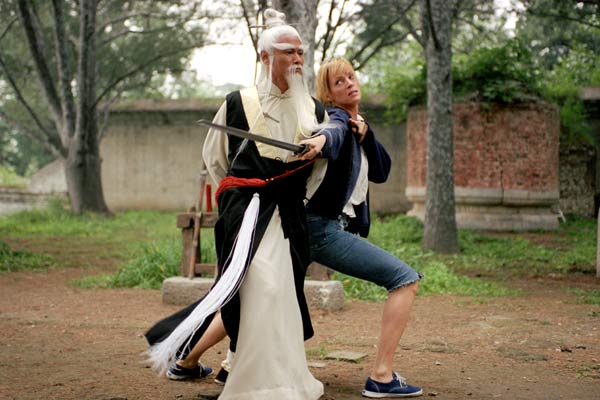
Silly Caucasian girl likes to play with Samurai swords.

No 325 - Kill Bill Volume 1
Director - Quentin Tarantino

It really bugs me when films are released in two parts with cliff hangers. I don't mean films like Lord of the Rings but films like Kill Bill, or the Matrix sequels. Films shouldn't end on a cliff hanger. It feels unfair.
This is where DVD comes in. I chose to sit and watch Kill Bill as a whole, however I will review them in two parts. Otherwise it'll mess up my numbering.

Volume 1 tells the story of The Bride's recovery from the wedding massacre and the first two of her kills in her quest for vengeance. In typical Tarantino style, these are told out of sequence.

I have an odd relationship with Tarantino. I love Pulp Fiction and Inglourious Basterds blew me away but I have found his other films a bit lacking and I can't pin point what it is exactly. After all his musical choices are inspired, his visuals are stunning, he writes interesting stories and simply fantastic dialogue. Yet, the whole is less than the sum of its parts. It is a strange (and not very common) view point. What it does mean however, is that his films are full of inspired and beautiful little moments.

Volume 1 seems to be made up of two sections, one section dedicated to O-ren and another dealing with everything else. What makes this story shocking is how almost nobody in it is nice. Of course we are dealing with assassins and mobsters and the Yakuza, we don't expect niceness. But when The Bride lies in hospital comatose, her nurse pimps out her unconscious body.
We are living in a harsh world.
The grittiness of the first half of the film is intercut with a few wonderful moments. The key one that I wish to talk about is the introduction to O-ren. Told through a fabulous elegant and flowing anime scene. It is clear that Tarantino had a lot of styles he wished to experiment with. By splitting the film up into chapters he can give each chapter a distinctive visual style and give himself artistic freedom to change at will.
This works well as a technique in Volume 1, but doesn't work quite so well in Volume 2.

Despite a couple of chapters dealing with the grittiness of The Bride's coma and a very savage fight scene with Vernita Green, the Bride's real focus is O-Ren, and the films main visual style is an almost cartoon level of excess. A stylised eastern exploitation film.
This helps to dull the fact that there is a lot of violence in Kill Bill. A lot of death.

The Bride kills everyone who crosses her path. From sickos like Buck through to Oren's personal army. But whereas in the gritty real world of the film's first half we have knives through the chest or a slit ankle (wince). Once we enter Japan, the deaths become cleanly lopped of limbs and gushing gushing fountains of blood. This is cartoon violence bought to life.

The film's central point, and key triumph, is the battle with the Crazy 88 - O-Ren's personal army. It begins slowly, introducing the army in twos and threes. Then it introduces GoGo, O-Ren's insane schoolgirl bodyguard. She is played perfectly (and terrifyingly) by Chiaki Kuriyama. I have only ever seen her in this and Battle Royale and both times se has played terrifyingly insane assassin school girls. I hope she doesn't get typecast, but she does it so well.
Each of these battles are short sharp and savage and whilst GoGo's fight is the most elaborate, her death is the most restrained, for a section which seems to favour fountains of bloody.

After each of these short frantic bursts, the rest of the crazy 88 begin as does a massive fight scene that feels like it may go on forever. Shot in black and white or in silhouette against a blue background the whole fight is presented in a stylised way, making the violence far more acceptable. It is the same thing that makes Sin City a watchable film, the cartoonification of the horrific violence.
I heard that it had to be done in order to stop the film receiving an X certificate, but it works. In Asia there is a full colour un edited version of the fight.... but I think that would lose some of the quality of the piece. By presenting in such a stylised way it allows the savage savage black humour to seep through. There is something quite amusing in the myriad of limbless people hobbling away from their encounter with the Bride.

I am a sick and twisted individual.

At which point I feel it is time to discuss the film's greatest strength (and arguably Tarantino's greatest strength) - The soundtrack.
The songs in Volume 1 lean towards the east and combine beautiful and elegant pieces with Tarantino's more familiar funk and soul tunes. I heartily recommend you check it out. It is a fabulous collection of music and is vital to one of the finest moments in the entire film. The Bride's show down with O-Ren.

Visually, the film couldn't look more eastern. We are in a Japanese garden it is snowing, it is night. It is serenity personified. Except for the two circling figures, brandishing samurai swords. Over this there is the almost primal beat of Santa Esmerelda's cover of Don't Let me Be Misunderstood. The mix of Latin American sounds and Eastern Visuals works perfectly and the rhythm of the fight is immense, a strong choreography tying the visuals in with the sound with such grace.
I remember seeing it at the cinema and it gave me goosebumps, little moments like that are why Tarantino deserves the credit he gets, followed by the cut aways to the peaceful garden, it allows the scene to move at quite a gentle pace, before the savage (but again, essentially restrained) scalping.

It is an excellent ending to O-Ren's story. But the film chooses to end with a bloody cliff hanger.
Alas, I must do the same. Because although I've watched Volume 2. I don't have time to blog it right now.