Showing posts with label David Lynch. Show all posts

Friday, 18 June 2010

It'll be just like in the movies. Pretending to be somebody else.

No 391 - Mulholland Drive
Director - David Lynch

After watching a few fairly simple films, I thought I would entertain myself by watching a guaranteed head fuck which I've never before seen.
Also Ultra Culture bloody loves this film - and they're an excellent blog with pretty reliable views on stuff..

I don't want to sit down and write a detailed essay explaining what I think the film is about (though I've found some great sites which have helped deepen my experience, which I'll list at the end... in case you guys need help) - I'm instead going to talk about what I though about the film. Looking at it as a classic Neo-Noir and as a piece of atmospheric wonderment.

We begin with a bungled assassination of a nameless woman (Laura Harring - the character later takes the name Rita from a Rita Hayworth movie poster), who escapes the site and crawls into an empty apartment.
Alas, the apartment is later occupied by Betty (played by Naomi Watts) who has flown to LA from Ontario and plans to become an actress. The majority of the film is about the wonderful relationship which blossoms between Rita and Betty.

However - I just want to add one thing here, which may or may not be relevant to anything (that's the problem with this film, you just don't know) - when we first meet Betty, she is in the airport speaking to an elderly couple she met on the plane. Strangely, her speech pattern is stilted and halting. It felt unnatural enough for me to make a note of it whilst watching.

So Betty meets Rita, and the two are naturally suspicious of one another but gradually - as they try to find out about Rita's identity - a really rather wonderful friendship begins to blossom, before turning into a fully fledged romance. Generally, couples never seem to fare that well in Lynch's films, so once you get over the titillation of their sex scenes (after all, they're both very attractive ladies) it is nice to see an unabusive, genuinely loving relationship.

There are many subplots throughout this film - for example, an assassin trying to get a black book, and a director being forced by a mysterious group to cast someone called Camilla Rhodes in his film. He refuses and is visited by The Cowboy (who also appears later, in what is arguably the most important single moment of the film), who explains how the director really doesn't have a choice. However, the best thing about this shadowy cabal is that it is led by the fabulous Michael J Anderson as Mr Roque. Mr Roque utters one word throughout the entire film, and is on screen for probably a minute, but he is instantly fascinating. Lynch clearly loves Anderson as he finds a way to crowbar him into a lot of his films - and his performance in twin peaks is beyond iconic. In one scene he essentially defines Lynch.

Also, on a brief tangent, is this the weirdest Lynch reference ever? Way to alienate your audience, Sesame Street.

Back to subplots. The one I wish to discuss is that of Wilkies Diner. The diner appears a lot, and each time is important to the film. For example, the waitress there is called Diane; and this reminds Rita that she knew a Diane (who alas is now dead and rotting - possibly the victim of the assassin). But the big scene for Wilkies is the dream scene. Two men discuss a dream that one of them has been having in the diner in which he is haunted by a horrible face. Whilst explaining the story, he retraces his steps and comes face to face with the *terrifying* dirt smeared crone (who glides out from behind a wall) and dies, clutching his chest.
It is clearly an important scene, but (like all the scenes in this film) if you take it at face value - it makes no fucking sense.

All these scenes actually take place and whilst it may be hard to see how they relate, they seem to follow their own logic. After seeing Diane dead, Rita starts to wear a Blonde wig much like Betty's hair - and the two begin to move (often in unison) from venue to venue in similar black outfits.

The climax of their relationship (for afterwards Betty just vanishes) occurs in the super creepy Club Silencia where Betty finds a blue box, which corresponds with a blue key, which was one of the few objects Rita had on her possession. Rita opens the box and ALL HELL BREAKS LOOSE!

But importantly, The Cowboy returns and utters the important line:

Hey, pretty girl, time to wake up.


OK, I'm going to break this down into bullet points.
  • Naomi Watts gets up from bed, and we see that she has been asleep in the same position as the previously dead Diane.
  • For the rest of the film, Naomi Watts is referred to as Diane.
  • Laura Harring appears fleetingly (in what I assume are flashbacks), and is referred to as Camilla.
  • Diane and Camilla used to date, until Camilla said she didn't think they should do so any more.
  • Rita/Camilla is now sleeping with the director from the earlier subplot.
At this point the film's order goes all over the place - as several scenes occur during Naomi Watts' walk from the kitchen to the sofa.
  • We see her suffer a break up, humiliation.
  • We see her discuss Laura Harring's character with the assassin.
  • We see a regular blue Yale lock passed to her.
And just as things get really really weird (and this is a fabulous creepy weirdness which has been slowly building up for the past two and a bit hours), the dirt faced crone vagrant releases the elderly couple from a paper bag. They sneak in to Watts' house - under the door - and torment her until she shoots herself. Leaving a smoking bed.

A true WHAT THE FUCK moment, if ever I've seen one.

As a portrayal of mood it is wonderful. The film is deliciously tense. A true horror.

But what does it mean? I'll leave you with some heavy reading:
City of Nightmares - An In depth Analysis of Mulholland Drive

(I'm not saying this is right - Lynch himself refuses to divulge - but it is interesting, and a lot of the original points are similar to what I thought - only he goes in a LOT more detail and research)

Monday, 7 June 2010

Baby wants to fuck! Baby wants to fuck Blue Velvet!

No 85 - Blue Velvet
Director - David Lynch

I do not own Speed or Easy Rider or Rebel Without a Cause and so when I heard of the death of the great Dennis Hopper I pulled out the two films I do own - this or Apocalypse Now. I decided it had to be this, as I have Apocalypse Now Redux, which isn't TECHNICALLY the film which was voted in...
It also meant that I could continue my tradition of watching completely unsuitable films over breakfast.

The film begins pretty innocuously with beautiful opening credits of elegant text against blue velvet (naturally) - it feels like a classic MGM film and that feeling's continued when the film pans into the middle American suburbia that Lynch is clearly fascinated by (see Twin Peaks for a small town version of the same theme).
But once we have been lulled into this false sense of security, the Lynchian weirdness begins. However, this is still a fairly (and surprisingly) standard story. There is none of the insanity of Eraserhead or Mulholland Drive. I kept expecting a strange angry dwarf to appear or some shocking nightmarish image. But there aren't any. The majority of the film fits the story. It is just that once we seep through the suburban exterior, we face the shockingly foul-mouthed violent underbelly.

Our protagonist is Jeffrey (an amazingly young Kyle MachLachlan) who discovers a disembodied ear in the middle of the woods. He then decides to investigate the ear himself - partly out of curiosity but also partly to impress the detective's attractive daughter.
Once there, he becomes embroiled with Frank; the insane, torturing, murdering psycho and the villain of this film. Also just an amazingly powerful and genuinely terrifying performance from Dennis Hopper.
I did not know that this was his 'comeback' film until I started doing a bit of research after watching, but what a comeback it is. Violent and abrasive he (literally) screams his presence and sears himself into the viewer's mind. It is made all the more scary by his unpredictable nature. Yes, he has goons, and yes, they all seem to be joyfully violent and vindictive - but they seem safe in comparison to Frank because they're not gassed up. Gas makes villains far more terrifying...
Frank's world is weird - but it isn't the nightmarish world which I was geared up to expect. Most of it is just cruel and unusual, and the only bit that genuinely doesn't make sense is that one of the cast appears to suddenly get a lobotomy. Is it a stray bullet? Or some kind of deliberate ploy to silence someone? Don't expect an answer. Just expect a stationary dribbling fool.

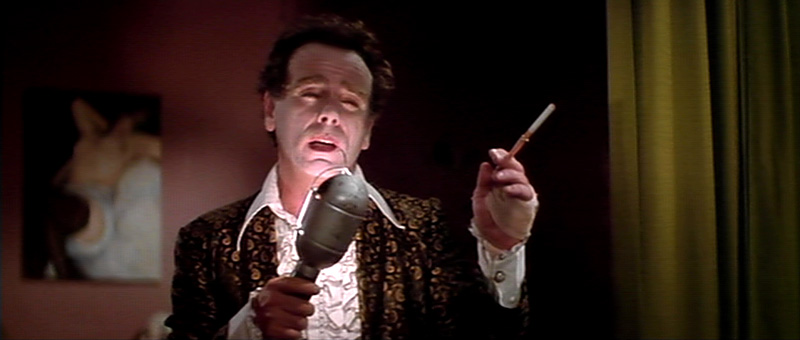
However, the best bit of Frank's world is that it includes a really effeminate Dean Stockwell as Ben (who is - to quote Frank - "One Suave Fucker"). Bloody love Dean Stockwell - he is great in both BSG and Quantum Leap! Certainly, the point where he starts singing is odd. But again, not as odd as Eraserhead.

This is a film which has touches of symbolism and the briefest hint of surrealism but is mostly quite realistic and a gritty return to classic film noir.

Whilst certainly not an easy watch, I found it quite enjoyable!

Saturday, 21 November 2009

I am not an elephant! I am not an animal! I am a human being! I am a man!

No 362 – The Elephant Man
Director – David Lynch

There are two things in particular which I intend to focus on in this blog. Firstly, my surprise that this is a David Lynch film, secondly the fact that John Merrick was a real person (though he was actually called Joseph Merrick fact fans) and that therefore this story is based in truth.
I have a John Merrick biography which I attempted to read over the summer. I found it a bit too intense, too heavy and sad to read on a poolside in France. However as the winter months draw in it might be worth crack it out and reading up on the poor man.

However, first things first. I wish to talk about Lynch and the visual style of this film. I have a bit of a confused relationship with David Lynch, the first film I saw of his was Eraserhead which scared me to pieces. Ever since then, his films have left me feeling confused and uncomfortable. Yet with Elephant Man we have a fairly normal story. A story with a clear overarching plot, with a linear story and with only the merest hint of midgets.
What I loved was the feel of the film. It felt like an old film. This is more than merely being in black and white. There is something that ekes out of every element of the film. The lighting, the framing, the way that characters talk, the grainy stock footage. It is difficult to put your finger on the exact reason but the film feels old. It feels like the kind of films that were made in the 40s and are now shown on BBC2 or Channel 4 on a weekday afternoon.
It is a very unusual visual aesthetic, I’m pretty sure that it was filmed entirely in a studio, even the few outdoor shots feel like they were in a studio. The way that the film was made means it never looks or feels like a film made in 1980. It feels much older, and it is only the occasional nightmare sequence which brings back the disturbing horror that is so classically Lynchian. Obscure images and overlaying moments, discordant sounds and frantic editing. It all jars against the antiquated feel of the rest of the film, yet feels right for a nightmare sequence.
But then, Lynch always does excellent dreams.

The fact that these nightmare sequences are the exception rather than the norm means that this is the most accessible of Lynch’s films.
It is, however, also the saddest. The film includes a series of elements which combine into a heartbreaking depiction and story.
Firstly, the whole notion of freak shows are horrible. Films like Tod Browning's Freaks made the brotherhood of circus freaks feel somewhat glamorous, or at least a loving family. Carnivale makes it all seem a bit like a struggle but essentially an adventure. However, this film shows the freak circuit for what it is. Exploitation. The dirt, the squalor, the abuse, the cages. The depiction is really quite horrific and quite distressing. It is made all the more worse when you begin to relate with the character of Merrick. This is down entirely to John Hurt in a phenomenal performance.
I mean look at John Hurt. Now look at his character. He is 90% facial make up. In fact, probably more than that because they've expanded so much on the size of his head. And yet, despite the vast amount of make up or prosthetics, his performance is really moving. See the point where John Merrick speaks to the wife of Dr Treeves for the first time. After a polite conversation he bursts into tears. Surprised and moved that a lady has been so kind to him. The single scene encapsulates both the delicate nature of Merrick but also the abuse he has suffered in the past. It is a very moving scene and a fantastic performance, showing Hurt's skill at creating emotion from quite an emotionless mass of tumor.
I've been a huge fan of Hurt for quite some time and this film shows why. It is such a deep and all encompassing performance showing the resignation, fear and latterly anger towards his mistreatment but also his love and joy and excitement as he becomes involved with high society. Again, look at the rapturous joy when he first reads Shakespeare or first goes to the theatre. Truly moving.

The final, and most traumatic, aspect of the film is the behaviour of 75% of the rest of the characters. When compared with the delicacy and quiet dignity of Merrick the other characters come off as quite detestable. Anthony Hopkins' Dr Treeves fears that what he is doing is just another form of the spectacle and exploitation that Merrick had been exposed to. But at least he shows Merrick respect. At least he treats Merrick as an equal. It is in scenes with Bytes, the freakshow owner, or Michael Elphick's hospital porter that you see the real evil of people.
It is this element that makes me want to read the book, because it can't be that horrible.
Of course, the people of Victorian times would not be so kind to people they saw as different. Specially not so horrific an illness as Merrick's condition. However whilst I'm aware he would have been treated poorly, I'd hate to think that people really did used to sneak to his hospital rooms to exploit and abuse him.

In all these films it is impossible to know what is based on truth and what is based on the myth, or expanded upon for the sake of the story.
However, even if we take away the 'based on a true story' element, we are faced with a beautiful and moving tale of a Victorian gentleman dealing with impossible odds.
If it turns out to be true, it is heartbreaking.