No 63 - Sunset Boulevard
Director - Billy Wilder
Man, I just love Billy Wilder. This film challenge has taught me that he is a really impressive talent, as yet again here he has written and directed a bloody wonderful little film. The other thing that is dawning me is quite how much the advent of sound shook up cinema and quite how much it upset the old school.
The transition is sort of explored in Singing in the Rain (another amazing film) but is played there more as a comedy (well, as a musical - though it's still very funny). Here we get to a more frank look at the terribly bleak after-effects of the transition to 'talkies'. Thematically, this film could be something of a sequel to Singing in the Rain (although a psychic sequel - as it was released two years earlier), perhaps looking at Lina Lamont 20 years later...
In order to discuss this transition, the film does something really quite brilliant. Now, I'm not very well versed on films from the 50's and earlier (so I may be wrong), but I think that sunset Boulevard's idea of having actors and directors cameoing as themselves was pretty new.
Certainly nowadays we have lots of shows in which people play themselves, but this film is 60 years old... which means that we get glimpses of legends like Buster Keaton, and although he only appears for about 4 seconds, he manages to look excellently resentful and bitter during his game of cards.
However the real surprise (after all, actors are actors and you shouldn't be too surprised to see them in films) is the appearance of Cecille B DeMille in an acting part, playing himself. After all, the man is a giant of early cinema, and it is brilliant to see him performing, and holding his own within the performances.
All these cameos flutter sporadically across the film's storyline. For whilst we follow the character of Joe Gillis (William Holden brilliantly playing an initially unlikeable selfish bugger who softens throughout the film) - and whilst he may be our main protagonist, it is Gloria Swanson's terrifying and heartbreaking Norma Desmond who is the film's true star.
Indeed, she steals so much of the film that the plot lines that don't include her (like the little love triangle Gillis gets mixed up in) seem dull and unnecessary. You just want to go back to her creepy old house.
So why is Norma Desmond such a great character? It's mostly attributable to the many layers Gloria Swanson gives her. In almost every scene we learn something new about her; something which casts her in a new light, something which changes how we feel about her. She begins as a wonderful Morticia Addams-type character - in her strange dilapidated house with her strange Germanic butler and her dead chimp. Her movements and facial tics are all over-dramatic, her expressions are frozen masks. She is the stereotypical over-exaggerated silent movie actress. She is proud. She is arrogant. And she has the potential to be dangerous.
However - as we learn more about her, you realise that she is really very tragic. Her pride and her arrogance stem from her naivety and her self-delusion, and whilst that begins as sad (the butler Max's speech about Norma's decline is particularly moving), it ends up more terrifying than her unusual performance at the beginning of the film.
So when we come to that final scene, and Norma's final iconic line - All right Mr. DeMille, I'm ready for my close-up - Norma has become much more than a funny deluded fool, much more than an insane woman. She is horrific because we don't know how to categorise her - we don't know how to react to her.
At one point, earlier in the film, she explains why the silent movie actors were better than their talking counterparts. Her explanation is thus: We didn't need dialogue. We had faces!
In the film's final moments, it is Norma's face that we remember. And it is the chilling face of madness.
Showing posts with label billy wilder. Show all posts
Showing posts with label billy wilder. Show all posts
Wednesday, 18 August 2010



Thursday, 17 June 2010
I'm a thousand-dollar-a-day newspaperman. You can have me for nothing.
#385 - Ace in the hole
Director - Billy Wilder
I have yet to watch Sunset Blvd, and therefore this is the first of Billy Wilder's films I've watched which isn't a comedy. And yet, it begins in a comically jolly way, with lively 50's music and a wonderful shot of our lead - Charles Tatum (played by a young Kirk Douglas - who looks a lot like Alex Winter in the 80's) - reading the paper in his car as it is towed.
Tatum is a typical New Yorker. Fast talking, aggressive and brash. However he is also reckless and arrogant - and this is how he finds himself fired from all the big city papers and working in a small local paper in Albuquerque. His motivation for the entire film is simple: find a story which is big enough to get him noticed and get his old job back in New York.
After a tedious year on the paper, Tatum gets his wish. En route to a rattlesnake hunt with his photographer he stumbles upon a man called Leo trapped in a cave-in. To make matters worse, none of the local native Americans will go into the cave as it is cursed - the Mountain of the Seven Vultures. This is Tatum's story.
The rest of the film is watching Tatum spin the situation to his advantage.
This is very much a film of its time - and I don't just mean the appalling and consistent casual racism directed towards the Native Americans - in the way that the news travels. It is very interesting to see how reporters worked in a time when phones were sparse, let alone mobiles. This type of monopoly on a story (Tatum manages to successfully negotiate no other reporters being allowed on site) could never happen in our world of mobile camera phones, audioboo, twitter etc etc. We're an immediate culture - when just fifty years ago it was all a lot slower.
So, Tatum takes control of the event and manages to manipulate the rescue, stringing it out into an elaborate charade:
The public face of Leo's suffering is not with him, but with his parents. We very rarely see Leo, as most of the film takes place outside the mountain, but the few visits into the heart of the cave show a man who quickly loses his chirpy attitude and then begins to lose health, gradually becoming a weaker shell of a man.
Meanwhile, on the outside, his parents have to deal with the circus (both media and literal) which has emerged around the cave. It is interesting that the film is also referred to as The Big Carnival (apparently it was renamed) - which refers to both the carnival set up outside the mountain (for the entertainment of the the hundreds of people coming to watch the spectacle event) and also to the horrible events which are unfolding, manipulating Leo's suffering.
It is a really uncomfortable film to watch - the exploitation of suffering and danger is so hideously inhumane that you're essentially watching it as car crash cinema. Not because it's a bad film, but because the subject matter is just horrific.
The worst character by far (in my mind) is Lorraine - after all, the Sheriff is just a corrupt policeman, a film archetype. And yes, Tatum may be the violent, abusive, racist misogynist who orchestrated the whole event, but he is just an amoral reporter. He has no stake in the people around him. He could not care less. Whilst Lorraine may no longer love Leo, and may even be planning to leave him, she allows her husband and her husband's family to be hideously manipulated and exploited just so she can make some money and attempt to seduce Tatum.
Of course, things go wrong - and whilst the final act is inevitable, you spend the whole film hoping that it won't fall apart, that Leo will be OK even if it means that the amoral bastards get away with it.
A fascinating look at the arrogance, greed and corruption of people. It is entrancing - if utterly uncomfortable - cinema.
Billy Wilder really is bloody good.
Director - Billy Wilder
I have yet to watch Sunset Blvd, and therefore this is the first of Billy Wilder's films I've watched which isn't a comedy. And yet, it begins in a comically jolly way, with lively 50's music and a wonderful shot of our lead - Charles Tatum (played by a young Kirk Douglas - who looks a lot like Alex Winter in the 80's) - reading the paper in his car as it is towed.

Tatum is a typical New Yorker. Fast talking, aggressive and brash. However he is also reckless and arrogant - and this is how he finds himself fired from all the big city papers and working in a small local paper in Albuquerque. His motivation for the entire film is simple: find a story which is big enough to get him noticed and get his old job back in New York.
After a tedious year on the paper, Tatum gets his wish. En route to a rattlesnake hunt with his photographer he stumbles upon a man called Leo trapped in a cave-in. To make matters worse, none of the local native Americans will go into the cave as it is cursed - the Mountain of the Seven Vultures. This is Tatum's story.
The rest of the film is watching Tatum spin the situation to his advantage.
This is very much a film of its time - and I don't just mean the appalling and consistent casual racism directed towards the Native Americans - in the way that the news travels. It is very interesting to see how reporters worked in a time when phones were sparse, let alone mobiles. This type of monopoly on a story (Tatum manages to successfully negotiate no other reporters being allowed on site) could never happen in our world of mobile camera phones, audioboo, twitter etc etc. We're an immediate culture - when just fifty years ago it was all a lot slower.
So, Tatum takes control of the event and manages to manipulate the rescue, stringing it out into an elaborate charade:
- Tatum can use a big story to reclaim his status and get his New York Job back.
- Leo's wife Lorraine is planning to leave him anyway, but sees the media frenzy and public interest as an easy way to cash in.
- Sheriff Kretzer needs a big public interest story and the positive spin from Tatum in order to make sure he is re-elected.
The public face of Leo's suffering is not with him, but with his parents. We very rarely see Leo, as most of the film takes place outside the mountain, but the few visits into the heart of the cave show a man who quickly loses his chirpy attitude and then begins to lose health, gradually becoming a weaker shell of a man.
Meanwhile, on the outside, his parents have to deal with the circus (both media and literal) which has emerged around the cave. It is interesting that the film is also referred to as The Big Carnival (apparently it was renamed) - which refers to both the carnival set up outside the mountain (for the entertainment of the the hundreds of people coming to watch the spectacle event) and also to the horrible events which are unfolding, manipulating Leo's suffering.
It is a really uncomfortable film to watch - the exploitation of suffering and danger is so hideously inhumane that you're essentially watching it as car crash cinema. Not because it's a bad film, but because the subject matter is just horrific.
The worst character by far (in my mind) is Lorraine - after all, the Sheriff is just a corrupt policeman, a film archetype. And yes, Tatum may be the violent, abusive, racist misogynist who orchestrated the whole event, but he is just an amoral reporter. He has no stake in the people around him. He could not care less. Whilst Lorraine may no longer love Leo, and may even be planning to leave him, she allows her husband and her husband's family to be hideously manipulated and exploited just so she can make some money and attempt to seduce Tatum.
Of course, things go wrong - and whilst the final act is inevitable, you spend the whole film hoping that it won't fall apart, that Leo will be OK even if it means that the amoral bastards get away with it.
A fascinating look at the arrogance, greed and corruption of people. It is entrancing - if utterly uncomfortable - cinema.
Billy Wilder really is bloody good.
Friday, 19 February 2010
Look how she moves! It's like Jell-O on springs. Must have some sort of built-in motor or something
No 27 – Some Like it Hot
Director – Billy Wilder
EGADS!! Almost an entire month has passed without me blogging. If I continue at this rate I’ll still be watching these films when I’m 50.
Well, I firmly believe I’ll still be watching THIS film when I’m 50. I love it. It is genius.
This is a very important film; it is the film which convinced my youngest sister not to dismiss Black and White films. It is also the film with the funniest closing line ever.
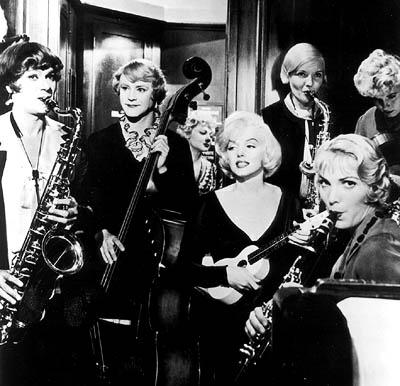
This film is most well known for the middle section in which Jack Lemmon and Tony Curtis dress up as women to join an all-girl jazz band. Yet there is so much more in this film. Some of it works utterly utterly brilliantly while others feel out of place.
I’m going to begin with the out of place elements so that I can then begin spouting on about the bits of the film I love.
The film is set in the 1920’s and the opening scenes do an excellent job of showing the excess and the glamour of the illegal speakeasies. It sets up the characters perfectly (you see Curtis’ Joe introduced as a gambling, vice ridden lothario the perfect foil to the incessant worrier in Lemmon’s Jerry) and it highlights the desperation in the characters. They’re in a bit of a financial pickle. They need money.
We’re then introduced to the gangsters. The film is bookended with some proper 20’s mob action; it is this that feels unusual, and wrong in the film. Now I love 1920’s mobsters. They dress well; they have excellent morals and the skirt just on the right side of Italio-American cliché.
Spats, for example, is just a fabulous mafia villain. He is cold and chilling. Calculated and callous. He is someone that Joe and Jerry are wise to run from. However his arc feels completely tonally wrong. Every time he appears on screen it ends in a murder. His first murder is witnessed by Joe and Jerry. It is the very reason that they’re on the run and dressed as women. It is a pivotal plot point for the film and yet it feels completely out of place in such a fluffy film about love (and deception).
The film’s real triumph is the middle act – the love stories. These are so ingenious, they still hold there own 50 years on.
It all begins with a character called Sugar Kane.
My ruddy goodness… Marilyn Monroe is sexy. Tony Curtis comes out of this film as quite a good looking chap all ruggedly handsome and that but Monroe is just a hypnotic blend of wide eyed naivety and pure undiluted sex. She is involved in some particularly hot scenes (more on that later) but even when she isn’t doing anything particularly raunchy she is utterly intoxicating.
It is only natural that both Joe and Jerry become obsessed with her and Joe’s seduction of Sugar is wonderful to watch. His character, Junior – the young heir of shell oil, is meticulously designed to tick all of Sugar’s boxes. He also is pulling of a wonderful mimicry of Carey Grant’s vocal style.
The culmination of this romance is the yacht scene. Joe and Sugar are alone on a yacht and Joe (as Jr) tells the tragic story of his failed libido and how kisses leave him cold.
Cue Sugar performing ever more passionate and ever more intimate kisses. I heard Tony Curtis in an interview a couple of years ago and he said (rather brilliantly) that Marilyn Monroe would deliberately push against him and move away as they performed these kisses. It seems right; the sense of sexual teasing is very evident in the scene, which is incredibly sexy. Incredibly sexy.
I’m not surprised to learn that Tony Curtis ‘exploded’ (as he so delightfully puts it) on several takes.
So what of Jerry? Well Jerry’s alter ego Daphne catches the eye of a genuine millionaire, and the best character in the film, Osgood Fielding III. Osgood begins a very sweet, and almost innocent, seduction of Daphne with diamonds and flowers (all stolen by Joe to aid his seduction of Sugar) and dancing.
What is nicest though is that Jerry begins to genuinely fall for Osgood. He enjoys the attention, the flattery and the affection. And Osgood is a genuinely lovely character.
Joe trying to explain how marriage couldn’t work between Jerry and Osgood makes for a wonderful sequence.
You see, really, for all the gangsters, for all the shootings, for all the sultry wide eyed blondes, this is a proper traditional farce. It is all about quick costume changes and having to hide and false identities and lots of manic running around.
It ends, of course, with big reveals. Joe has to tell Sugar that he isn’t a millionaire. But by then, she doesn’t mind. Jerry has to tell Osgood that they can’t marry as he isn’t a Daphne but a Jerry.
Osgood’s response closes the film and is both a perfect representation of his character and a perfect message to close the film on.
It truly is the greatest closing line in a film.
Director – Billy Wilder
EGADS!! Almost an entire month has passed without me blogging. If I continue at this rate I’ll still be watching these films when I’m 50.
Well, I firmly believe I’ll still be watching THIS film when I’m 50. I love it. It is genius.
This is a very important film; it is the film which convinced my youngest sister not to dismiss Black and White films. It is also the film with the funniest closing line ever.
This film is most well known for the middle section in which Jack Lemmon and Tony Curtis dress up as women to join an all-girl jazz band. Yet there is so much more in this film. Some of it works utterly utterly brilliantly while others feel out of place.
I’m going to begin with the out of place elements so that I can then begin spouting on about the bits of the film I love.
The film is set in the 1920’s and the opening scenes do an excellent job of showing the excess and the glamour of the illegal speakeasies. It sets up the characters perfectly (you see Curtis’ Joe introduced as a gambling, vice ridden lothario the perfect foil to the incessant worrier in Lemmon’s Jerry) and it highlights the desperation in the characters. They’re in a bit of a financial pickle. They need money.
We’re then introduced to the gangsters. The film is bookended with some proper 20’s mob action; it is this that feels unusual, and wrong in the film. Now I love 1920’s mobsters. They dress well; they have excellent morals and the skirt just on the right side of Italio-American cliché.
Spats, for example, is just a fabulous mafia villain. He is cold and chilling. Calculated and callous. He is someone that Joe and Jerry are wise to run from. However his arc feels completely tonally wrong. Every time he appears on screen it ends in a murder. His first murder is witnessed by Joe and Jerry. It is the very reason that they’re on the run and dressed as women. It is a pivotal plot point for the film and yet it feels completely out of place in such a fluffy film about love (and deception).
The film’s real triumph is the middle act – the love stories. These are so ingenious, they still hold there own 50 years on.
It all begins with a character called Sugar Kane.
My ruddy goodness… Marilyn Monroe is sexy. Tony Curtis comes out of this film as quite a good looking chap all ruggedly handsome and that but Monroe is just a hypnotic blend of wide eyed naivety and pure undiluted sex. She is involved in some particularly hot scenes (more on that later) but even when she isn’t doing anything particularly raunchy she is utterly intoxicating.
It is only natural that both Joe and Jerry become obsessed with her and Joe’s seduction of Sugar is wonderful to watch. His character, Junior – the young heir of shell oil, is meticulously designed to tick all of Sugar’s boxes. He also is pulling of a wonderful mimicry of Carey Grant’s vocal style.
The culmination of this romance is the yacht scene. Joe and Sugar are alone on a yacht and Joe (as Jr) tells the tragic story of his failed libido and how kisses leave him cold.
Cue Sugar performing ever more passionate and ever more intimate kisses. I heard Tony Curtis in an interview a couple of years ago and he said (rather brilliantly) that Marilyn Monroe would deliberately push against him and move away as they performed these kisses. It seems right; the sense of sexual teasing is very evident in the scene, which is incredibly sexy. Incredibly sexy.
I’m not surprised to learn that Tony Curtis ‘exploded’ (as he so delightfully puts it) on several takes.
So what of Jerry? Well Jerry’s alter ego Daphne catches the eye of a genuine millionaire, and the best character in the film, Osgood Fielding III. Osgood begins a very sweet, and almost innocent, seduction of Daphne with diamonds and flowers (all stolen by Joe to aid his seduction of Sugar) and dancing.
What is nicest though is that Jerry begins to genuinely fall for Osgood. He enjoys the attention, the flattery and the affection. And Osgood is a genuinely lovely character.
Joe trying to explain how marriage couldn’t work between Jerry and Osgood makes for a wonderful sequence.
You see, really, for all the gangsters, for all the shootings, for all the sultry wide eyed blondes, this is a proper traditional farce. It is all about quick costume changes and having to hide and false identities and lots of manic running around.
It ends, of course, with big reveals. Joe has to tell Sugar that he isn’t a millionaire. But by then, she doesn’t mind. Jerry has to tell Osgood that they can’t marry as he isn’t a Daphne but a Jerry.
Osgood’s response closes the film and is both a perfect representation of his character and a perfect message to close the film on.
It truly is the greatest closing line in a film.
Friday, 7 August 2009
Might as well go to mine. Everybody else does.
No 12 - The Apartment
Director - Billy Wilder
"The time has come," the Walrus said, "To talk of many things: Of shoes--and ships--and sealing-wax and why it has been so bloody long since a blog on this site". I apologise. I truly truly do.
My actual life has been a massive interruption to my cinematic lazings. However I have moved house and am ready to continue watching films in shiny new Putney surroundings.
The Apartment is the highest ranking comedy on the top 500 (if we don't count Singin' in the Rain) and is a good 15 places above Some Like it Hot - a film I had often assumed was the greatest comedy of all time - so I was keen to check it out. It also has the excellent comedy stock of both Mr Billy Wilder and Mr Jack Lemmon.
I was expecting something with the same crystal sharp delivery and pitch perfect wit of Some Like it Hot. I was wrong. This is a very different type of comedy.
It is also a comedy of two halves, as the film slowly turns into a beautiful rom-com with some really tragic moments. I'm saving my review of The Royal Tenembauns for a day where I feel I can write it in an unbiased way - however, I'm a big big fan of the tragi-comic and i loved this film.
The film follows C.C.Baxter who has a non-descript job in an insurance company. He also hires out his apartment as a venue for management to have their illicit affairs. By schmoozing this small group of executives, Baxter manages to work his way up the company with startling speed. Ending up the assistant director of the entire firm. However, it is here that the first of the film's morals appear.
The better Baxter is doing at work, the worse his social life and his free time. This is a film which shows the difficulties of having a decent work/life balance. Although - I think that this is not helped by the fact that Baxter is a bit of a wet blanket, bending over backwards to accommodate the executives to the detriment of his own health, happiness and sanity.
Where the film really kicks off is with the introduction of Fran Kubelik, played by the beautiful Shirley MacLaine. Her character is one of the lift operators for the firm and she is a feisty, out going and just wonderful person. It is clear why Baxter is in love with her. Every moment she spends on screen illuminates the film and makes it crackle with energy. The viewer (or at least me) falls for her instantly... making Baxter's plight all the more personal.
As you can see from the clip up there.... Fran has a man and sadly for Baxter she is seeing the (married) chief of the company. His boss, Jeff Sheldrake. Jeff is (naturally) one of the people that hires Baxter's apartment.
So, here is the set up for what could be quite a formulaic romantic comedy as Baxter tries to win Fran from Sheldrake. Except.... an hour into the film, Fran attempts to commit suicide. A large 30 minute chunk of the film is about Baxter caring for Fran in the days after her sleeping pill overdose (prompted (amongst other things) by her realisation of who's flat she is in). Baxter has just found out who Sheldrake's mystery woman is and is heartbroken as he cares for Fran... knowing that she loves someone else. The scenes are funny at times, but more so than that they're poignant, beautiful and really quite bleak.
The film also includes a scene where Baxter watches on, with a mix of worry and adoration, as his doctor neighbour forces Fran to vomit up the sleeping pills. A scene which probably was the influence for Almost Famous and which also shows just how edgy this film was for its time (I can't think of many films made in the late 50s that dealt with stomach pumps and drug overdoses). It also showcases some of the brutality of medicine at that time - best way to sort out an overdose? Slap the woman around and force her to drink coffee. Granted, I bet it works like a charm, it just seems quite savage.
The scenes post overdose also show the fragility of Fran's character, who goes from this bantering witty confident woman to a fragile broken shell, wrapped in Baxter's dressing gown. There are wonderful moments such as the game of gin where Baxter refuses to join into Fran's conversation. She is talking about the lack of hope and falling for the wrong men and he focuses all his attention in getting her to focus on the game. This is a beautiful piece of distraction, but also, the look on Baxter's face shows how upset and heartbroken he is... a masterful piece of acting from Lemmon.
You see - I still think Some Like it Hot is a funnier film. However, The Apartment is a much greater showcase for Lemmon's skills. As the film progresses Baxter seems bolder and braver. His final move (leaving the company because he refuses to continue letting his boss seduce Fran in the apartment) is also the point where everything seems to start going well for them.
It is of course inevitable that Fran and Baxter get together and the journey that they share throughout the film meant I was really really happy when that inevitable moment happened. What I like is the intelligent way that it is all implied. The pair never kiss, never share any 'obvious' cinema affection, however it is evident that here is a couple who love each other utterly. The film is also a smart and unpredictable Romantic Comedy.
There was a fantastic blog on empireonline about how Rom-Coms these days have become far too formulaic. For some reason it was removed from the site, but it shows everything that this film isn't.
There is no hackneyed argument crowbarred in to make the couple split up, instead Fran moves from being the object of Baxter's affection, to someone who he definitely can't be with. This is a much more realistic progression and something that every person has experienced.
However as he is forced into a situation where he has to spend more time with Fran, the bond between them grows and Baxter's affections are no longer unrequited.
The moment of realisation as Fran runs to Baxter's apartment (without the dreadful fake suspense of a 'dash to the airport' which seems to be pre-requisite in all romantic comedies) is not a 'will they won't they' moment but an 'At last - she has seen sense' moment. And whilst I'm all for the occasional bit of drinking alone. I think come New Years Eve, Baxter would rather share his champagne with a beautiful lady.
The final thing I want to talk about is the final line. I don't know if it is a theme amongst Billy wilder comedies (I've only seen 2) but I've always loved the final line of Some Like it Hot (Nobodies Perfect) - it is throwaway and flippant and yet seems to encapsulate the exact emotion of the film.
In this, he manages the same thing. Baxter tells Fran he loves her and Fran replies with "Shut up and Deal".
Just a wonderful wonderful finish to a beautiful little film
Director - Billy Wilder
"The time has come," the Walrus said, "To talk of many things: Of shoes--and ships--and sealing-wax and why it has been so bloody long since a blog on this site". I apologise. I truly truly do.
My actual life has been a massive interruption to my cinematic lazings. However I have moved house and am ready to continue watching films in shiny new Putney surroundings.
The Apartment is the highest ranking comedy on the top 500 (if we don't count Singin' in the Rain) and is a good 15 places above Some Like it Hot - a film I had often assumed was the greatest comedy of all time - so I was keen to check it out. It also has the excellent comedy stock of both Mr Billy Wilder and Mr Jack Lemmon.
I was expecting something with the same crystal sharp delivery and pitch perfect wit of Some Like it Hot. I was wrong. This is a very different type of comedy.
It is also a comedy of two halves, as the film slowly turns into a beautiful rom-com with some really tragic moments. I'm saving my review of The Royal Tenembauns for a day where I feel I can write it in an unbiased way - however, I'm a big big fan of the tragi-comic and i loved this film.
The film follows C.C.Baxter who has a non-descript job in an insurance company. He also hires out his apartment as a venue for management to have their illicit affairs. By schmoozing this small group of executives, Baxter manages to work his way up the company with startling speed. Ending up the assistant director of the entire firm. However, it is here that the first of the film's morals appear.
The better Baxter is doing at work, the worse his social life and his free time. This is a film which shows the difficulties of having a decent work/life balance. Although - I think that this is not helped by the fact that Baxter is a bit of a wet blanket, bending over backwards to accommodate the executives to the detriment of his own health, happiness and sanity.
Where the film really kicks off is with the introduction of Fran Kubelik, played by the beautiful Shirley MacLaine. Her character is one of the lift operators for the firm and she is a feisty, out going and just wonderful person. It is clear why Baxter is in love with her. Every moment she spends on screen illuminates the film and makes it crackle with energy. The viewer (or at least me) falls for her instantly... making Baxter's plight all the more personal.

As you can see from the clip up there.... Fran has a man and sadly for Baxter she is seeing the (married) chief of the company. His boss, Jeff Sheldrake. Jeff is (naturally) one of the people that hires Baxter's apartment.
So, here is the set up for what could be quite a formulaic romantic comedy as Baxter tries to win Fran from Sheldrake. Except.... an hour into the film, Fran attempts to commit suicide. A large 30 minute chunk of the film is about Baxter caring for Fran in the days after her sleeping pill overdose (prompted (amongst other things) by her realisation of who's flat she is in). Baxter has just found out who Sheldrake's mystery woman is and is heartbroken as he cares for Fran... knowing that she loves someone else. The scenes are funny at times, but more so than that they're poignant, beautiful and really quite bleak.
The film also includes a scene where Baxter watches on, with a mix of worry and adoration, as his doctor neighbour forces Fran to vomit up the sleeping pills. A scene which probably was the influence for Almost Famous and which also shows just how edgy this film was for its time (I can't think of many films made in the late 50s that dealt with stomach pumps and drug overdoses). It also showcases some of the brutality of medicine at that time - best way to sort out an overdose? Slap the woman around and force her to drink coffee. Granted, I bet it works like a charm, it just seems quite savage.
The scenes post overdose also show the fragility of Fran's character, who goes from this bantering witty confident woman to a fragile broken shell, wrapped in Baxter's dressing gown. There are wonderful moments such as the game of gin where Baxter refuses to join into Fran's conversation. She is talking about the lack of hope and falling for the wrong men and he focuses all his attention in getting her to focus on the game. This is a beautiful piece of distraction, but also, the look on Baxter's face shows how upset and heartbroken he is... a masterful piece of acting from Lemmon.

You see - I still think Some Like it Hot is a funnier film. However, The Apartment is a much greater showcase for Lemmon's skills. As the film progresses Baxter seems bolder and braver. His final move (leaving the company because he refuses to continue letting his boss seduce Fran in the apartment) is also the point where everything seems to start going well for them.
It is of course inevitable that Fran and Baxter get together and the journey that they share throughout the film meant I was really really happy when that inevitable moment happened. What I like is the intelligent way that it is all implied. The pair never kiss, never share any 'obvious' cinema affection, however it is evident that here is a couple who love each other utterly. The film is also a smart and unpredictable Romantic Comedy.

There was a fantastic blog on empireonline about how Rom-Coms these days have become far too formulaic. For some reason it was removed from the site, but it shows everything that this film isn't.
There is no hackneyed argument crowbarred in to make the couple split up, instead Fran moves from being the object of Baxter's affection, to someone who he definitely can't be with. This is a much more realistic progression and something that every person has experienced.
However as he is forced into a situation where he has to spend more time with Fran, the bond between them grows and Baxter's affections are no longer unrequited.
The moment of realisation as Fran runs to Baxter's apartment (without the dreadful fake suspense of a 'dash to the airport' which seems to be pre-requisite in all romantic comedies) is not a 'will they won't they' moment but an 'At last - she has seen sense' moment. And whilst I'm all for the occasional bit of drinking alone. I think come New Years Eve, Baxter would rather share his champagne with a beautiful lady.

The final thing I want to talk about is the final line. I don't know if it is a theme amongst Billy wilder comedies (I've only seen 2) but I've always loved the final line of Some Like it Hot (Nobodies Perfect) - it is throwaway and flippant and yet seems to encapsulate the exact emotion of the film.
In this, he manages the same thing. Baxter tells Fran he loves her and Fran replies with "Shut up and Deal".
Just a wonderful wonderful finish to a beautiful little film
Subscribe to:
Posts (Atom)