Showing posts with label alfred hitchcock. Show all posts

Sunday, 10 July 2011

She knew everyone that mattered. Everyone loved her

No 318 - Rebecca
Director - Alfred Hitchcock

I have not read the original novel and only had the most basic understanding of the plot.... basically, I knew enough to know that the sketch 2:30 into the video below was based on Rebecca:

you may as well watch it all because Big Train is amazing


But I couldn't have told you what actually happens in the story. I think this is the best way to view the film, because it really heightens the fantastic series of twists and turns.

The story (which has apparently been sanitised slightly from the book which is even more morbid) follows a protagonist who is never given a first name (creating a weird distance and sense of formality between her and the viewer) as she marries above her station and is permanently belittled by the memory of his ex wife. Joan Fontaine is wonderful in this role. She manages to have a whole load of small town charm and elegance. However, she is also very much out of her comfort zone and frequently stressed and upset. You really sympathise with the character and want things to sort out for her.

The story starts fairly mundanely, as a film it is very much of its period and has dated quite badly in places (I particularly enjoyed the condescending attitude to those 'silly little women') and the scenes in Monte Carlo move quite slowly. However, Hitchcock's skill has always been tension and once the action moves away from the courting and into the stately home of Manderlay, the film really picks up.
There are secrets and mysteries which have not been explained, and Max De Winter's first wife Rebecca is at the heart of it all - her legacy clear not only in the sheer magnitude of objects with a monogrammed R, but also in the attitude of the servants. The most notable, and brilliant, is the creepy character of Mrs Danvers. A solemn figure who seems lurking behind all of Mrs De Winter's social faux pas and embarrassments. She is clearly a nasty piece of work, but might there be more to her?

And thats where I want to end it really.... Because the final act of the film is just an incredible barrage of twists, revelations and dramatic moments. None of which I really saw coming. They are also timed to perfection, so just as you recover from one game-changing statement, the next one hits you.

Accept that the film will begin slowly and pompously, and you're in for a treat. A complex and rewarding mystery that is explained in a third act which moves at an oddly breakneck pace after the first two far slower acts.

Wednesday, 29 December 2010

Oh, we have 12 vacancies. 12 cabins, 12 vacancies

No 45 - Psycho
Director - Alfred Hitchcock

Psycho is one of those films that has already been analysed and discussed to an incredible degree. I don't feel like I'll really be able add anything that hasn't already been explained a hundred times before. So all I'm going to do is discuss the little magical moments which help make this such a brilliant film.

The film follows Janet Leigh's Marion Crane as she steals some money from her work and proceeds to act very suspiciously. This means that (naturally) she attracts a lot of attention from the police and other types as she flees - initially you think this may be a bad thing, the fool is hardly subtle, but actually it turns out to be a good thing because it means there are a lot of people who remember her after the tragedy of meeting Norman Bates and his mother.


The shower scene is probably the most famous part of Psycho, and arguably the most famous sequence of Hitchcock's entire career. Whilst people may not have seen the incredibly edited series of short cuts (pardon the pun) - I reckon everyone in the UK knows what those screeching strings mean..... they mean stabbin'.
There are lots of places where you can explore the technical gubbins linked to this film but I want to talk about the effect. It is true that you see much less than you think you do. There is no stabbing, there is no naughty bits.... it is all implied. But not only does it feel more taboo than it is, it is also really bleak.... for me, on of the film's most chilling moments is that moment as Marion's gasping body slides down the wall of the shower... it is a really cold and really emotional.
Anyway... on the off chance that you've never seen that excellent moment.... look at it now.

But the shower scene isn't just a technical marvel (77 camera angles doncha know) - it is also a brave move as Janet Leigh was the biggest name in the film... it sets a chilling atmosphere, no one is safe. Anyone could be deaded. Other films have carried on this brave gambit. It makes slasher films a lot less predictable - and yet, Psycho was probably the first slasher film - so it goes to show how predictable things got after Hitchcock set the scene.

the only other thing I want to discuss is Anthony Perkins. - who is really quite remarkable in this. The way that he manages to alternate between looking quite naive and innocent to looking truly menacing (normally when he is standing in shadows).
I'm guessing most people have seen Psycho - but I don't want to spoiler it.... let me just say that Perkins' acting abilities pinnacle at the film's final scene. His monologue and his look directly to camera are the film's most chilling moment. Hitchcock manages to make the sequence even more chilling with a beautifully subtle skull overlap.

It is a masterful film. It has incredible music, incredible titles, incredible performances and (as you'd expect from Hitchcock) it is as taut and tense as can be.

And, the best thing of all is this EXCELLENT trailer, showing that Hitchcock is not only a great storyteller, he is a comedy genius.


Wednesday, 17 March 2010

Why would a man leave his apartment three times on a rainy night with a suitcase and come back three times?

No 103 - Rear Window
Director - Alfred Hitchcock

I had watched this film before, a few years back, and I thought I knew pretty much what was happening. Especially towards the end. However, I'm embarrassed to admit that at times, what I've done is mix this film with the Simpson's episode lampooning it.
My mind appears to be a whirling blender of pop culture. Sometimes I'm not very good at sifting it.

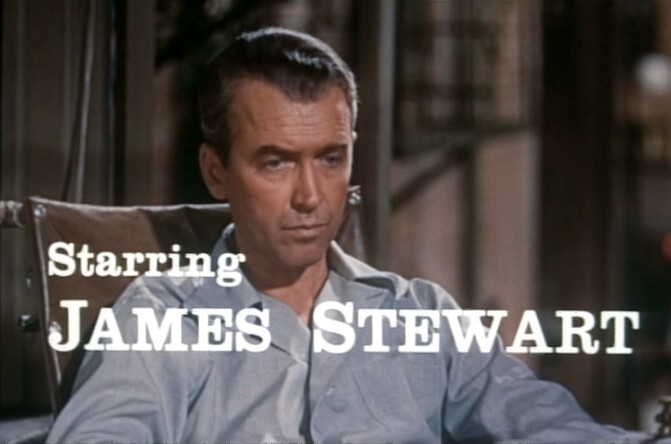
On the plus side, it meant I was constantly being surprised by a film who's actual plot I had forgotten. The plot it self is delightfully simple. L.B 'Jeff' Jeffries (played by the always brilliant Jimmy Stewart) witnesses his neighbour acting very suspiciously and is gradually convinced that he has witnessed a murder. What is impressive is that Hitchcock leaves you guessing throughout the film. After all there are a lot of reasons why Jeff could be wrong, most of which are pointed out before the 'crime' is committed. It is unfeasibly hot and Jeff is in plaster and unable to move around. He is grouchy, bored, irritable, hot and just desperate for a distraction. If you look at the degree his curiosity turns into an all out obsession you can see just how desperate he is for something to focus on.
Gradually, during his obsessive pursuit, he manages to convert his nurse Stella (Thelma Ritter) and his girlfriend Lisa (Grace Kelly - which, tragically, made me instantly think of the Mika song) and the three of them spend days watching their mysterious neighbour Lars Thorwald as he acts all mysteriously.

When you think about it, the crime that Thorwald is accused of by the trio of busybodies is pretty horrific. Not only has he murdered his wife, he has subsequently used a knife and a saw to hack her up into lots of little pieces. He has then transported those pieces out of his house, using his suitcase. In installments.
Throughout this process Lars continues to stay calm and calculated. If Jeff is correct then this isn't an act of passion, this is a cold and calculated killing with a lot of planning - it is this that starts to concern Jeff, the sheer cold heartedness and meticulousness of the crime. Made worse that nobody else believes him.
This is embodied by Jeff's convenient friend Lt Thomas J Doyle (Wendell Corey) who not only refuses to join in with the paranoia but who offers sound alternative theories and sometimes actual proof as to what could have happened. In fact he hardly gets roped in at all until the end. But it means nothing, Jeff, Lisa and Stella still have their obsession and focus on their theories, rather than anything which contradicts. Even the all out evidence is ignored. After all, you can prove anything with facts. If anything, this film is a tribute to all the curtain twitchers who are being paranoid, judgemental busybodies. One day you will have your moment of triumph.
However, oddly for such a taut and well made thriller, the story isn't the most exciting bit. Well, not for me. This film excited the design geek that lives inside my jaded heart due to the fantastic way it uses and films its set.
The set is immense. It is nice to think that a film which is almost entirely set in one corner of one room has such a massive sprawling and complicated set. Hitchcock built an entire street scene which his neighbours (at times little more than glorified extras) could live in. He even built a massive complicated lighting rig so that he could instantly flip to different points in the day. It makes me think of Synechdoche New York, but it also makes me think of theatre. It is very rare that a film is made in one setting, let alone one physical set. If the massive street could be replicated on stage, then a play of the film would easily work. We, don't get the freedom to explore this amazing set though, we're confined to view the lives of its inhabitants from Jeff's rear window. We're only allowed more clarity when Jeff decides to crack out the binoculars or his long zoom lens. Then we get to see their worlds in a little bit more detail, but we're still confined to the limitations of Jeff's viewpoint. It is a very brave move and one that helps make sure the audience is clamouring for information and verification, as they're in the same boat as the protagonist.
The one time that the rule is broken, doesn't really add anything to the film, but it does finally allow us to see up close the people we've been watching from afar. Their lives feel real, they seem to have real issues and in some ways I find the the endings to Miss Lonelyheart's arc and to Miss Torso's arc more satisfying than the ending to the main plot itself. But then they all add up together to show an overall happy ending for that community.