No 69 - Trois Couleurs: Rouge (Three Colours: Red)
Director - Krzysztof Kieslowski
Rouge is the last film of Kieslowski's Three Colours trilogy (Blue, White and Red - covering the themes liberté, égalité and fraternité) and even though the films aren't directly related (besides tone and style) I felt it was right to watch them in order, as I had never seen the Three Colours Trilogy before. The trilogy also managed to inject a bit of much needed culture after I shamefully watched the Big Brother launch and Team America.
As the film begins, I noticed an immediate stylistic different to Blue and White. The way that the camera whizzes down wires is far more stylised than the more naturalistic preceding two films - it almost feels Jeunot-esque. However, after that shot we're in far more familiar territory as we follow Valentine (the delightful Irene Jacob) living out her life. She has a boyfriend who doesn't care about her and she is introduced to a Judge who is a bit of a voyeur, listening to phone conversations and particularly relishing the sex calls. Irene struggle with morality, not knowing how to react - but in Irene the judge finds comfort and begins to change his ways.
During this story, we're following Auguste. His relationship with Irene is very similar to the relationship of the three films. Although they pass each other and often appear at the same moment at the same time, they never directly affect each other. His life also seems to draw parallels with that of the Judge: for as we watch the events unfold for Auguste, they correlate with the sad stories the Judge is telling.
I find it strange that this is the film which is viewed as the best; that this film got into the list whereas the other two didn't. For me, I found that Red was the weakest of the three. I found the story far too fragmented, and the characters not strong enough to pull it along. Now, the film is still wonderful, but I preferred the heart-breakingly tragic characters of Blue and the oddly whimsical story of White. It is all part of Kieslowski's bizarre universe - the reoccurring themes throughout the three films are strange, from the obvious (and masterful) decision of making sure the titular colour is prominent throughout the film through to the inclusion of the same elderly woman struggling with the same bottle bank in each film (whilst in Blue and White we watch the old lady struggle, in Red - Fraternity - Valentine assists her with her bottle). We also have the inclusion of Kieslowski's whimsy: the fictional composer Van den Budenmayer - who appears in all of his films.
Whilst the story seems to meander, it finally picks up in the end: A heart to heart between Irene and the Judge adds the final levels of richness and depth to those characters and turns them into real and fascinating people.
The wonderful coincidences in the end which allow the major characters of the three films to finally meet is a marvellous touch which I won't explain for fear of ruining.
So, yes... Red is nice, but in my opinion it isn't the best in the trilogy, and its powerful moments are most powerful when you can refer them back to White and Blue. They're only short films (about ninety minutes each) so do yourself a favour: watch the Three Colours trilogy, rather than just watching Red.
Saturday, 12 June 2010


Friday, 11 June 2010
It's up to you, Fogell. This guy is either gonna think 'Here's another kid with a fake ID' or 'Here's McLovin, a 25 year-old Hawaiian organ donor'
No 487 - Superbad
Director - Greg Mottola
I like it when a film accepts what it is and doesn't try to be clever... This is a film which just accepts its own stupidity and embarks upon a fabulously ridiculous journey. The plot is incredibly simple: three teenagers try to supply a house party with booze - an act which will turn them into legends and probably get them laid. Ah teen comedies, sex is all the motivation there needs to be :)
Whereas the film may struggle with a narrative, it does manage the one important thing for a teen comedy: it accurately portray teens. These are swearing, sex obsessed idiots who lack the courage to act on what they talk incessantly about. What I also like is that the characters show different sides to what we'd expect. I've gotten used to Jonah Hill being a brash and foul mouthed character... but here, his arrogant potty mouth just hides his character Seth's insecurity. His masses of insecurity. Watch his drunken revelation to Jules about how he had to get drunk in order to get the courage to make a move... it is tragically sad and tragically real. We've all been in that situation.
Michael Cera, on the other hand, is playing Evan, who is the role he always plays - the nervous, awkward geek - but this time he swears like a trooper and talks constantly about sex. It just shows a different side to him - though I'm waiting for his turn as an action hero with masses of excitement.
Seth and Evan are desperate to seduce the girls of their dreams. Martha MacIsaacs' Becca, the typical girl next door, is delightfully sweet and perfect for the nervous Evan. So the scene in which she drunkenly propositions Evan is even more cringe-inducing than Seth's attempt with Jules. Though it does give us an excellent line, which manages to be both hilarious but also show just how inexperienced (and wasted) the people are in this scene: I am gonna give you the best blow J ever... with my mouth.
Emma Stone's Jules seems far more adult and far more confident. She is also the owner of a surprisingly husky voice for one so young (this film makes me feel old). She is the most adult character within the entire film. The sober centre point who is both the catalyst for the film's narrative but also its most grounded point.
However, really this film isn't about Seth and Evan. Even though they're the leads and even though they represent an augmented autobiographical tale of the script writers - Seth Rogen and Evan Goldberg - they are not the story's shining star.
You see... Rogen and Goldberg initially wrote this when they were 19 or 20 - with the idea that they (or at least Seth) would play themselves. However... they grew up and had to write themselves adult parts instead. So we have the film's strongest (and stupidest) story arc, and the introduction of Fogell - another teenage character, who gets caught up with two cops.
Christopher Mintz-Plasse came from nowhere to become the supremo geek extraordinaire. Fogell is a spindly hilarious loser. But he is getting a fake ID, and is therefore essential to the operation. Unfortunately, Fogell gets the worst fake ID ever, with a singular name. He is McLovin.
Through a series of mishaps he is abandoned by Seth and Evan and questioned by the police: McLovin? Sounds like a sexy hamburger!
For the remaining majority of the film he gets up to ridiculous adventures with his new friends: Officer Michaels (the excellent Bill Hader) and Officer Slater (Seth Rogen, making sure he gets one of the most fun roles). They are idiots who enjoy drinking, shooting guns, spinning doughnuts and generally abusing their police powers. However, as soon as it becomes clear that they may get in trouble, we see a whole new side to the cops. Violent and brutal, they are willing to attack and stop anyone if it'll make them look better (and they can always fix it in the paperwork). They are the embodiment of corruption in the police force, and it is odd that the only person they're really nice to throughout the film is Fogell - they will happily attack and terrify a hundred teens, as long as the one that they're trying to impress stays impressed.
It is a stupid film. So serious respect that it can pull off a restrained and fairly moving ending. For all the vulgarity and idiocy it is quite cute. It targets the fear and worry of having to leave your school friends to go to college and the fear of how you should act with women.
It is a teenage film. On the surface it is a juvenile idiot obsessed with sex, but underneath it is a bag of insecurities.
Superbad? Supergood more like...
(I've been waiting the whole review to say that!)
Director - Greg Mottola
I like it when a film accepts what it is and doesn't try to be clever... This is a film which just accepts its own stupidity and embarks upon a fabulously ridiculous journey. The plot is incredibly simple: three teenagers try to supply a house party with booze - an act which will turn them into legends and probably get them laid. Ah teen comedies, sex is all the motivation there needs to be :)
Whereas the film may struggle with a narrative, it does manage the one important thing for a teen comedy: it accurately portray teens. These are swearing, sex obsessed idiots who lack the courage to act on what they talk incessantly about. What I also like is that the characters show different sides to what we'd expect. I've gotten used to Jonah Hill being a brash and foul mouthed character... but here, his arrogant potty mouth just hides his character Seth's insecurity. His masses of insecurity. Watch his drunken revelation to Jules about how he had to get drunk in order to get the courage to make a move... it is tragically sad and tragically real. We've all been in that situation.
Michael Cera, on the other hand, is playing Evan, who is the role he always plays - the nervous, awkward geek - but this time he swears like a trooper and talks constantly about sex. It just shows a different side to him - though I'm waiting for his turn as an action hero with masses of excitement.
Seth and Evan are desperate to seduce the girls of their dreams. Martha MacIsaacs' Becca, the typical girl next door, is delightfully sweet and perfect for the nervous Evan. So the scene in which she drunkenly propositions Evan is even more cringe-inducing than Seth's attempt with Jules. Though it does give us an excellent line, which manages to be both hilarious but also show just how inexperienced (and wasted) the people are in this scene: I am gonna give you the best blow J ever... with my mouth.
Emma Stone's Jules seems far more adult and far more confident. She is also the owner of a surprisingly husky voice for one so young (this film makes me feel old). She is the most adult character within the entire film. The sober centre point who is both the catalyst for the film's narrative but also its most grounded point.
However, really this film isn't about Seth and Evan. Even though they're the leads and even though they represent an augmented autobiographical tale of the script writers - Seth Rogen and Evan Goldberg - they are not the story's shining star.
You see... Rogen and Goldberg initially wrote this when they were 19 or 20 - with the idea that they (or at least Seth) would play themselves. However... they grew up and had to write themselves adult parts instead. So we have the film's strongest (and stupidest) story arc, and the introduction of Fogell - another teenage character, who gets caught up with two cops.
Christopher Mintz-Plasse came from nowhere to become the supremo geek extraordinaire. Fogell is a spindly hilarious loser. But he is getting a fake ID, and is therefore essential to the operation. Unfortunately, Fogell gets the worst fake ID ever, with a singular name. He is McLovin.


Through a series of mishaps he is abandoned by Seth and Evan and questioned by the police: McLovin? Sounds like a sexy hamburger!
For the remaining majority of the film he gets up to ridiculous adventures with his new friends: Officer Michaels (the excellent Bill Hader) and Officer Slater (Seth Rogen, making sure he gets one of the most fun roles). They are idiots who enjoy drinking, shooting guns, spinning doughnuts and generally abusing their police powers. However, as soon as it becomes clear that they may get in trouble, we see a whole new side to the cops. Violent and brutal, they are willing to attack and stop anyone if it'll make them look better (and they can always fix it in the paperwork). They are the embodiment of corruption in the police force, and it is odd that the only person they're really nice to throughout the film is Fogell - they will happily attack and terrify a hundred teens, as long as the one that they're trying to impress stays impressed.


It is a stupid film. So serious respect that it can pull off a restrained and fairly moving ending. For all the vulgarity and idiocy it is quite cute. It targets the fear and worry of having to leave your school friends to go to college and the fear of how you should act with women.
It is a teenage film. On the surface it is a juvenile idiot obsessed with sex, but underneath it is a bag of insecurities.
Superbad? Supergood more like...
(I've been waiting the whole review to say that!)
That's what I'm trying to prove mother. Rod didn't kill Tina and he didn't hang himself. There's this guy. He's after us in our dreams.
No 162 - A Nightmare on Elm Street
Director - Wes Craven
One, two, Freddy's coming for you.
Three, four, better lock your door.
Five, six, grab your crucifix.
Seven, eight, better stay awake.
Nine, ten, never sleep again.
Everything is scarier when it is accompanied by a rhyme. There is something about an innocent children's rhyme that just makes scary things scarier. I think it is the cruel cruel juxtaposition. It is like the Gentlemen - they were the SCARIEST Buffy villains, and that was probably helped by the accompanying chilling rhyme.
The thing that I find disappointing about this film is that it just fails to live up to the premise. The idea of a homicidal maniac with phenomenal God like powers terrorising you through your dreams is a genuinely terrifying concept, and yet it never lives up to its full potential. I think this is partly down to the special effects. As this is a film which relies a lot on special effects, the fact that they're dated does make the film feel slightly hokey.
And yet, that is what is all the more disappointing about the remake. Even though they have better special effects, they still haven't grasped the FUN you could have with such a concept. Almost endless fun.
And whilst Nightmare is slightly flawed as a horror, it is a wonderfully fun piece of film. Freddy Krueger is a genuinely chilling villain in the fact that he seems to just be really enjoying what he does. The gleeful way he torments his victims is both horrifically cruel but wonderfully joyous - his cackling face as the teenagers claw at him for freedom. He does also seem to have a slightly masochistic personality. Just before he uses his claw hands (such an amazing, instantly iconic, weapon) he likes to show off how sharp they are - cutting off fingers or slicing into his own skin. He just enjoys a bit of self mutilation before he attacks.
The fact that Freddy Krueger was a child killer is unimportant. The fact that he is clearly stark raving MAD is what makes him a dangerous villain. Just really not a scary one. I was going to say that he is like a clown trying to kill you - but that is terrifying... Freddy just isn't scary. Dead Tina is scary, wrapped in her bloodied sheets, but he isn't.
However, his character does allow for some amazing visual moments. Stairs which collapse and melt in crumbling squidgy marshmallow, individual flaming footprints and tongues which creep out of the phone receiver to lick your face...
And the deaths are phenomenal! An echo back to the 70's and the ridiculous over the top deaths of Dario Argento. Fountains of bright bright red blood shower out as limbs are severed and blood flies everywhere. It is gloriously over the top. It all helps to make sure you're never drawn into the film too much - it is all so absurd.
Another thing that keeps you from falling too far in are the number of recognisable faces looking so young... Look at young little Johnny Depp. Look at Lin Shaye playing the teacher (best known to me as Magda in Something About Mary or (even better) Mrs Bruce in the awesomely bad Detroit Rock City). And who is playing the doctor? Why it is the man I find infuriating... the voice of Roger Rabbit himself Charles Fleischer (I dunno why, I just find him REALLY annoying). All of these people rip me out of the story, but allow me to enjoy it for the camp violent stupidity of it all. And that is a good thing.
This is a film that for all its violence and gore, feels cosy. There is something jolly and fun about it, which is quite a feat considering it touches on some dark topics. It is a horror romp, but it is one which manages a wonderfully surprising ending that leaves you with a little buzz of adrenaline.
Great.
Director - Wes Craven
One, two, Freddy's coming for you.
Three, four, better lock your door.
Five, six, grab your crucifix.
Seven, eight, better stay awake.
Nine, ten, never sleep again.
Everything is scarier when it is accompanied by a rhyme. There is something about an innocent children's rhyme that just makes scary things scarier. I think it is the cruel cruel juxtaposition. It is like the Gentlemen - they were the SCARIEST Buffy villains, and that was probably helped by the accompanying chilling rhyme.

The thing that I find disappointing about this film is that it just fails to live up to the premise. The idea of a homicidal maniac with phenomenal God like powers terrorising you through your dreams is a genuinely terrifying concept, and yet it never lives up to its full potential. I think this is partly down to the special effects. As this is a film which relies a lot on special effects, the fact that they're dated does make the film feel slightly hokey.
And yet, that is what is all the more disappointing about the remake. Even though they have better special effects, they still haven't grasped the FUN you could have with such a concept. Almost endless fun.
And whilst Nightmare is slightly flawed as a horror, it is a wonderfully fun piece of film. Freddy Krueger is a genuinely chilling villain in the fact that he seems to just be really enjoying what he does. The gleeful way he torments his victims is both horrifically cruel but wonderfully joyous - his cackling face as the teenagers claw at him for freedom. He does also seem to have a slightly masochistic personality. Just before he uses his claw hands (such an amazing, instantly iconic, weapon) he likes to show off how sharp they are - cutting off fingers or slicing into his own skin. He just enjoys a bit of self mutilation before he attacks.
The fact that Freddy Krueger was a child killer is unimportant. The fact that he is clearly stark raving MAD is what makes him a dangerous villain. Just really not a scary one. I was going to say that he is like a clown trying to kill you - but that is terrifying... Freddy just isn't scary. Dead Tina is scary, wrapped in her bloodied sheets, but he isn't.
However, his character does allow for some amazing visual moments. Stairs which collapse and melt in crumbling squidgy marshmallow, individual flaming footprints and tongues which creep out of the phone receiver to lick your face...
And the deaths are phenomenal! An echo back to the 70's and the ridiculous over the top deaths of Dario Argento. Fountains of bright bright red blood shower out as limbs are severed and blood flies everywhere. It is gloriously over the top. It all helps to make sure you're never drawn into the film too much - it is all so absurd.
Another thing that keeps you from falling too far in are the number of recognisable faces looking so young... Look at young little Johnny Depp. Look at Lin Shaye playing the teacher (best known to me as Magda in Something About Mary or (even better) Mrs Bruce in the awesomely bad Detroit Rock City). And who is playing the doctor? Why it is the man I find infuriating... the voice of Roger Rabbit himself Charles Fleischer (I dunno why, I just find him REALLY annoying). All of these people rip me out of the story, but allow me to enjoy it for the camp violent stupidity of it all. And that is a good thing.



This is a film that for all its violence and gore, feels cosy. There is something jolly and fun about it, which is quite a feat considering it touches on some dark topics. It is a horror romp, but it is one which manages a wonderfully surprising ending that leaves you with a little buzz of adrenaline.
Great.
Monday, 7 June 2010
It's only after we've lost everything that we're free to do anything
No 10 - Fight Club
Director - David Fincher
I am Jack's sense of joyous nostalgia. The end of my last GCSE consisted of two things - an epic water fight in my local park and the first time I watched Fight Club. Later, my 'coming of age' in a series of madcap adventures in Ecuador meant that whilst I watched Fight Club in a dingy and strange cinema bar we drank all of the venue's beer, gin and tonic water. This is a film which is firmly part of my journey to adulthood.
Which is worrying when you think how joyfully nihilistic it is.
Now.... if you haven't seen this film PLEASE DON'T READ THIS REVIEW. I can't talk about it without giving away massive and crucial spoilers which will ruin it for you...
Good.
Before we talk of plot and twists and stories, let's begin by talking about the visual aesthetic. There are some wonderful stylistic touches in this film and elements which I think were pretty new when Fincher did them. I certainly had never seen the exciting way in which the camera flies and darts through the CGI environs (a stylistic flourish he later made even more impressive in the otherwise unremarkable Panic Room). Even the opening sequence is amazing as the camera rushes out of Ed Norten's head and along the barrel of a gun.
We're then introduced to Ed Norton's narrator - a lead without a name - and from his first dead eyed look and dead pan voice over one thing is made absolutely clear. This film is cool. And it knows it is cool. This film KNOWS it is cooler than you. From every dry line and every piece of inspired casting (Meatloaf's Bob is particularly brilliant) it taunts you with its cool. But what is so interesting is that the narrator isn't particularly cool... he is plain, suppressed and he isn't happy.
Each piece of furniture is amusingly annotated with prices and descriptions as he walks through it. His house is an IKEA catalogue. He has no personality.
However we begin to see traces of the Narrator's other side... we're introduced to Marla Singer, who I'll speak about later. But we also get flashes of Tyler Durden. There are at least 3 times that I have seen... Firstly, in the office he appears standing by the photo copier. Secondly, he flashes behind the shoulders of his doctor and thirdly (if I remember correctly) when Marla Singer ousts him from his self help therapy. There may be more, and if there are I've not noticed them.
It isn't until on a plane that we meet Tyler Durden. Played with violent, anarchic panache by Brad Pitt. He is part Rusty Ryan - suave bastard, and part Jeoffrey Goines - total loon. He is 100% dangerous and a wonderful cinematic thing to behold. I'll let Empire describe him better than me...
This is where we discover the second thing about the film. Not only does the film know it is cooler than you. It doesn't give a fuck.
There are moments in this film which discuss how a film works (explaining 'cigarette burns' which I now notice all the time) and there are moments which (whether real or digitally created) seem to mess with the cinema. Whether it is splicing a penis in to the film for a pre-credit gag or shaking and distorting the film in an angry rant. I can't think of a film (not including Planet Terror's graininess and missing reel) that is as brave with the concept of film since Hellzapoppin' - though there probably are some...
Tyler is a destructive guru. He looks awesome. He reeks of confidence. He is too good to be true. That is the first clue we really get... from the ease with which he acts out his pretty misguided anarchic views all the way to his impossibly ripped physique. From his mind to his body he is almost too perfect. And in a film which is keen to press that nobody is perfect, that should be a warning that he might, just might, not be real.
He is also wonderfully nihilistic. He is true punk. He compliments perfectly the suicidal over-thinking nature of Marla... Her morbid character is so different to Tyler, who embraces life to a dangerous degree, but yet is also very similar. Both seem to attach little value to material things. Both are happy living in squalor. Both just want to feel. Whether it is the feeling of death for Marla (her own or someone else's) or the exhilaration of violence for Tyler (whether personal or vandalism) - it is all about having a genuine connection. It is probably also why they have so much sex throughout.
Norten's character is as entranced by him as we are, and soon the two join forces and the titular Fight Club is born. Surely everyone watching when Brad Pitt swaggers into the middle of his bloodlusting punters, and booms out the now immortal rules of fight club, is transfixed. I can't show you his performance... but even the script is perfect. Just wonderful.
What is interesting about the actual fight club is that it manages to show two contradictory things... at the same time. Firstly, the fights are horrible, savage and brutal. Secondly, those fights are wonderful; almost aspirational. The way that it's filmed and the reactions from the characters show how free they are. How happy. It makes me want to get into a fight - and I'm a fat cowardly pacifist.
What this film begins to show is how an idea can go too far. How the freedom of being in a fight and letting off steam (if somewhat violently) turns into a breeding ground for nihilistic terrorists. It shows how easily people are led by charismatics with a different view. It show how dangerous people can be and how dangerous organised societies can be. The cinematic portrayal of Project Mayhem is as much of an attack on corporations and capitalism as it is an attack on fundamentalist religion. For Project Mayhem could easily be considered a fundamentalist religion. This is a film that is far more intelligent than its title implies... This is a film which makes you think. If you go in expecting a film about a club where people get into fights you'll be sorely disappointed, as the actual club only features for the briefest moments.
This is a film about introspection, about our own personal demons and our own little misanthropic tendencies. It is a film about embracing who we are before we suppress it too far and snap. This is a film about violence. Just not always the punchy punchy kablammo kind.
So we come to the reveal... the twist... Ed Norton's narrator IS Tyler Durden. Of course he is. Tyler Durden is what any suppressed white collar depressed individual would want to be. A gorgeous bastard who could beat you up and doesn't care what anybody thinks. Of course he is an aspiration.
And yet he is still there and he is still very dangerous.
I think the reveal is great, and whilst it was beginning to twig as the events unfurled, I had never figured out the twist before the reveal (unlike, say... The 6th Sense) - and yes there are moments which become farcical (see the scenes in which Ed Norton fights himself) but the danger is still there - how do you kill off your other personality?
The film ends with the last of Tyler's plans coming to fruition. As the Pixies sound up, the skyscrapers fall and there is a joyous uplifting vibe to the whole thing. I haven't felt this happy watching terrorism since V for Vendetta.
It is a celebration of the little bastard in all of us that just wants to break things. And it is a warning that maybe we shouldn't always listen to it.
Director - David Fincher
I am Jack's sense of joyous nostalgia. The end of my last GCSE consisted of two things - an epic water fight in my local park and the first time I watched Fight Club. Later, my 'coming of age' in a series of madcap adventures in Ecuador meant that whilst I watched Fight Club in a dingy and strange cinema bar we drank all of the venue's beer, gin and tonic water. This is a film which is firmly part of my journey to adulthood.
Which is worrying when you think how joyfully nihilistic it is.
Now.... if you haven't seen this film PLEASE DON'T READ THIS REVIEW. I can't talk about it without giving away massive and crucial spoilers which will ruin it for you...
Good.
Before we talk of plot and twists and stories, let's begin by talking about the visual aesthetic. There are some wonderful stylistic touches in this film and elements which I think were pretty new when Fincher did them. I certainly had never seen the exciting way in which the camera flies and darts through the CGI environs (a stylistic flourish he later made even more impressive in the otherwise unremarkable Panic Room). Even the opening sequence is amazing as the camera rushes out of Ed Norten's head and along the barrel of a gun.
We're then introduced to Ed Norton's narrator - a lead without a name - and from his first dead eyed look and dead pan voice over one thing is made absolutely clear. This film is cool. And it knows it is cool. This film KNOWS it is cooler than you. From every dry line and every piece of inspired casting (Meatloaf's Bob is particularly brilliant) it taunts you with its cool. But what is so interesting is that the narrator isn't particularly cool... he is plain, suppressed and he isn't happy.
Each piece of furniture is amusingly annotated with prices and descriptions as he walks through it. His house is an IKEA catalogue. He has no personality.
However we begin to see traces of the Narrator's other side... we're introduced to Marla Singer, who I'll speak about later. But we also get flashes of Tyler Durden. There are at least 3 times that I have seen... Firstly, in the office he appears standing by the photo copier. Secondly, he flashes behind the shoulders of his doctor and thirdly (if I remember correctly) when Marla Singer ousts him from his self help therapy. There may be more, and if there are I've not noticed them.
It isn't until on a plane that we meet Tyler Durden. Played with violent, anarchic panache by Brad Pitt. He is part Rusty Ryan - suave bastard, and part Jeoffrey Goines - total loon. He is 100% dangerous and a wonderful cinematic thing to behold. I'll let Empire describe him better than me...


This is where we discover the second thing about the film. Not only does the film know it is cooler than you. It doesn't give a fuck.
There are moments in this film which discuss how a film works (explaining 'cigarette burns' which I now notice all the time) and there are moments which (whether real or digitally created) seem to mess with the cinema. Whether it is splicing a penis in to the film for a pre-credit gag or shaking and distorting the film in an angry rant. I can't think of a film (not including Planet Terror's graininess and missing reel) that is as brave with the concept of film since Hellzapoppin' - though there probably are some...
Tyler is a destructive guru. He looks awesome. He reeks of confidence. He is too good to be true. That is the first clue we really get... from the ease with which he acts out his pretty misguided anarchic views all the way to his impossibly ripped physique. From his mind to his body he is almost too perfect. And in a film which is keen to press that nobody is perfect, that should be a warning that he might, just might, not be real.
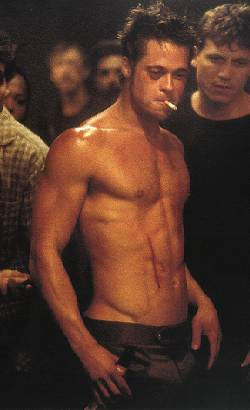
He is also wonderfully nihilistic. He is true punk. He compliments perfectly the suicidal over-thinking nature of Marla... Her morbid character is so different to Tyler, who embraces life to a dangerous degree, but yet is also very similar. Both seem to attach little value to material things. Both are happy living in squalor. Both just want to feel. Whether it is the feeling of death for Marla (her own or someone else's) or the exhilaration of violence for Tyler (whether personal or vandalism) - it is all about having a genuine connection. It is probably also why they have so much sex throughout.
Norten's character is as entranced by him as we are, and soon the two join forces and the titular Fight Club is born. Surely everyone watching when Brad Pitt swaggers into the middle of his bloodlusting punters, and booms out the now immortal rules of fight club, is transfixed. I can't show you his performance... but even the script is perfect. Just wonderful.
What is interesting about the actual fight club is that it manages to show two contradictory things... at the same time. Firstly, the fights are horrible, savage and brutal. Secondly, those fights are wonderful; almost aspirational. The way that it's filmed and the reactions from the characters show how free they are. How happy. It makes me want to get into a fight - and I'm a fat cowardly pacifist.
What this film begins to show is how an idea can go too far. How the freedom of being in a fight and letting off steam (if somewhat violently) turns into a breeding ground for nihilistic terrorists. It shows how easily people are led by charismatics with a different view. It show how dangerous people can be and how dangerous organised societies can be. The cinematic portrayal of Project Mayhem is as much of an attack on corporations and capitalism as it is an attack on fundamentalist religion. For Project Mayhem could easily be considered a fundamentalist religion. This is a film that is far more intelligent than its title implies... This is a film which makes you think. If you go in expecting a film about a club where people get into fights you'll be sorely disappointed, as the actual club only features for the briefest moments.
This is a film about introspection, about our own personal demons and our own little misanthropic tendencies. It is a film about embracing who we are before we suppress it too far and snap. This is a film about violence. Just not always the punchy punchy kablammo kind.
So we come to the reveal... the twist... Ed Norton's narrator IS Tyler Durden. Of course he is. Tyler Durden is what any suppressed white collar depressed individual would want to be. A gorgeous bastard who could beat you up and doesn't care what anybody thinks. Of course he is an aspiration.
And yet he is still there and he is still very dangerous.
I think the reveal is great, and whilst it was beginning to twig as the events unfurled, I had never figured out the twist before the reveal (unlike, say... The 6th Sense) - and yes there are moments which become farcical (see the scenes in which Ed Norton fights himself) but the danger is still there - how do you kill off your other personality?
The film ends with the last of Tyler's plans coming to fruition. As the Pixies sound up, the skyscrapers fall and there is a joyous uplifting vibe to the whole thing. I haven't felt this happy watching terrorism since V for Vendetta.
It is a celebration of the little bastard in all of us that just wants to break things. And it is a warning that maybe we shouldn't always listen to it.
Baby wants to fuck! Baby wants to fuck Blue Velvet!
No 85 - Blue Velvet
Director - David Lynch
I do not own Speed or Easy Rider or Rebel Without a Cause and so when I heard of the death of the great Dennis Hopper I pulled out the two films I do own - this or Apocalypse Now. I decided it had to be this, as I have Apocalypse Now Redux, which isn't TECHNICALLY the film which was voted in...
It also meant that I could continue my tradition of watching completely unsuitable films over breakfast.
The film begins pretty innocuously with beautiful opening credits of elegant text against blue velvet (naturally) - it feels like a classic MGM film and that feeling's continued when the film pans into the middle American suburbia that Lynch is clearly fascinated by (see Twin Peaks for a small town version of the same theme).
But once we have been lulled into this false sense of security, the Lynchian weirdness begins. However, this is still a fairly (and surprisingly) standard story. There is none of the insanity of Eraserhead or Mulholland Drive. I kept expecting a strange angry dwarf to appear or some shocking nightmarish image. But there aren't any. The majority of the film fits the story. It is just that once we seep through the suburban exterior, we face the shockingly foul-mouthed violent underbelly.
Our protagonist is Jeffrey (an amazingly young Kyle MachLachlan) who discovers a disembodied ear in the middle of the woods. He then decides to investigate the ear himself - partly out of curiosity but also partly to impress the detective's attractive daughter.
Once there, he becomes embroiled with Frank; the insane, torturing, murdering psycho and the villain of this film. Also just an amazingly powerful and genuinely terrifying performance from Dennis Hopper.
I did not know that this was his 'comeback' film until I started doing a bit of research after watching, but what a comeback it is. Violent and abrasive he (literally) screams his presence and sears himself into the viewer's mind. It is made all the more scary by his unpredictable nature. Yes, he has goons, and yes, they all seem to be joyfully violent and vindictive - but they seem safe in comparison to Frank because they're not gassed up. Gas makes villains far more terrifying...
Frank's world is weird - but it isn't the nightmarish world which I was geared up to expect. Most of it is just cruel and unusual, and the only bit that genuinely doesn't make sense is that one of the cast appears to suddenly get a lobotomy. Is it a stray bullet? Or some kind of deliberate ploy to silence someone? Don't expect an answer. Just expect a stationary dribbling fool.
However, the best bit of Frank's world is that it includes a really effeminate Dean Stockwell as Ben (who is - to quote Frank - "One Suave Fucker"). Bloody love Dean Stockwell - he is great in both BSG and Quantum Leap! Certainly, the point where he starts singing is odd. But again, not as odd as Eraserhead.
This is a film which has touches of symbolism and the briefest hint of surrealism but is mostly quite realistic and a gritty return to classic film noir.
Whilst certainly not an easy watch, I found it quite enjoyable!
Director - David Lynch
I do not own Speed or Easy Rider or Rebel Without a Cause and so when I heard of the death of the great Dennis Hopper I pulled out the two films I do own - this or Apocalypse Now. I decided it had to be this, as I have Apocalypse Now Redux, which isn't TECHNICALLY the film which was voted in...
It also meant that I could continue my tradition of watching completely unsuitable films over breakfast.
The film begins pretty innocuously with beautiful opening credits of elegant text against blue velvet (naturally) - it feels like a classic MGM film and that feeling's continued when the film pans into the middle American suburbia that Lynch is clearly fascinated by (see Twin Peaks for a small town version of the same theme).
But once we have been lulled into this false sense of security, the Lynchian weirdness begins. However, this is still a fairly (and surprisingly) standard story. There is none of the insanity of Eraserhead or Mulholland Drive. I kept expecting a strange angry dwarf to appear or some shocking nightmarish image. But there aren't any. The majority of the film fits the story. It is just that once we seep through the suburban exterior, we face the shockingly foul-mouthed violent underbelly.
Our protagonist is Jeffrey (an amazingly young Kyle MachLachlan) who discovers a disembodied ear in the middle of the woods. He then decides to investigate the ear himself - partly out of curiosity but also partly to impress the detective's attractive daughter.
Once there, he becomes embroiled with Frank; the insane, torturing, murdering psycho and the villain of this film. Also just an amazingly powerful and genuinely terrifying performance from Dennis Hopper.
I did not know that this was his 'comeback' film until I started doing a bit of research after watching, but what a comeback it is. Violent and abrasive he (literally) screams his presence and sears himself into the viewer's mind. It is made all the more scary by his unpredictable nature. Yes, he has goons, and yes, they all seem to be joyfully violent and vindictive - but they seem safe in comparison to Frank because they're not gassed up. Gas makes villains far more terrifying...
Frank's world is weird - but it isn't the nightmarish world which I was geared up to expect. Most of it is just cruel and unusual, and the only bit that genuinely doesn't make sense is that one of the cast appears to suddenly get a lobotomy. Is it a stray bullet? Or some kind of deliberate ploy to silence someone? Don't expect an answer. Just expect a stationary dribbling fool.
However, the best bit of Frank's world is that it includes a really effeminate Dean Stockwell as Ben (who is - to quote Frank - "One Suave Fucker"). Bloody love Dean Stockwell - he is great in both BSG and Quantum Leap! Certainly, the point where he starts singing is odd. But again, not as odd as Eraserhead.
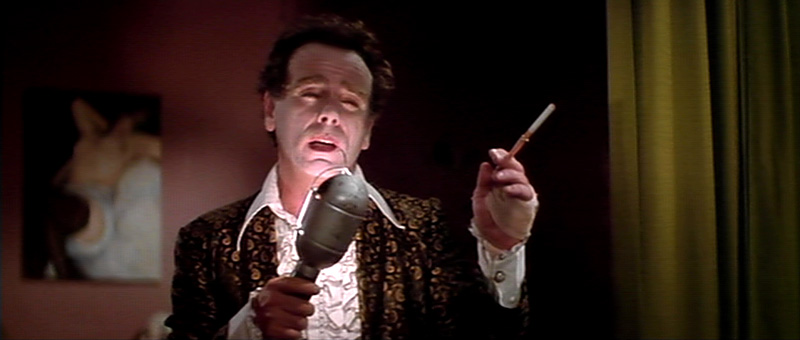
This is a film which has touches of symbolism and the briefest hint of surrealism but is mostly quite realistic and a gritty return to classic film noir.
Whilst certainly not an easy watch, I found it quite enjoyable!
This cannot be "One of Those Things... ” This, please, cannot be that. And for what I would like to say, I can't. This Was Not Just A Matter Of Chance
No 89 - Magnolia
Director - Paul Thomas Anderson
My apologies again, I have been on a bit of a roll with watching films (both on and off list) and have not been keeping up to date with my blogging. So, apologies if once again my views are less concise in these blogs, as several days have passed since I saw some of them.
I had only ever seen Magnolia once prior to this viewing and I remembered it being one of those films which I had to struggle through... I'm not sure if I hadn't been in the correct mind back then or if I have matured (ha!) but I found completely the opposite this time. I still found it long, but this time it was fascinating and captivating and full of characters who were incredibly interesting.
The key phrase here being 'full of characters' - this is a massive ensemble cast. Massive and powerful. But not only is it a massive cast, it is a phenomenal cast full of powerhouse actors (though several of them are P. T. Anderson regulars) John C Reilly, William H Macy, Philip Seymour Hoffman, Julianne Moore, Tom Cruise. There are so many respected actors in this film that they even turn up in bit parts. Look at Alfred Molina sneaking in for a scene. This is clearly a film that a lot of people wanted to be part of. What impresses me is the balanced way that the film juggles such a large cast and allows each character to have their own story and to have enough time for that story to be told.
Most of the stories are terribly, beautifully sad. Look at Donnie for example - the tragic former child genius who no longer has a purpose in life. A strange and lonely man, you can see him as worrying premonition of the current young genius Stanley's future. However, there are some quietly uplifting stories scattered throughout.
Take John C Reilly - his Officer Jim Kurring is another lonely person (a definite theme throughout this film), but through mild bending of policing policy he manages to find happiness. And it is wonderful to see John C Reilly playing a deep and meaningful role rather than something silly.
However, the real star of this film is Tom Cruise. This film is further evidence that he should break away from his 'safe' action hero roles and play a bastard more often. After all, he is excellent as Lestat and even manages to be one of the more enjoyably silly elements of Tropic Thunder. Frank TJ Mackey is a wonderful character - allegedly based on Ross Jeffries, he blusters around full of arrogance and with a back story full of lies.
What is really interesting though is watching his defences crumble as he is interviewed by someone who knows his true back story - the way he moves from being charmingly contradictory, through to aggressive, and finally to a petulant silent bastard.
His final scenes with his dying father are generally beautiful and show a wondrous character arc.
It is a film which really takes care of its character but which puts them through a proper obstacle course of emotions. Whilst this film is emotionally tiring it stays grounded in realism; so the few times it moves away from realism have a powerful punch.
Let's begin with the montage of people singing Aimee Mann's Wise Up - this is something very easy to get wrong, to make look cheesy. Yet kudos to Anderson, he manages to make a montage which not only isn't jarring, but is actually moving.
It is also surprising that when Deus Ex Machina is literally used (a genuine biblical plague) in order to bring the characters closer together it doesn't feel forced. It feels surprising and strange. But it feels like it is handled correctly. And there is something sickeningly funny about watching the cars try to drive through the bloody piles of frogs in the aftermath of the storm.
There is an awful lot going on in this film. Even were the film to give each character a simple character arc, it would still be a long film - but its characters are flawed, complex and real, which makes a film that is both long and utterly captivating.
However, whilst this may sound like scant praise, the best bit of the film is the introduction: an amazing narration from Ricky Jay begins to explain the nature of coincidences and of freak moments. It also sets up the importance of suspension of disbelief. It sets us up for the strange cinematic moments amongst the tragic realism but it also ensnares the viewer. I found it fascinating and from those first moments I was hooked. I was prepared to go on the journey this film was offering. I was willing to believe or disbelieve whatever it takes in order to be in the world of the film (this doesn't always happen... sometimes I just can't suspend my disbelief and the whole film jars).
For while the film is grounded in realism, it still relies a lot on coincidence.
And to quote the narrator:
We generally say - 'well, if that was in a movie, I wouldn't believe it.' Someone's so-and-so met someone else's so-and-so and so on. And it is in the humble opinion of this narrator that strange things happen all the time. And so it goes. And so it goes.
Director - Paul Thomas Anderson
My apologies again, I have been on a bit of a roll with watching films (both on and off list) and have not been keeping up to date with my blogging. So, apologies if once again my views are less concise in these blogs, as several days have passed since I saw some of them.
I had only ever seen Magnolia once prior to this viewing and I remembered it being one of those films which I had to struggle through... I'm not sure if I hadn't been in the correct mind back then or if I have matured (ha!) but I found completely the opposite this time. I still found it long, but this time it was fascinating and captivating and full of characters who were incredibly interesting.
The key phrase here being 'full of characters' - this is a massive ensemble cast. Massive and powerful. But not only is it a massive cast, it is a phenomenal cast full of powerhouse actors (though several of them are P. T. Anderson regulars) John C Reilly, William H Macy, Philip Seymour Hoffman, Julianne Moore, Tom Cruise. There are so many respected actors in this film that they even turn up in bit parts. Look at Alfred Molina sneaking in for a scene. This is clearly a film that a lot of people wanted to be part of. What impresses me is the balanced way that the film juggles such a large cast and allows each character to have their own story and to have enough time for that story to be told.
Most of the stories are terribly, beautifully sad. Look at Donnie for example - the tragic former child genius who no longer has a purpose in life. A strange and lonely man, you can see him as worrying premonition of the current young genius Stanley's future. However, there are some quietly uplifting stories scattered throughout.
Take John C Reilly - his Officer Jim Kurring is another lonely person (a definite theme throughout this film), but through mild bending of policing policy he manages to find happiness. And it is wonderful to see John C Reilly playing a deep and meaningful role rather than something silly.
However, the real star of this film is Tom Cruise. This film is further evidence that he should break away from his 'safe' action hero roles and play a bastard more often. After all, he is excellent as Lestat and even manages to be one of the more enjoyably silly elements of Tropic Thunder. Frank TJ Mackey is a wonderful character - allegedly based on Ross Jeffries, he blusters around full of arrogance and with a back story full of lies.

What is really interesting though is watching his defences crumble as he is interviewed by someone who knows his true back story - the way he moves from being charmingly contradictory, through to aggressive, and finally to a petulant silent bastard.
His final scenes with his dying father are generally beautiful and show a wondrous character arc.
It is a film which really takes care of its character but which puts them through a proper obstacle course of emotions. Whilst this film is emotionally tiring it stays grounded in realism; so the few times it moves away from realism have a powerful punch.
Let's begin with the montage of people singing Aimee Mann's Wise Up - this is something very easy to get wrong, to make look cheesy. Yet kudos to Anderson, he manages to make a montage which not only isn't jarring, but is actually moving.
It is also surprising that when Deus Ex Machina is literally used (a genuine biblical plague) in order to bring the characters closer together it doesn't feel forced. It feels surprising and strange. But it feels like it is handled correctly. And there is something sickeningly funny about watching the cars try to drive through the bloody piles of frogs in the aftermath of the storm.
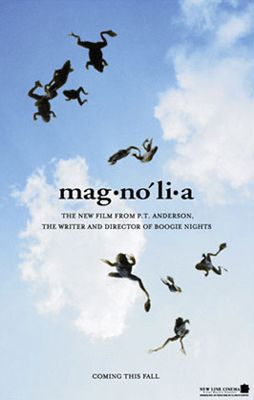
There is an awful lot going on in this film. Even were the film to give each character a simple character arc, it would still be a long film - but its characters are flawed, complex and real, which makes a film that is both long and utterly captivating.
However, whilst this may sound like scant praise, the best bit of the film is the introduction: an amazing narration from Ricky Jay begins to explain the nature of coincidences and of freak moments. It also sets up the importance of suspension of disbelief. It sets us up for the strange cinematic moments amongst the tragic realism but it also ensnares the viewer. I found it fascinating and from those first moments I was hooked. I was prepared to go on the journey this film was offering. I was willing to believe or disbelieve whatever it takes in order to be in the world of the film (this doesn't always happen... sometimes I just can't suspend my disbelief and the whole film jars).
For while the film is grounded in realism, it still relies a lot on coincidence.
And to quote the narrator:
We generally say - 'well, if that was in a movie, I wouldn't believe it.' Someone's so-and-so met someone else's so-and-so and so on. And it is in the humble opinion of this narrator that strange things happen all the time. And so it goes. And so it goes.
Friday, 28 May 2010
Spartans! Ready your breakfast and eat hearty… for tonight we dine in hell!
No 337 – 300
Director – Zack Snyder
Throughout this film, the Spartans give out a fascinatingly shit war cry. “Hoo Hah” they repeat. Over and over again. I like to think that when the powers that be sat down to plan 300 they just did the same… repeating “Hoo Hah” over again – Hell, it even works as a film synopsis.Unlike Transformers (I know I keep referring back to it) which cluttered all its stupid action with masses of exposition, 300 knows that it is nothing but stupid action and doesn’t seek to apologise or disguise the fact. After about 15 minutes they give up on even giving us a plot. We sit there, watching a short set up, explaining the culture and ways of Sparta and explaining the progress of Xerxe’s army.
There is a lot of screaming.
So, why do I enjoy this film when I should find it infuriating? Why do I relish in its brainless nonsense? It makes even less sense when I think how I derided other films for doing the same. I think, firstly, that it isn’t trying to be anything else. Whilst not being tongue in cheek, it doesn’t really take itself too seriously. After all there are only so many slow motion stabbings and lacerations that can occur before it becomes a joke. Likewise, in between the stabbings and attacks, we get to view the ‘banter’ between the soldiers. Which is awful. So awful, that it can’t be legit. It has to be a weird homoerotic joke.
Director – Zack Snyder
Throughout this film, the Spartans give out a fascinatingly shit war cry. “Hoo Hah” they repeat. Over and over again. I like to think that when the powers that be sat down to plan 300 they just did the same… repeating “Hoo Hah” over again – Hell, it even works as a film synopsis.Unlike Transformers (I know I keep referring back to it) which cluttered all its stupid action with masses of exposition, 300 knows that it is nothing but stupid action and doesn’t seek to apologise or disguise the fact. After about 15 minutes they give up on even giving us a plot. We sit there, watching a short set up, explaining the culture and ways of Sparta and explaining the progress of Xerxe’s army.
Then Gerard Butler kicks a messenger down the well and screams.
There is a lot of screaming.
At this point, the film makers decide that they’ve had quite enough plot thank you very much and the film becomes nothing more than a non-interactive video game. A massively outnumbered hero battling wave after wave of enemies with ever increasing difficulty. I am in fact surprised that King Leonidas’ adventures haven’t been made into a game, because the set up is perfect. Far better than most film to game conversions. I once had a computer game version of Wall:E – I never got any further than the bit where you go around collecting rubbish and putting it into stacks.
So, why do I enjoy this film when I should find it infuriating? Why do I relish in its brainless nonsense? It makes even less sense when I think how I derided other films for doing the same. I think, firstly, that it isn’t trying to be anything else. Whilst not being tongue in cheek, it doesn’t really take itself too seriously. After all there are only so many slow motion stabbings and lacerations that can occur before it becomes a joke. Likewise, in between the stabbings and attacks, we get to view the ‘banter’ between the soldiers. Which is awful. So awful, that it can’t be legit. It has to be a weird homoerotic joke.
Normally this doesn’t matter, you watch the film and let the fools kill each other. But at one particular point we’re expected to emote. We’re expected to feel the grief of the father whose son has died. However, there are three things the film has forgotten about.
There has been NO character development in this film at all…. Why are we supposed to care?
The Spartans believed that to die in the battle is the greatest thing you can aspire to… Why are we supposed to feel bad for this particular great death?
When asked whether he felt his son should go to battle, he tells King Leonidas that he has two others…. Why the sudden change of heart?
Silly film. Don’t expect us to relate to the characters. Just let us watch the biffing and the bashing and marvel in how pretty it is.
And it is pretty. As you sit there watching hundreds of oiled up men spearing each other through their washboard stomachs and rippling abs you get to enjoy some amazing cinematography.
What I like is that - much like Sin City (also by Frank Miller) – the film copies the graphic novel’s visual style. This time working in shades of sepia and black with the occasional splash of deep coppery blood.

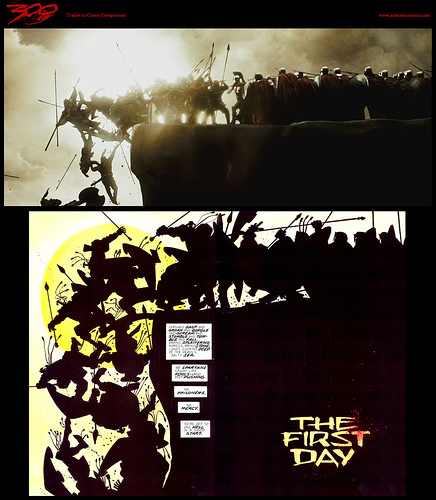
The film relishes in the visuals. It focuses on the horrors and the glories of war and enjoys the comparisons of the Spartan practicality with the Persian pomp and circumstance. The film is a celebration of the violence and whilst you may not agree with the themes, you can not deny that the presentation is beautiful.
Frank Miller’s world is very odd. It is a world in which most people look like chiselled statues of perfection. But scattered amongst them are freaks. And not just mildly weird looking freaks; we’re talking properly mutated. The film seems obsessed by the freaks.
From snivelling drooling rambling hunchbacks to neck-less giants with lobster claws… the film takes pleasure in being a bit of a freak show amidst the violence and showiness.
This, oddly, doesn’t feel that manipulative – I think because the characters are so obviously CGI (there is no way they can be real)… I think it helps to detach us from the violence. It makes it seem more of a fantasy. More of a fiction and less of a horrifying death match.
There are, however a few little things that I do find uncomfortable. Firstly, the weird relationship the film has to women: I am aware that this is a story about two armies of men battling each other, but the women get a rough deal in this film. Firstly, there are only two female characters who make it past being anything but an extra: Queen Gorgo, and the Oracle. Neither of these have particularly rich or complex characters (though the film does try with Queen Gorgo; bless it how it tries) and both suffer from the following:
1) The camera will linger slightly too long on their bare breasts (particularly in the Oracle’s trance scene which seems like an oddly abstract perfume advert with excessive levels of nudity).
2) The character will be placed in a situation which strongly hints that a rape is about to happen.
This is not a woman friendly film.
But then, Zack Snyder seems to get a bit weird when filming women - it's the same in Watchmen.
Both of these films have a sex scene which is handled in a way that appears to jar with the rest of the film. This is very difficult to put into words, but I shall try. He seems to over-sensualise the sex scenes. Almost putting them in soft focus, and letting the camera linger around the bodies.
It is as if, amidst all the explosions and violence (of which there is a lot of in both Watchmen and 300), Snyder really wants to make a soft core porno. I can’t really describe why I find it so strange, but I do. In both films it took me away from the story because I found the tone so jarring. The almost ‘worshipful’ nature the films show to sex. It feels to me that they're done by someone that doesn’t know how to handle sex scenes, and therefore tries to make them serious and sensual and reverential. But instead makes something a bit immature and lecherous.
But probably…. The worst crime of 300…. Was the introduction of Meet the Spartans.
Shudder
Subscribe to:
Posts (Atom)