No 226 - William Shakespeare's Romeo + Juliet
Director - Baz Luhrmann
Baz Luhrmann is a very brave man. With Moulin Rouge! he made the musical popular again (and is, for that reason, in the running for LOVEFiLM's most influencial film of the decade) and with this film he made Shakespeare not only approachable but cool.
It is always exciting to see a Shakespeare play delivered in a way that makes it understandable and relevant. It is why I like going to the Globe and watching it done by the experts. The comedies are funny and the tragedies are tragic.
This film is truly, heartbreakingly tragic. It is also a dramatic spectacle, a signature of Baz Luhrmann's gloriously OTT 'Red Curtain Trilogy'. From the film's opening moments, a flickering TV moving to a newscaster gives the opening monologue and the film explodes into the cast list. Big, dramatic and ridiculous.
Luhrmann's little flurries are everywhere.
I want to start by looking at the ball. An important scene as it separates Juliet from Paris (an unexpected cameo from Paul Rudd) and introduces her to Romeo. The scene is opulent and lavish. Gold and majestic. It also introduces Mercutio, in an amazing cameo from Lost's Michael, Harold Perrineau. The first time we see him is in sequined drag spinning and singing in an explosive drug trip. Baz Luhrmann seems to live drug trips, and this one has the same swirling insanity as seen in Moulin Rouge's Absinthe bender.
Finally, as Romeo's drug bender calms down he lays eyes on his Juliet, and here we can speak about another of the film's strengths, the casting. I think Leonardo DiCaprio is an excellent actor, especially now that he has grown a goatee and become all serious - however I think Romeo is his best role as a young pretty boy. And he is a pretty boy in this film, he looks so young and innocent. It is the same with Claire Danes as Juliet - she is so innocent, her startled eyes and constant little smile. They are the prettiest poster couple. You want them to survive and be happy. Even though you know they won't.
The fact that the characters are so likable makes the deaths so much worse. When Mercutio is shanked, for example, it is genuinely heartbreaking. The shock on his face is second to the pain and rage on Romeo's. That scene has so much emotion. So much drama. You see it for what it is, the most powerful and the most tragic moment in the entire tale. This is the point where everything goes wrong and the downward spiral begins. It is the death of the two best characters in the film. For not only does the mighty Mercutio die, so does the excellent Tybalt. John Leguizamo plays the role with arrogance and hatred and a sleazy mafiosa villainy. It is brilliant. He is brilliant. Look at him.
I find their deaths far more tragic than the titular characters. Romeo and Juliet's deaths are quite underplayed, with a relative subtleness compared to the rest of the film. Though the setting is decorated with lashings and lashings of religious gaudiness.
There isn't much more I can say about this really. The story is a classic and what makes this film special is the excellent portrayal of.
The immaculate casting (as I've described above) and the wonderful over the top scenarios. Luhrmann mixes in modern settings with religious iconography and pop culture references to great effect. A highlight of which is the choral version of When doves Cry sung in Romeo and Juliet's wedding. It is a mix which is turned up to 11 in Moulin Rouge but which just accentuates Shakespeare's story in this. The odd mix of the visuals and the sound works perfectly.
It is just a really good way of re inventing a classic story and making it enjoyable for people who have probably had to dissect it at school.
That is Baz Luhrmann's greatest triumph.
Monday, 16 November 2009


Sunday, 15 November 2009
Groupies sleep with rockstars because they want to be near someone famous. We are here because of the music, we inspire the music. We are Band Aids.
No 142 - Almost Famous
Director - Cameron Crowe
Almost Famous has been the 'almost' film for a couple of months. I keep putting it on the shortlist of films I want to watch, but then picking something else. So I decided that I should finally get round to watching it. Anyway, it has also been a long time since I last watched a film with Zooey Deschanel in.
So with those tenuous reasons put into play and the most infernal of hangovers thumping in my brain, I slipped into the warmth and comfort of this beauty of a film.
Almost Famous is not a realistic study of the music scene in the 70s (actually, it might be... I wasn't there, but it doesn't seem it). It is a love letter, purely and simply - and whilst you might think that rock and roll is the key focus of the film, it isn't. This is a film about friendships. The excitement and mystery of new friendship and the pain and reconciliation when old friendships go through rough patches. It is about befriending your heroes and seeing them as human beings. It didn't have to be about rock stars and groupies (sorry band aids), it is about friends.
We follow William Miller, played by the excellent Patrick Fugit (if you can track down Wristcutters: A Love Story - then do so), who is our narrator and our outsider, allowing us to enter an alien world of Rock and Roll. It is all quite immense and overwhelming, but that is ok because our lead is overwhelmed by it all as well.
Whilst this is a world littered with real bands such as Deep Purple and Bowie (all mentioned but never seen) we follow Stillwater, a fictional band, based in part on the real band Stillwater (they play some genuine Stillwater songs) but with none of the characters based on actual Stillwater band members. The band are coming to terms with their new found success and popularity and this film follows their rivalry, ego and jealousy of one another. It is as much about the complicated relationship between Billy Cruddup's guitarist Russell and Jason Lee's front man Jeff as it is about William's coming of age.
William is led through this film by several forces, namely the adoration of the band Stillwater, the help of Music guru Lester Bangs (Phillip Seymour-Hoffman, as I recently saw The Boat that Rocked, it seems Hoffman is the man of choice for 70s Rock aficionado roles) and the love of Penny Lane.
William's love of Penny Lane is adorable, I personally find her quite irritating. Her flights of fancy and her imposed mystique is not as endearing as the brash and honest floozeyness in the rest of the Band Aids (see the scene where the group decides to deflower William. It shows the honest niceness of the characters, as well as their open sexuality. You can't help but feel a little bit jealous of Patrick Fugit). But for William it is all about Penny, and subsequently this film romanticises the (frequently stupid and naive) things that Penny does.
This brings me nicely to what I want to discuss - magic moments in cinema. Almost Famous is a comfy Sunday film. Despite it dealing with sex, drugs and Rock and Roll, it does so in a very nice and untaxing way. Whilst the whole film rides this wave there are two standalone moments. Moments that give me goosebumps and show the skill and power of Cameron Crowe as a director. The first ties in with the silly things Penny does, and the romanticising of them.
Penny OD's on Quaalude leaving William to call a doctor and watch as she has her stomach pumped. Rather than using this as a harsh lesson against misusing drugs, it is shown in slow motion and almost soft focus. Making the whole spectacle almost ethereal and magical as William watches on with a look of helpless adoration.
It is the moment which sums up and epitomises their relationship, it does so better than words ever could. It is a wonderful piece of cinema. As is Russell's resolution with the band. The second section I wish to discuss.
After a massive falling out with his band, Russell takes William to a house party and subsequently takes far too much acid. The next morning he is brought back onto the tense and silent tourbus, naked, shivering and coming down. Slowly the tourbus unwinds and the group bond through the medium of Tiny Dancer.
Cameron Crowe's use of music is wonderful throughout, but this is just the pivotal moment for the entire film, coupled with my love of early Elton John, this is just the finest moment in the whole film. Watch it. Feel the tension melt away. Feel that tingly moment of joy as the chorus hits in. Gorgeous.
Of course there are the stereotypical trials and tribulations that have to be overcome and the hostility the band shows William at the film's end seems cruel. But it all works out in the end. And whilst William never gets to be with Penny Lane, all other relationships are rectified.
That's whats important. Sometimes the unobtainable woman has to remain unobtainable, and it feels wonderful to see the characters grow and to see a romantic comedy where the guy doesn't get the girl.
Director - Cameron Crowe
Almost Famous has been the 'almost' film for a couple of months. I keep putting it on the shortlist of films I want to watch, but then picking something else. So I decided that I should finally get round to watching it. Anyway, it has also been a long time since I last watched a film with Zooey Deschanel in.

So with those tenuous reasons put into play and the most infernal of hangovers thumping in my brain, I slipped into the warmth and comfort of this beauty of a film.
Almost Famous is not a realistic study of the music scene in the 70s (actually, it might be... I wasn't there, but it doesn't seem it). It is a love letter, purely and simply - and whilst you might think that rock and roll is the key focus of the film, it isn't. This is a film about friendships. The excitement and mystery of new friendship and the pain and reconciliation when old friendships go through rough patches. It is about befriending your heroes and seeing them as human beings. It didn't have to be about rock stars and groupies (sorry band aids), it is about friends.
We follow William Miller, played by the excellent Patrick Fugit (if you can track down Wristcutters: A Love Story - then do so), who is our narrator and our outsider, allowing us to enter an alien world of Rock and Roll. It is all quite immense and overwhelming, but that is ok because our lead is overwhelmed by it all as well.

Whilst this is a world littered with real bands such as Deep Purple and Bowie (all mentioned but never seen) we follow Stillwater, a fictional band, based in part on the real band Stillwater (they play some genuine Stillwater songs) but with none of the characters based on actual Stillwater band members. The band are coming to terms with their new found success and popularity and this film follows their rivalry, ego and jealousy of one another. It is as much about the complicated relationship between Billy Cruddup's guitarist Russell and Jason Lee's front man Jeff as it is about William's coming of age.


William is led through this film by several forces, namely the adoration of the band Stillwater, the help of Music guru Lester Bangs (Phillip Seymour-Hoffman, as I recently saw The Boat that Rocked, it seems Hoffman is the man of choice for 70s Rock aficionado roles) and the love of Penny Lane.


William's love of Penny Lane is adorable, I personally find her quite irritating. Her flights of fancy and her imposed mystique is not as endearing as the brash and honest floozeyness in the rest of the Band Aids (see the scene where the group decides to deflower William. It shows the honest niceness of the characters, as well as their open sexuality. You can't help but feel a little bit jealous of Patrick Fugit). But for William it is all about Penny, and subsequently this film romanticises the (frequently stupid and naive) things that Penny does.
This brings me nicely to what I want to discuss - magic moments in cinema. Almost Famous is a comfy Sunday film. Despite it dealing with sex, drugs and Rock and Roll, it does so in a very nice and untaxing way. Whilst the whole film rides this wave there are two standalone moments. Moments that give me goosebumps and show the skill and power of Cameron Crowe as a director. The first ties in with the silly things Penny does, and the romanticising of them.
Penny OD's on Quaalude leaving William to call a doctor and watch as she has her stomach pumped. Rather than using this as a harsh lesson against misusing drugs, it is shown in slow motion and almost soft focus. Making the whole spectacle almost ethereal and magical as William watches on with a look of helpless adoration.
It is the moment which sums up and epitomises their relationship, it does so better than words ever could. It is a wonderful piece of cinema. As is Russell's resolution with the band. The second section I wish to discuss.
After a massive falling out with his band, Russell takes William to a house party and subsequently takes far too much acid. The next morning he is brought back onto the tense and silent tourbus, naked, shivering and coming down. Slowly the tourbus unwinds and the group bond through the medium of Tiny Dancer.
Cameron Crowe's use of music is wonderful throughout, but this is just the pivotal moment for the entire film, coupled with my love of early Elton John, this is just the finest moment in the whole film. Watch it. Feel the tension melt away. Feel that tingly moment of joy as the chorus hits in. Gorgeous.
Of course there are the stereotypical trials and tribulations that have to be overcome and the hostility the band shows William at the film's end seems cruel. But it all works out in the end. And whilst William never gets to be with Penny Lane, all other relationships are rectified.
That's whats important. Sometimes the unobtainable woman has to remain unobtainable, and it feels wonderful to see the characters grow and to see a romantic comedy where the guy doesn't get the girl.
Wednesday, 11 November 2009
You're a vampire Michael! My own brother, a goddamn, shit-sucking vampire. You wait 'till mom finds out, buddy!
No 438 - The Lost Boys
Director - Joel Schumacher
I find vampires fascinating. There are so many different ways to tell the story, from the sublime to the ridiculous. I love that there are so many ways to tell the story, that although there are similarities, no two vampire films are alike with different powers and different weaknesses.
In this list we'll look at a number of very different Vampires ranging from the ethereal beauty of Anne Rice's vampires to the brutish Monsters at the Titty Twister.
We begin with Lost Boys, looking at Vampires as 80's heart throbs and icons. Where the key word is 80's. It seems that in order to become a vampire at Santa Carla you have to have the most atrocious mullet - but not only that, it seems that this entire film is a celebration of the 80s, with a fantastic cast - including the Coreys - both Haim and Feldman and with none other than Bill S Preston esq (I never knew Alex Winter did anything outside of Bill and Ted), and an amazing soundtrack.
It is important to mention the excellent Cry Little Sister which adds the perfect level of electro Gothic to the environs.
However, whilst I could spend the entire blog talking about the incredible 80's-ness of the film, let us move on and look at the actual vampire elements and the story.
A family move to a coastal town that is terrorized by a group of vampires (led by a menacing and genuinely quite creepy Kiefer Sutherland), the eldest Son, Mike (Jason Patric - my friend Tara would like to point out that he is a handsome chappy) gets roped into the vampire group and gradually descends into a worse and worse condition.
Meanwhile, the youngest son, Sam, gets increasingly paranoid and starts hanging out with Santa Carla's young vampire hunters, the Frog brothers.
As there are two key plot strands in this film I want to tackle them individually, starting with the Vampire element.
Whilst the film has really dated, the story of Mike's descent is very well done. The film brings the concept of full and half vampires. Mike is a half vampire and gradually becomes more vampiric throughout the film. Mike is frequently shot to look like a junkie, and a lot of his traits and characteristics are quite common with the way they show addicts in films. He becomes more slovenly, he becomes more tetchy, he lies around all day and craves his next fix. Of blood. Of course, Mike also starts floating around his room, which is not a common junkie trait.
I think this is an idea which the film was trying to portray - see the point where Mike first takes blood and the very deliberate overlapped photo of Jim Morrison
The plot is handled quite seriously, it is about a boy getting caught up in the wrong crowd, of gradually alienating himself. The vampiric element is almost secondary, it is a metaphor. It is about this titular idea of Lost Boys. Of losing a son to a group or to a drug, of them becoming more and more alienated and aggressive.
All of this makes sense in the film. It is just a shame that they cheapen it with the Frog Brothers and with Sam's vampire hunting mission. Before I talk about the final scenes of the film, I just want to say that I don't like the Frog Brothers... mainly because of Feldman's ridiculous gravelly voice. It sounds silly.
Over the course of the film, Sam and the Frog brothers gather more information about the vampires and lure them to Sam's home for the final showdown - armed with water pistols and baths full of holy water, with dozens of stakes the film takes an unusual (and not really ideal) change of tone.
Rather than taking a turn for the darker with an epic final battle, the tone kind of goes down the Home Alone or Gremlins route. So firstly the house is full of booby traps but most disappointing is that the deaths are slapstick explosions of blood and body parts, melting skeletons and pantomime horror.
The only person who seems to avoid this is Kiefer Sutherland who gets a serene white light as he is staked, rather than gushing geysers of blood from his wounds.
I think these final scenes spell out the problem with the entire film. The central idea is good but the execution is not. The film has dated and the film is unsure in its tonality, which is a shame... The sexy teen idea of vampirism has been
I've heard that the sequel is worse. Part of me really wants to watch it.
Director - Joel Schumacher
I find vampires fascinating. There are so many different ways to tell the story, from the sublime to the ridiculous. I love that there are so many ways to tell the story, that although there are similarities, no two vampire films are alike with different powers and different weaknesses.
In this list we'll look at a number of very different Vampires ranging from the ethereal beauty of Anne Rice's vampires to the brutish Monsters at the Titty Twister.

We begin with Lost Boys, looking at Vampires as 80's heart throbs and icons. Where the key word is 80's. It seems that in order to become a vampire at Santa Carla you have to have the most atrocious mullet - but not only that, it seems that this entire film is a celebration of the 80s, with a fantastic cast - including the Coreys - both Haim and Feldman and with none other than Bill S Preston esq (I never knew Alex Winter did anything outside of Bill and Ted), and an amazing soundtrack.


It is important to mention the excellent Cry Little Sister which adds the perfect level of electro Gothic to the environs.
However, whilst I could spend the entire blog talking about the incredible 80's-ness of the film, let us move on and look at the actual vampire elements and the story.
A family move to a coastal town that is terrorized by a group of vampires (led by a menacing and genuinely quite creepy Kiefer Sutherland), the eldest Son, Mike (Jason Patric - my friend Tara would like to point out that he is a handsome chappy) gets roped into the vampire group and gradually descends into a worse and worse condition.

Meanwhile, the youngest son, Sam, gets increasingly paranoid and starts hanging out with Santa Carla's young vampire hunters, the Frog brothers.
As there are two key plot strands in this film I want to tackle them individually, starting with the Vampire element.
Whilst the film has really dated, the story of Mike's descent is very well done. The film brings the concept of full and half vampires. Mike is a half vampire and gradually becomes more vampiric throughout the film. Mike is frequently shot to look like a junkie, and a lot of his traits and characteristics are quite common with the way they show addicts in films. He becomes more slovenly, he becomes more tetchy, he lies around all day and craves his next fix. Of blood. Of course, Mike also starts floating around his room, which is not a common junkie trait.
I think this is an idea which the film was trying to portray - see the point where Mike first takes blood and the very deliberate overlapped photo of Jim Morrison
The plot is handled quite seriously, it is about a boy getting caught up in the wrong crowd, of gradually alienating himself. The vampiric element is almost secondary, it is a metaphor. It is about this titular idea of Lost Boys. Of losing a son to a group or to a drug, of them becoming more and more alienated and aggressive.
All of this makes sense in the film. It is just a shame that they cheapen it with the Frog Brothers and with Sam's vampire hunting mission. Before I talk about the final scenes of the film, I just want to say that I don't like the Frog Brothers... mainly because of Feldman's ridiculous gravelly voice. It sounds silly.

Over the course of the film, Sam and the Frog brothers gather more information about the vampires and lure them to Sam's home for the final showdown - armed with water pistols and baths full of holy water, with dozens of stakes the film takes an unusual (and not really ideal) change of tone.
Rather than taking a turn for the darker with an epic final battle, the tone kind of goes down the Home Alone or Gremlins route. So firstly the house is full of booby traps but most disappointing is that the deaths are slapstick explosions of blood and body parts, melting skeletons and pantomime horror.
The only person who seems to avoid this is Kiefer Sutherland who gets a serene white light as he is staked, rather than gushing geysers of blood from his wounds.
I think these final scenes spell out the problem with the entire film. The central idea is good but the execution is not. The film has dated and the film is unsure in its tonality, which is a shame... The sexy teen idea of vampirism has been
I've heard that the sequel is worse. Part of me really wants to watch it.
Saturday, 7 November 2009
I made a mess of everything, even my death.
No 142 - Cyrano de Bergerac
Director - Jean-Paul Rappeneau
It's shallow to start blogs, by saying you adore,
the 1600s due to their sense that more was more.
But I loved it in this and do truly believe
That life would be better if this style was reprieved.
So instead of subtle clothes with elegant grace,
we'd get velvet garments with feathers, capes and lace.
This visual aesthetic makes something so much more
from the tale of battle. And romance at its core.
We follow a duellist, with sword and lengthy nose
In love with his cousin, and challenges that pose
with dealing with rivals in his quest for her hand
whilst he thinks he is doomed, that God had somehow planned
for him to be lonely, unloved and out of grace,
Due to the protuberance emerging from his face.
The cousin is Roxanne, the beauty, bloss'ming peach
(Loved by Christian, Cyrano and the Comte de Guiche).
She seems to me quite plain, nowhere near as stunning
She's far too thin for one, and thinks she is cunning
as she manipulates men in each discussion.
We know these plans will fail, there'll be repercussions.
Cyrano loves Roxanne (but shy, coz of his nose),
Roxanne falls for Christian, who is rubbish at prose.
So the men join forces. As a poet, with books,
Cyrano provides passion, whilst Christian provides looks.
Combined they make a match so perfect for Roxanne
that she can not help but fall madly for the man.
With Cyrano's writing, Christian wins Roxanne's heart
Kissing in the bedroom, they swear they'll never part.
(All this while Cyrano is below the balcony
in the pouring rain. Pathetic fallacy?)
Seconds after kissing, the pair of them marry,
for the Comte is coming so they cannot tarry.
Cyrano delays de Guiche in feeble disguise,
he masks his famous nose he doesn't mask his eyes.
Nor does he mask his voice, thus the Comte uncovers
Cyrano's true face and breaks up the young lovers.
In a fit of angry jealousy he sends cadets to war
(which includes Cyrano and Roxanne's Paramour).
The war is cruel violence and of course Christian dies
Tragically Cyrano continues the lies.
It would break Roxanne's heart if he pledged his heart to hers.
So he never mentions that he wrote Christian's words
Only on his death bed is the truth uncovered
Cyrano mourns his life and his lack of lovers.
Those final scenes are sad, more tragic than mere death,
but also quite annoying as Cyrano's last breath
takes bloody hours from the start of his speech,
he shouts and walks around and sword fights with a Beech.
(Really... the type of tree he fights with, I don't know
I just used Beech to rhyme, and help the rhythmic flow.)
The film is pretentious (I'll explain in a sec),
but it is quite moving and well worth the respect,
that it got from Oscars, especially Gerard
who deserved Best Actor, which he won in regard
of the moving balance of passions - love and war
which he presented in a manner that's so raw
he starts off as a prick whom you'd not want to know
but by the end you love the tragic Cyrano -
Who was a real person, though without the large nose
He was a real duellist and he wrote actual prose.
He really knew Roxanne, they really were cousins
A beam fell on his head for real, but then dozens
Of lies and fantasies were weaved into a myth
to create this tragic romantic monolith.
Back to the film now please, I have my final point
Pardon the pun, but this put my nose out of joint.
The big annoying thing, was that most of the time
the subtitles weren't following the spoken line.
Alexandrines were used for the initial script
So with their subtitles, the same trick was equipped.
And yes, it is clever but it is also a pain
Reading something diff'rent from what they're all sayin'
(seriously.... bloody hell. I don't know how someone wrote a film using that rhyming pattern... IT IS TOUGH. Anyway, good film, but a bit of a headache to follow. Probably like this nonsensical blog - proud I hardly had to cheat though (except for the last line, look at those apostrophes... eek!)
Thursday, 5 November 2009
I guess you've just gotta find something you love to do and then... do it for the rest of your life. For me, it's going to Rushmore.
No 175 - Rushmore
Director - Wes Anderson
I love Wes Anderson, I have already spoken about my love for him in my rambly blog entry on The Royal Tenenbaums., which is my favourite film. Rushmore, however, is the favourite film of quite a few people I respect and admire such as Phil, my former housemate and the excellent comedian Miss Josie Long. This is reason enough for me to explore it.
Wes Anderson has a very distinctive style, both visually and thematically, so it is always comfortable to slip into one of his films. The big change in this film is the focus of the protagonist. The most common theme for his films are that a father figure is stubborn and self involved and needs to come to terms with the outside world. Here instead of a father we have a 15 year old boy. Max Fischer is rude and insular, delusional and petulant. He has these ideas that he is sophisticated and adult, yet he still throws massive petty sulks when he doesn't get his own way. He is not an immediately likable character. But he is fascinating.
The film is also littered with Anderson regulars. Small parts from actors such as Dipak Pallana (who only appears in Wes Anderson films, in tiny roles), Dipak's father (another actor who has a career forged by Anderson) Kumar Pallana and Seymour Cassel, who is the SPITTING IMAGE of Carl Fredricksen in Pixar's Up. On a side note, how cool is THIS?!
We then move to the larger cameos from Luke Wilson and the main roles themselves. Max Fischer, played by Jason Schwartzman at his most Sylar looking (I think it is the eyebrows), and Mr Herman Bloom by the fabulous Bill Murray.
Bill Murray is fabulous, and has created this wonderful new identity for his Autumn years, which other actors in his former gang have failed. Whereas in the past he was manic and wisecracking, Murray seems to be at his best nowadays when portraying the opposite. He is still a very funny man but it is a far sadder comedy from with bored heartbroken faces and just general stillness. And he has an excellent moustache in this film - surely that needs to be mentioned.
As well as being Max's story, this film follows a sort of love triangle between Max, Hermon Bloom and Olivia Williams' character Miss Cross. Occasionally Olivia Williams would say quite sexual things in her very posh English accent and it made me feel a bit funny and goosebumpy. Most of the time you're just in shock that Max can't see how inappropriate the whole thing is. He acts out on large grand stunts to show how much he cares for Miss Cross, and is encouraged by the wealthy and massively damaged Mr Bloom. Together they decide to throw as much money and deceit into the process to try and win Miss Cross.
It is only through the help of his school friends that Max finally has his moment of realisation and sorts out his life.
When discussing his school friends, there is only one person worth talking about. Th adorable Margaret Yang played by Sara Tanaka. Seriously, you couldn't have a more sweet and lovely character in a film. Her perseverance at looking after Max and the sheer adoration she has to him and her little smiley face. She is literally adorable. Bless her.
And it is through her that we get the best bit of the film. The film's grand finale and easily the most bonkers part of the film. Wes Anderson doesn't really shoot action sequences and yet Max puts on a Vietnam War set school play. It is like Michel Gondry doing Platoon. It is genius.
Bombs. Explosions. Helicopters. A working flamethrower. This is without a doubt the greatest school play ever.
As well as being 5 minutes of insanity in the middle of a character piece, it also sets up Margaret Yang as Max's girlfriend and sort of irons out the 'love triangle'.
It is not a neat ending, but life doesn't have neat endings. It is beautiful mind and ends in that lovely slow motiony way which Wes Anderson always seems to use.
Director - Wes Anderson
I love Wes Anderson, I have already spoken about my love for him in my rambly blog entry on The Royal Tenenbaums., which is my favourite film. Rushmore, however, is the favourite film of quite a few people I respect and admire such as Phil, my former housemate and the excellent comedian Miss Josie Long. This is reason enough for me to explore it.
Wes Anderson has a very distinctive style, both visually and thematically, so it is always comfortable to slip into one of his films. The big change in this film is the focus of the protagonist. The most common theme for his films are that a father figure is stubborn and self involved and needs to come to terms with the outside world. Here instead of a father we have a 15 year old boy. Max Fischer is rude and insular, delusional and petulant. He has these ideas that he is sophisticated and adult, yet he still throws massive petty sulks when he doesn't get his own way. He is not an immediately likable character. But he is fascinating.
The film is also littered with Anderson regulars. Small parts from actors such as Dipak Pallana (who only appears in Wes Anderson films, in tiny roles), Dipak's father (another actor who has a career forged by Anderson) Kumar Pallana and Seymour Cassel, who is the SPITTING IMAGE of Carl Fredricksen in Pixar's Up. On a side note, how cool is THIS?!


We then move to the larger cameos from Luke Wilson and the main roles themselves. Max Fischer, played by Jason Schwartzman at his most Sylar looking (I think it is the eyebrows), and Mr Herman Bloom by the fabulous Bill Murray.

Bill Murray is fabulous, and has created this wonderful new identity for his Autumn years, which other actors in his former gang have failed. Whereas in the past he was manic and wisecracking, Murray seems to be at his best nowadays when portraying the opposite. He is still a very funny man but it is a far sadder comedy from with bored heartbroken faces and just general stillness. And he has an excellent moustache in this film - surely that needs to be mentioned.
As well as being Max's story, this film follows a sort of love triangle between Max, Hermon Bloom and Olivia Williams' character Miss Cross. Occasionally Olivia Williams would say quite sexual things in her very posh English accent and it made me feel a bit funny and goosebumpy. Most of the time you're just in shock that Max can't see how inappropriate the whole thing is. He acts out on large grand stunts to show how much he cares for Miss Cross, and is encouraged by the wealthy and massively damaged Mr Bloom. Together they decide to throw as much money and deceit into the process to try and win Miss Cross.

It is only through the help of his school friends that Max finally has his moment of realisation and sorts out his life.
When discussing his school friends, there is only one person worth talking about. Th adorable Margaret Yang played by Sara Tanaka. Seriously, you couldn't have a more sweet and lovely character in a film. Her perseverance at looking after Max and the sheer adoration she has to him and her little smiley face. She is literally adorable. Bless her.

And it is through her that we get the best bit of the film. The film's grand finale and easily the most bonkers part of the film. Wes Anderson doesn't really shoot action sequences and yet Max puts on a Vietnam War set school play. It is like Michel Gondry doing Platoon. It is genius.
Bombs. Explosions. Helicopters. A working flamethrower. This is without a doubt the greatest school play ever.
As well as being 5 minutes of insanity in the middle of a character piece, it also sets up Margaret Yang as Max's girlfriend and sort of irons out the 'love triangle'.
It is not a neat ending, but life doesn't have neat endings. It is beautiful mind and ends in that lovely slow motiony way which Wes Anderson always seems to use.
Tuesday, 3 November 2009
When I woke up I went on what the movie advertisements refer to as a roaring rampage of revenge. I roared. & I rampaged. & I got bloody satisfaction
No 423 - Kill Bill Volume 2
Director - Quentin Tarantino
Whereas Volume 1 was a tribute to Eastern cinema, Volume 2 is a modern western. Gritty and dirty and dusty.
It also begins by telling a bit more about the character of The Bride, introducing the wedding rehearsal, and also introducing the all important Samuel L Jackson role as Rufus, the Organist.
But, most importantly, in those opening scenes we finally meet Bill.
The saga of Kill Bill appears to be about timing, about the slow leak of information. Volume 1 meant we never saw Bill - just his hands, or his gun, or his voice, as soon as Volume 2 begins, he is there and we see his face.
It is the same with The Bride's true name. For the entire of Volume 1, her name is edited out of conversation (for reasons that I do not understand) until, in Volume 2, we learn she is called Beatrix Ditto. Whilst I understand the suspense in not showing the viewer the titular Bill, I did not gain anything from knowing The Bride's true name. It is not an important enough bit of information to deserve a BIG reveal. But that is just my view, Tarantino enjoys these little gimmicks and whilst a lot of them do work, some (such as The Bride's name) do fall a little short.
What really works though, are some of his camera tricks. Volume 2 only really has one fight, despite The Bride going after 3 people. I want to talk about the first of the three - Budd, Bill's brother and the only male in Bill's gang.
The introduction to Budd's character makes him seem he may have changed his ways slightly. He is certainly no pacifist but has a zen view to his past:
That woman deserves her revenge... and we deserve to die.
Despite this introduction, he is the one closest to beating The Bride and he is also the cause of the most disturbing piece of torture in the entire story.
After the quick and nimble sword play and ninja skills seen in Volume 1, Budd's fight feels like cheating as he shoots her in the chest with rock salt (ouch) and then leaves her knocked out.
The screen closes in on a small patch focused on The Bride's face. The rest of the screen is a black frame, it shows the claustrophobic condition that The Bride is in, but it also gets us to focus on The Bride's face. Then, as she is put in a coffin and buried alive, the screen goes black. All we here are the coffin being dragged, the deafening THUDS of dirt being piled on top of the coffin and the constant exhausted whimpers of The Bride.
That single moment affected me more than any slit ankle, gouged out eyeball or wooshing geyser of bloody. That single moment is a beautifully presented segment of undiluted horror.
It also really works because it fits perfectly into the tone of Volume 2, unlike the Pei Mei flashback.
All of a sudden we're sent back to the whimsy of the first film's Eastern fantasy. This time it is made to look like a 70s film, complete with crash zooms and wonky cameras. Whilst Pei Mei does have the greatest eyebrows ever (like the guy in Parallel 9 before the dinosaur puppets came and ruined it. This is a show I SWORE I didn't invent, but which nobody remembers - thank you YouTube) I feel that his section is cheap for a number of reasons. Which I will list.
Firstly - by cutting back to the Eastern 70s vibe, it jars too much from the rest of the film. If this section was used as part of her training montage in Volume 1, it would have worked far better.
Secondly - there is too much of a feeling of Deus Ex Machina. She is trapped underground in a coffin... cut to a scene where she learns how to punch through woo at close range. How convenient..
It is a shame, because whilst I like the scene in itself, it doesn't sit well in the framing of the entire film. Whereas the subsequent fight scene with Elle works perfectly. Fast, frantic, gritty, set in a trailer and ending with an eyeball being yanked out and squashed. An excellent little fight that leads me to an interesting point (which my housemate, Doc, uncovered.... not I).
In Volume 1, The Bride kills hundreds of people - anybody that crosses her path. However, she fails to Kill Bill.
In Volume 2, despite the fights (Budd is killed by Elle, Elle is left blind) The Bride ONLY Kills Bill. That is a nice touch and a good way of dividing up the film, and is something which my frazzled brain failed to notice.
The act of killing Bill seems oddly anti climactic. The Bride meets her daughter for the first time and the three play happy family until BB goes to bed. There is a minor scuffle, some completely un necessary pop culture chat (almost as if Tarantino couldn't help himself and had to drop SOME in) and then the Five Point Palm Exploding Heart Technique. This leaves Bill in the position where after he walks five steps, his heart will explode and he will die.
It is graceful and it is elegant. It is a fitting way for Bill to die. It just lacks the grand finale vibe which is so prevalent with O-Ren at the end of Volume 1.
But, maybe death shouldn't be showy. Death shouldn't be a spectacle. Death should just be death.
Which brings me to the end of my blog. I'm a little sad that there was no natural space to include Estoban. A fabulous pimp played by Michael Parks. Parks also plays Texan Ranger Earl McGraw who appears in Volume 1 and a number of Tarantino and Rodriguez films. How meta.
Director - Quentin Tarantino
Whereas Volume 1 was a tribute to Eastern cinema, Volume 2 is a modern western. Gritty and dirty and dusty.
It also begins by telling a bit more about the character of The Bride, introducing the wedding rehearsal, and also introducing the all important Samuel L Jackson role as Rufus, the Organist.

But, most importantly, in those opening scenes we finally meet Bill.

The saga of Kill Bill appears to be about timing, about the slow leak of information. Volume 1 meant we never saw Bill - just his hands, or his gun, or his voice, as soon as Volume 2 begins, he is there and we see his face.
It is the same with The Bride's true name. For the entire of Volume 1, her name is edited out of conversation (for reasons that I do not understand) until, in Volume 2, we learn she is called Beatrix Ditto. Whilst I understand the suspense in not showing the viewer the titular Bill, I did not gain anything from knowing The Bride's true name. It is not an important enough bit of information to deserve a BIG reveal. But that is just my view, Tarantino enjoys these little gimmicks and whilst a lot of them do work, some (such as The Bride's name) do fall a little short.
What really works though, are some of his camera tricks. Volume 2 only really has one fight, despite The Bride going after 3 people. I want to talk about the first of the three - Budd, Bill's brother and the only male in Bill's gang.

The introduction to Budd's character makes him seem he may have changed his ways slightly. He is certainly no pacifist but has a zen view to his past:
That woman deserves her revenge... and we deserve to die.
Despite this introduction, he is the one closest to beating The Bride and he is also the cause of the most disturbing piece of torture in the entire story.
After the quick and nimble sword play and ninja skills seen in Volume 1, Budd's fight feels like cheating as he shoots her in the chest with rock salt (ouch) and then leaves her knocked out.
The screen closes in on a small patch focused on The Bride's face. The rest of the screen is a black frame, it shows the claustrophobic condition that The Bride is in, but it also gets us to focus on The Bride's face. Then, as she is put in a coffin and buried alive, the screen goes black. All we here are the coffin being dragged, the deafening THUDS of dirt being piled on top of the coffin and the constant exhausted whimpers of The Bride.
That single moment affected me more than any slit ankle, gouged out eyeball or wooshing geyser of bloody. That single moment is a beautifully presented segment of undiluted horror.
It also really works because it fits perfectly into the tone of Volume 2, unlike the Pei Mei flashback.
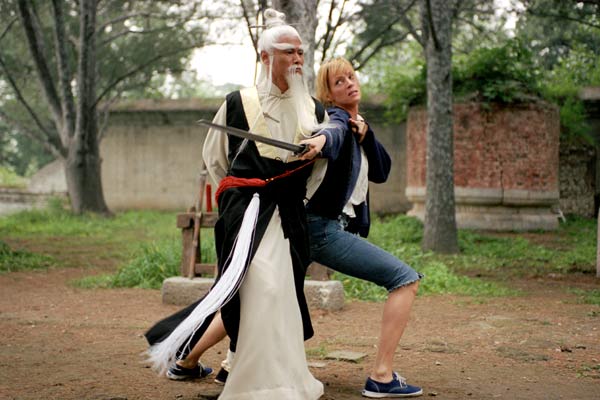
All of a sudden we're sent back to the whimsy of the first film's Eastern fantasy. This time it is made to look like a 70s film, complete with crash zooms and wonky cameras. Whilst Pei Mei does have the greatest eyebrows ever (like the guy in Parallel 9 before the dinosaur puppets came and ruined it. This is a show I SWORE I didn't invent, but which nobody remembers - thank you YouTube) I feel that his section is cheap for a number of reasons. Which I will list.

Firstly - by cutting back to the Eastern 70s vibe, it jars too much from the rest of the film. If this section was used as part of her training montage in Volume 1, it would have worked far better.
Secondly - there is too much of a feeling of Deus Ex Machina. She is trapped underground in a coffin... cut to a scene where she learns how to punch through woo at close range. How convenient..
It is a shame, because whilst I like the scene in itself, it doesn't sit well in the framing of the entire film. Whereas the subsequent fight scene with Elle works perfectly. Fast, frantic, gritty, set in a trailer and ending with an eyeball being yanked out and squashed. An excellent little fight that leads me to an interesting point (which my housemate, Doc, uncovered.... not I).
In Volume 1, The Bride kills hundreds of people - anybody that crosses her path. However, she fails to Kill Bill.
In Volume 2, despite the fights (Budd is killed by Elle, Elle is left blind) The Bride ONLY Kills Bill. That is a nice touch and a good way of dividing up the film, and is something which my frazzled brain failed to notice.
The act of killing Bill seems oddly anti climactic. The Bride meets her daughter for the first time and the three play happy family until BB goes to bed. There is a minor scuffle, some completely un necessary pop culture chat (almost as if Tarantino couldn't help himself and had to drop SOME in) and then the Five Point Palm Exploding Heart Technique. This leaves Bill in the position where after he walks five steps, his heart will explode and he will die.
It is graceful and it is elegant. It is a fitting way for Bill to die. It just lacks the grand finale vibe which is so prevalent with O-Ren at the end of Volume 1.
But, maybe death shouldn't be showy. Death shouldn't be a spectacle. Death should just be death.
Which brings me to the end of my blog. I'm a little sad that there was no natural space to include Estoban. A fabulous pimp played by Michael Parks. Parks also plays Texan Ranger Earl McGraw who appears in Volume 1 and a number of Tarantino and Rodriguez films. How meta.
Silly Caucasian girl likes to play with Samurai swords.
No 325 - Kill Bill Volume 1
Director - Quentin Tarantino
It really bugs me when films are released in two parts with cliff hangers. I don't mean films like Lord of the Rings but films like Kill Bill, or the Matrix sequels. Films shouldn't end on a cliff hanger. It feels unfair.
This is where DVD comes in. I chose to sit and watch Kill Bill as a whole, however I will review them in two parts. Otherwise it'll mess up my numbering.
Volume 1 tells the story of The Bride's recovery from the wedding massacre and the first two of her kills in her quest for vengeance. In typical Tarantino style, these are told out of sequence.
I have an odd relationship with Tarantino. I love Pulp Fiction and Inglourious Basterds blew me away but I have found his other films a bit lacking and I can't pin point what it is exactly. After all his musical choices are inspired, his visuals are stunning, he writes interesting stories and simply fantastic dialogue. Yet, the whole is less than the sum of its parts. It is a strange (and not very common) view point. What it does mean however, is that his films are full of inspired and beautiful little moments.
Volume 1 seems to be made up of two sections, one section dedicated to O-ren and another dealing with everything else. What makes this story shocking is how almost nobody in it is nice. Of course we are dealing with assassins and mobsters and the Yakuza, we don't expect niceness. But when The Bride lies in hospital comatose, her nurse pimps out her unconscious body.
We are living in a harsh world.
The grittiness of the first half of the film is intercut with a few wonderful moments. The key one that I wish to talk about is the introduction to O-ren. Told through a fabulous elegant and flowing anime scene. It is clear that Tarantino had a lot of styles he wished to experiment with. By splitting the film up into chapters he can give each chapter a distinctive visual style and give himself artistic freedom to change at will.
This works well as a technique in Volume 1, but doesn't work quite so well in Volume 2.
Despite a couple of chapters dealing with the grittiness of The Bride's coma and a very savage fight scene with Vernita Green, the Bride's real focus is O-Ren, and the films main visual style is an almost cartoon level of excess. A stylised eastern exploitation film.
This helps to dull the fact that there is a lot of violence in Kill Bill. A lot of death.
The Bride kills everyone who crosses her path. From sickos like Buck through to Oren's personal army. But whereas in the gritty real world of the film's first half we have knives through the chest or a slit ankle (wince). Once we enter Japan, the deaths become cleanly lopped of limbs and gushing gushing fountains of blood. This is cartoon violence bought to life.
The film's central point, and key triumph, is the battle with the Crazy 88 - O-Ren's personal army. It begins slowly, introducing the army in twos and threes. Then it introduces GoGo, O-Ren's insane schoolgirl bodyguard. She is played perfectly (and terrifyingly) by Chiaki Kuriyama. I have only ever seen her in this and Battle Royale and both times se has played terrifyingly insane assassin school girls. I hope she doesn't get typecast, but she does it so well.
Each of these battles are short sharp and savage and whilst GoGo's fight is the most elaborate, her death is the most restrained, for a section which seems to favour fountains of bloody.
After each of these short frantic bursts, the rest of the crazy 88 begin as does a massive fight scene that feels like it may go on forever. Shot in black and white or in silhouette against a blue background the whole fight is presented in a stylised way, making the violence far more acceptable. It is the same thing that makes Sin City a watchable film, the cartoonification of the horrific violence.
I heard that it had to be done in order to stop the film receiving an X certificate, but it works. In Asia there is a full colour un edited version of the fight.... but I think that would lose some of the quality of the piece. By presenting in such a stylised way it allows the savage savage black humour to seep through. There is something quite amusing in the myriad of limbless people hobbling away from their encounter with the Bride.
I am a sick and twisted individual.
At which point I feel it is time to discuss the film's greatest strength (and arguably Tarantino's greatest strength) - The soundtrack.
The songs in Volume 1 lean towards the east and combine beautiful and elegant pieces with Tarantino's more familiar funk and soul tunes. I heartily recommend you check it out. It is a fabulous collection of music and is vital to one of the finest moments in the entire film. The Bride's show down with O-Ren.
Visually, the film couldn't look more eastern. We are in a Japanese garden it is snowing, it is night. It is serenity personified. Except for the two circling figures, brandishing samurai swords. Over this there is the almost primal beat of Santa Esmerelda's cover of Don't Let me Be Misunderstood. The mix of Latin American sounds and Eastern Visuals works perfectly and the rhythm of the fight is immense, a strong choreography tying the visuals in with the sound with such grace.
I remember seeing it at the cinema and it gave me goosebumps, little moments like that are why Tarantino deserves the credit he gets, followed by the cut aways to the peaceful garden, it allows the scene to move at quite a gentle pace, before the savage (but again, essentially restrained) scalping.
It is an excellent ending to O-Ren's story. But the film chooses to end with a bloody cliff hanger.
Alas, I must do the same. Because although I've watched Volume 2. I don't have time to blog it right now.
Director - Quentin Tarantino
It really bugs me when films are released in two parts with cliff hangers. I don't mean films like Lord of the Rings but films like Kill Bill, or the Matrix sequels. Films shouldn't end on a cliff hanger. It feels unfair.
This is where DVD comes in. I chose to sit and watch Kill Bill as a whole, however I will review them in two parts. Otherwise it'll mess up my numbering.
Volume 1 tells the story of The Bride's recovery from the wedding massacre and the first two of her kills in her quest for vengeance. In typical Tarantino style, these are told out of sequence.
I have an odd relationship with Tarantino. I love Pulp Fiction and Inglourious Basterds blew me away but I have found his other films a bit lacking and I can't pin point what it is exactly. After all his musical choices are inspired, his visuals are stunning, he writes interesting stories and simply fantastic dialogue. Yet, the whole is less than the sum of its parts. It is a strange (and not very common) view point. What it does mean however, is that his films are full of inspired and beautiful little moments.
Volume 1 seems to be made up of two sections, one section dedicated to O-ren and another dealing with everything else. What makes this story shocking is how almost nobody in it is nice. Of course we are dealing with assassins and mobsters and the Yakuza, we don't expect niceness. But when The Bride lies in hospital comatose, her nurse pimps out her unconscious body.

We are living in a harsh world.
The grittiness of the first half of the film is intercut with a few wonderful moments. The key one that I wish to talk about is the introduction to O-ren. Told through a fabulous elegant and flowing anime scene. It is clear that Tarantino had a lot of styles he wished to experiment with. By splitting the film up into chapters he can give each chapter a distinctive visual style and give himself artistic freedom to change at will.
This works well as a technique in Volume 1, but doesn't work quite so well in Volume 2.
Despite a couple of chapters dealing with the grittiness of The Bride's coma and a very savage fight scene with Vernita Green, the Bride's real focus is O-Ren, and the films main visual style is an almost cartoon level of excess. A stylised eastern exploitation film.
This helps to dull the fact that there is a lot of violence in Kill Bill. A lot of death.
The Bride kills everyone who crosses her path. From sickos like Buck through to Oren's personal army. But whereas in the gritty real world of the film's first half we have knives through the chest or a slit ankle (wince). Once we enter Japan, the deaths become cleanly lopped of limbs and gushing gushing fountains of blood. This is cartoon violence bought to life.
The film's central point, and key triumph, is the battle with the Crazy 88 - O-Ren's personal army. It begins slowly, introducing the army in twos and threes. Then it introduces GoGo, O-Ren's insane schoolgirl bodyguard. She is played perfectly (and terrifyingly) by Chiaki Kuriyama. I have only ever seen her in this and Battle Royale and both times se has played terrifyingly insane assassin school girls. I hope she doesn't get typecast, but she does it so well.


Each of these battles are short sharp and savage and whilst GoGo's fight is the most elaborate, her death is the most restrained, for a section which seems to favour fountains of bloody.
After each of these short frantic bursts, the rest of the crazy 88 begin as does a massive fight scene that feels like it may go on forever. Shot in black and white or in silhouette against a blue background the whole fight is presented in a stylised way, making the violence far more acceptable. It is the same thing that makes Sin City a watchable film, the cartoonification of the horrific violence.
I heard that it had to be done in order to stop the film receiving an X certificate, but it works. In Asia there is a full colour un edited version of the fight.... but I think that would lose some of the quality of the piece. By presenting in such a stylised way it allows the savage savage black humour to seep through. There is something quite amusing in the myriad of limbless people hobbling away from their encounter with the Bride.
I am a sick and twisted individual.
At which point I feel it is time to discuss the film's greatest strength (and arguably Tarantino's greatest strength) - The soundtrack.
The songs in Volume 1 lean towards the east and combine beautiful and elegant pieces with Tarantino's more familiar funk and soul tunes. I heartily recommend you check it out. It is a fabulous collection of music and is vital to one of the finest moments in the entire film. The Bride's show down with O-Ren.
Visually, the film couldn't look more eastern. We are in a Japanese garden it is snowing, it is night. It is serenity personified. Except for the two circling figures, brandishing samurai swords. Over this there is the almost primal beat of Santa Esmerelda's cover of Don't Let me Be Misunderstood. The mix of Latin American sounds and Eastern Visuals works perfectly and the rhythm of the fight is immense, a strong choreography tying the visuals in with the sound with such grace.
I remember seeing it at the cinema and it gave me goosebumps, little moments like that are why Tarantino deserves the credit he gets, followed by the cut aways to the peaceful garden, it allows the scene to move at quite a gentle pace, before the savage (but again, essentially restrained) scalping.
It is an excellent ending to O-Ren's story. But the film chooses to end with a bloody cliff hanger.
Alas, I must do the same. Because although I've watched Volume 2. I don't have time to blog it right now.
Subscribe to:
Posts (Atom)