No 142 - Cyrano de Bergerac
Director - Jean-Paul Rappeneau
It's shallow to start blogs, by saying you adore,
the 1600s due to their sense that more was more.
But I loved it in this and do truly believe
That life would be better if this style was reprieved.
So instead of subtle clothes with elegant grace,
we'd get velvet garments with feathers, capes and lace.
This visual aesthetic makes something so much more
from the tale of battle. And romance at its core.
We follow a duellist, with sword and lengthy nose
In love with his cousin, and challenges that pose
with dealing with rivals in his quest for her hand
whilst he thinks he is doomed, that God had somehow planned
for him to be lonely, unloved and out of grace,
Due to the protuberance emerging from his face.
The cousin is Roxanne, the beauty, bloss'ming peach
(Loved by Christian, Cyrano and the Comte de Guiche).
She seems to me quite plain, nowhere near as stunning
She's far too thin for one, and thinks she is cunning
as she manipulates men in each discussion.
We know these plans will fail, there'll be repercussions.
Cyrano loves Roxanne (but shy, coz of his nose),
Roxanne falls for Christian, who is rubbish at prose.
So the men join forces. As a poet, with books,
Cyrano provides passion, whilst Christian provides looks.
Combined they make a match so perfect for Roxanne
that she can not help but fall madly for the man.
With Cyrano's writing, Christian wins Roxanne's heart
Kissing in the bedroom, they swear they'll never part.
(All this while Cyrano is below the balcony
in the pouring rain. Pathetic fallacy?)
Seconds after kissing, the pair of them marry,
for the Comte is coming so they cannot tarry.
Cyrano delays de Guiche in feeble disguise,
he masks his famous nose he doesn't mask his eyes.
Nor does he mask his voice, thus the Comte uncovers
Cyrano's true face and breaks up the young lovers.
In a fit of angry jealousy he sends cadets to war
(which includes Cyrano and Roxanne's Paramour).
The war is cruel violence and of course Christian dies
Tragically Cyrano continues the lies.
It would break Roxanne's heart if he pledged his heart to hers.
So he never mentions that he wrote Christian's words
Only on his death bed is the truth uncovered
Cyrano mourns his life and his lack of lovers.
Those final scenes are sad, more tragic than mere death,
but also quite annoying as Cyrano's last breath
takes bloody hours from the start of his speech,
he shouts and walks around and sword fights with a Beech.
(Really... the type of tree he fights with, I don't know
I just used Beech to rhyme, and help the rhythmic flow.)
The film is pretentious (I'll explain in a sec),
but it is quite moving and well worth the respect,
that it got from Oscars, especially Gerard
who deserved Best Actor, which he won in regard
of the moving balance of passions - love and war
which he presented in a manner that's so raw
he starts off as a prick whom you'd not want to know
but by the end you love the tragic Cyrano -
Who was a real person, though without the large nose
He was a real duellist and he wrote actual prose.
He really knew Roxanne, they really were cousins
A beam fell on his head for real, but then dozens
Of lies and fantasies were weaved into a myth
to create this tragic romantic monolith.
Back to the film now please, I have my final point
Pardon the pun, but this put my nose out of joint.
The big annoying thing, was that most of the time
the subtitles weren't following the spoken line.
Alexandrines were used for the initial script
So with their subtitles, the same trick was equipped.
And yes, it is clever but it is also a pain
Reading something diff'rent from what they're all sayin'
(seriously.... bloody hell. I don't know how someone wrote a film using that rhyming pattern... IT IS TOUGH. Anyway, good film, but a bit of a headache to follow. Probably like this nonsensical blog - proud I hardly had to cheat though (except for the last line, look at those apostrophes... eek!)
Saturday, 7 November 2009

Thursday, 5 November 2009
I guess you've just gotta find something you love to do and then... do it for the rest of your life. For me, it's going to Rushmore.
No 175 - Rushmore
Director - Wes Anderson
I love Wes Anderson, I have already spoken about my love for him in my rambly blog entry on The Royal Tenenbaums., which is my favourite film. Rushmore, however, is the favourite film of quite a few people I respect and admire such as Phil, my former housemate and the excellent comedian Miss Josie Long. This is reason enough for me to explore it.
Wes Anderson has a very distinctive style, both visually and thematically, so it is always comfortable to slip into one of his films. The big change in this film is the focus of the protagonist. The most common theme for his films are that a father figure is stubborn and self involved and needs to come to terms with the outside world. Here instead of a father we have a 15 year old boy. Max Fischer is rude and insular, delusional and petulant. He has these ideas that he is sophisticated and adult, yet he still throws massive petty sulks when he doesn't get his own way. He is not an immediately likable character. But he is fascinating.
The film is also littered with Anderson regulars. Small parts from actors such as Dipak Pallana (who only appears in Wes Anderson films, in tiny roles), Dipak's father (another actor who has a career forged by Anderson) Kumar Pallana and Seymour Cassel, who is the SPITTING IMAGE of Carl Fredricksen in Pixar's Up. On a side note, how cool is THIS?!
We then move to the larger cameos from Luke Wilson and the main roles themselves. Max Fischer, played by Jason Schwartzman at his most Sylar looking (I think it is the eyebrows), and Mr Herman Bloom by the fabulous Bill Murray.
Bill Murray is fabulous, and has created this wonderful new identity for his Autumn years, which other actors in his former gang have failed. Whereas in the past he was manic and wisecracking, Murray seems to be at his best nowadays when portraying the opposite. He is still a very funny man but it is a far sadder comedy from with bored heartbroken faces and just general stillness. And he has an excellent moustache in this film - surely that needs to be mentioned.
As well as being Max's story, this film follows a sort of love triangle between Max, Hermon Bloom and Olivia Williams' character Miss Cross. Occasionally Olivia Williams would say quite sexual things in her very posh English accent and it made me feel a bit funny and goosebumpy. Most of the time you're just in shock that Max can't see how inappropriate the whole thing is. He acts out on large grand stunts to show how much he cares for Miss Cross, and is encouraged by the wealthy and massively damaged Mr Bloom. Together they decide to throw as much money and deceit into the process to try and win Miss Cross.
It is only through the help of his school friends that Max finally has his moment of realisation and sorts out his life.
When discussing his school friends, there is only one person worth talking about. Th adorable Margaret Yang played by Sara Tanaka. Seriously, you couldn't have a more sweet and lovely character in a film. Her perseverance at looking after Max and the sheer adoration she has to him and her little smiley face. She is literally adorable. Bless her.
And it is through her that we get the best bit of the film. The film's grand finale and easily the most bonkers part of the film. Wes Anderson doesn't really shoot action sequences and yet Max puts on a Vietnam War set school play. It is like Michel Gondry doing Platoon. It is genius.
Bombs. Explosions. Helicopters. A working flamethrower. This is without a doubt the greatest school play ever.
As well as being 5 minutes of insanity in the middle of a character piece, it also sets up Margaret Yang as Max's girlfriend and sort of irons out the 'love triangle'.
It is not a neat ending, but life doesn't have neat endings. It is beautiful mind and ends in that lovely slow motiony way which Wes Anderson always seems to use.
Director - Wes Anderson
I love Wes Anderson, I have already spoken about my love for him in my rambly blog entry on The Royal Tenenbaums., which is my favourite film. Rushmore, however, is the favourite film of quite a few people I respect and admire such as Phil, my former housemate and the excellent comedian Miss Josie Long. This is reason enough for me to explore it.
Wes Anderson has a very distinctive style, both visually and thematically, so it is always comfortable to slip into one of his films. The big change in this film is the focus of the protagonist. The most common theme for his films are that a father figure is stubborn and self involved and needs to come to terms with the outside world. Here instead of a father we have a 15 year old boy. Max Fischer is rude and insular, delusional and petulant. He has these ideas that he is sophisticated and adult, yet he still throws massive petty sulks when he doesn't get his own way. He is not an immediately likable character. But he is fascinating.
The film is also littered with Anderson regulars. Small parts from actors such as Dipak Pallana (who only appears in Wes Anderson films, in tiny roles), Dipak's father (another actor who has a career forged by Anderson) Kumar Pallana and Seymour Cassel, who is the SPITTING IMAGE of Carl Fredricksen in Pixar's Up. On a side note, how cool is THIS?!


We then move to the larger cameos from Luke Wilson and the main roles themselves. Max Fischer, played by Jason Schwartzman at his most Sylar looking (I think it is the eyebrows), and Mr Herman Bloom by the fabulous Bill Murray.

Bill Murray is fabulous, and has created this wonderful new identity for his Autumn years, which other actors in his former gang have failed. Whereas in the past he was manic and wisecracking, Murray seems to be at his best nowadays when portraying the opposite. He is still a very funny man but it is a far sadder comedy from with bored heartbroken faces and just general stillness. And he has an excellent moustache in this film - surely that needs to be mentioned.
As well as being Max's story, this film follows a sort of love triangle between Max, Hermon Bloom and Olivia Williams' character Miss Cross. Occasionally Olivia Williams would say quite sexual things in her very posh English accent and it made me feel a bit funny and goosebumpy. Most of the time you're just in shock that Max can't see how inappropriate the whole thing is. He acts out on large grand stunts to show how much he cares for Miss Cross, and is encouraged by the wealthy and massively damaged Mr Bloom. Together they decide to throw as much money and deceit into the process to try and win Miss Cross.

It is only through the help of his school friends that Max finally has his moment of realisation and sorts out his life.
When discussing his school friends, there is only one person worth talking about. Th adorable Margaret Yang played by Sara Tanaka. Seriously, you couldn't have a more sweet and lovely character in a film. Her perseverance at looking after Max and the sheer adoration she has to him and her little smiley face. She is literally adorable. Bless her.

And it is through her that we get the best bit of the film. The film's grand finale and easily the most bonkers part of the film. Wes Anderson doesn't really shoot action sequences and yet Max puts on a Vietnam War set school play. It is like Michel Gondry doing Platoon. It is genius.
Bombs. Explosions. Helicopters. A working flamethrower. This is without a doubt the greatest school play ever.
As well as being 5 minutes of insanity in the middle of a character piece, it also sets up Margaret Yang as Max's girlfriend and sort of irons out the 'love triangle'.
It is not a neat ending, but life doesn't have neat endings. It is beautiful mind and ends in that lovely slow motiony way which Wes Anderson always seems to use.
Tuesday, 3 November 2009
When I woke up I went on what the movie advertisements refer to as a roaring rampage of revenge. I roared. & I rampaged. & I got bloody satisfaction
No 423 - Kill Bill Volume 2
Director - Quentin Tarantino
Whereas Volume 1 was a tribute to Eastern cinema, Volume 2 is a modern western. Gritty and dirty and dusty.
It also begins by telling a bit more about the character of The Bride, introducing the wedding rehearsal, and also introducing the all important Samuel L Jackson role as Rufus, the Organist.
But, most importantly, in those opening scenes we finally meet Bill.
The saga of Kill Bill appears to be about timing, about the slow leak of information. Volume 1 meant we never saw Bill - just his hands, or his gun, or his voice, as soon as Volume 2 begins, he is there and we see his face.
It is the same with The Bride's true name. For the entire of Volume 1, her name is edited out of conversation (for reasons that I do not understand) until, in Volume 2, we learn she is called Beatrix Ditto. Whilst I understand the suspense in not showing the viewer the titular Bill, I did not gain anything from knowing The Bride's true name. It is not an important enough bit of information to deserve a BIG reveal. But that is just my view, Tarantino enjoys these little gimmicks and whilst a lot of them do work, some (such as The Bride's name) do fall a little short.
What really works though, are some of his camera tricks. Volume 2 only really has one fight, despite The Bride going after 3 people. I want to talk about the first of the three - Budd, Bill's brother and the only male in Bill's gang.
The introduction to Budd's character makes him seem he may have changed his ways slightly. He is certainly no pacifist but has a zen view to his past:
That woman deserves her revenge... and we deserve to die.
Despite this introduction, he is the one closest to beating The Bride and he is also the cause of the most disturbing piece of torture in the entire story.
After the quick and nimble sword play and ninja skills seen in Volume 1, Budd's fight feels like cheating as he shoots her in the chest with rock salt (ouch) and then leaves her knocked out.
The screen closes in on a small patch focused on The Bride's face. The rest of the screen is a black frame, it shows the claustrophobic condition that The Bride is in, but it also gets us to focus on The Bride's face. Then, as she is put in a coffin and buried alive, the screen goes black. All we here are the coffin being dragged, the deafening THUDS of dirt being piled on top of the coffin and the constant exhausted whimpers of The Bride.
That single moment affected me more than any slit ankle, gouged out eyeball or wooshing geyser of bloody. That single moment is a beautifully presented segment of undiluted horror.
It also really works because it fits perfectly into the tone of Volume 2, unlike the Pei Mei flashback.
All of a sudden we're sent back to the whimsy of the first film's Eastern fantasy. This time it is made to look like a 70s film, complete with crash zooms and wonky cameras. Whilst Pei Mei does have the greatest eyebrows ever (like the guy in Parallel 9 before the dinosaur puppets came and ruined it. This is a show I SWORE I didn't invent, but which nobody remembers - thank you YouTube) I feel that his section is cheap for a number of reasons. Which I will list.
Firstly - by cutting back to the Eastern 70s vibe, it jars too much from the rest of the film. If this section was used as part of her training montage in Volume 1, it would have worked far better.
Secondly - there is too much of a feeling of Deus Ex Machina. She is trapped underground in a coffin... cut to a scene where she learns how to punch through woo at close range. How convenient..
It is a shame, because whilst I like the scene in itself, it doesn't sit well in the framing of the entire film. Whereas the subsequent fight scene with Elle works perfectly. Fast, frantic, gritty, set in a trailer and ending with an eyeball being yanked out and squashed. An excellent little fight that leads me to an interesting point (which my housemate, Doc, uncovered.... not I).
In Volume 1, The Bride kills hundreds of people - anybody that crosses her path. However, she fails to Kill Bill.
In Volume 2, despite the fights (Budd is killed by Elle, Elle is left blind) The Bride ONLY Kills Bill. That is a nice touch and a good way of dividing up the film, and is something which my frazzled brain failed to notice.
The act of killing Bill seems oddly anti climactic. The Bride meets her daughter for the first time and the three play happy family until BB goes to bed. There is a minor scuffle, some completely un necessary pop culture chat (almost as if Tarantino couldn't help himself and had to drop SOME in) and then the Five Point Palm Exploding Heart Technique. This leaves Bill in the position where after he walks five steps, his heart will explode and he will die.
It is graceful and it is elegant. It is a fitting way for Bill to die. It just lacks the grand finale vibe which is so prevalent with O-Ren at the end of Volume 1.
But, maybe death shouldn't be showy. Death shouldn't be a spectacle. Death should just be death.
Which brings me to the end of my blog. I'm a little sad that there was no natural space to include Estoban. A fabulous pimp played by Michael Parks. Parks also plays Texan Ranger Earl McGraw who appears in Volume 1 and a number of Tarantino and Rodriguez films. How meta.
Director - Quentin Tarantino
Whereas Volume 1 was a tribute to Eastern cinema, Volume 2 is a modern western. Gritty and dirty and dusty.
It also begins by telling a bit more about the character of The Bride, introducing the wedding rehearsal, and also introducing the all important Samuel L Jackson role as Rufus, the Organist.

But, most importantly, in those opening scenes we finally meet Bill.

The saga of Kill Bill appears to be about timing, about the slow leak of information. Volume 1 meant we never saw Bill - just his hands, or his gun, or his voice, as soon as Volume 2 begins, he is there and we see his face.
It is the same with The Bride's true name. For the entire of Volume 1, her name is edited out of conversation (for reasons that I do not understand) until, in Volume 2, we learn she is called Beatrix Ditto. Whilst I understand the suspense in not showing the viewer the titular Bill, I did not gain anything from knowing The Bride's true name. It is not an important enough bit of information to deserve a BIG reveal. But that is just my view, Tarantino enjoys these little gimmicks and whilst a lot of them do work, some (such as The Bride's name) do fall a little short.
What really works though, are some of his camera tricks. Volume 2 only really has one fight, despite The Bride going after 3 people. I want to talk about the first of the three - Budd, Bill's brother and the only male in Bill's gang.

The introduction to Budd's character makes him seem he may have changed his ways slightly. He is certainly no pacifist but has a zen view to his past:
That woman deserves her revenge... and we deserve to die.
Despite this introduction, he is the one closest to beating The Bride and he is also the cause of the most disturbing piece of torture in the entire story.
After the quick and nimble sword play and ninja skills seen in Volume 1, Budd's fight feels like cheating as he shoots her in the chest with rock salt (ouch) and then leaves her knocked out.
The screen closes in on a small patch focused on The Bride's face. The rest of the screen is a black frame, it shows the claustrophobic condition that The Bride is in, but it also gets us to focus on The Bride's face. Then, as she is put in a coffin and buried alive, the screen goes black. All we here are the coffin being dragged, the deafening THUDS of dirt being piled on top of the coffin and the constant exhausted whimpers of The Bride.
That single moment affected me more than any slit ankle, gouged out eyeball or wooshing geyser of bloody. That single moment is a beautifully presented segment of undiluted horror.
It also really works because it fits perfectly into the tone of Volume 2, unlike the Pei Mei flashback.
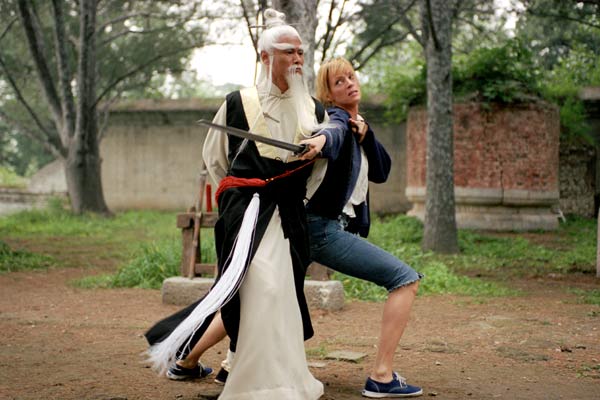
All of a sudden we're sent back to the whimsy of the first film's Eastern fantasy. This time it is made to look like a 70s film, complete with crash zooms and wonky cameras. Whilst Pei Mei does have the greatest eyebrows ever (like the guy in Parallel 9 before the dinosaur puppets came and ruined it. This is a show I SWORE I didn't invent, but which nobody remembers - thank you YouTube) I feel that his section is cheap for a number of reasons. Which I will list.

Firstly - by cutting back to the Eastern 70s vibe, it jars too much from the rest of the film. If this section was used as part of her training montage in Volume 1, it would have worked far better.
Secondly - there is too much of a feeling of Deus Ex Machina. She is trapped underground in a coffin... cut to a scene where she learns how to punch through woo at close range. How convenient..
It is a shame, because whilst I like the scene in itself, it doesn't sit well in the framing of the entire film. Whereas the subsequent fight scene with Elle works perfectly. Fast, frantic, gritty, set in a trailer and ending with an eyeball being yanked out and squashed. An excellent little fight that leads me to an interesting point (which my housemate, Doc, uncovered.... not I).
In Volume 1, The Bride kills hundreds of people - anybody that crosses her path. However, she fails to Kill Bill.
In Volume 2, despite the fights (Budd is killed by Elle, Elle is left blind) The Bride ONLY Kills Bill. That is a nice touch and a good way of dividing up the film, and is something which my frazzled brain failed to notice.
The act of killing Bill seems oddly anti climactic. The Bride meets her daughter for the first time and the three play happy family until BB goes to bed. There is a minor scuffle, some completely un necessary pop culture chat (almost as if Tarantino couldn't help himself and had to drop SOME in) and then the Five Point Palm Exploding Heart Technique. This leaves Bill in the position where after he walks five steps, his heart will explode and he will die.
It is graceful and it is elegant. It is a fitting way for Bill to die. It just lacks the grand finale vibe which is so prevalent with O-Ren at the end of Volume 1.
But, maybe death shouldn't be showy. Death shouldn't be a spectacle. Death should just be death.
Which brings me to the end of my blog. I'm a little sad that there was no natural space to include Estoban. A fabulous pimp played by Michael Parks. Parks also plays Texan Ranger Earl McGraw who appears in Volume 1 and a number of Tarantino and Rodriguez films. How meta.
Silly Caucasian girl likes to play with Samurai swords.
No 325 - Kill Bill Volume 1
Director - Quentin Tarantino
It really bugs me when films are released in two parts with cliff hangers. I don't mean films like Lord of the Rings but films like Kill Bill, or the Matrix sequels. Films shouldn't end on a cliff hanger. It feels unfair.
This is where DVD comes in. I chose to sit and watch Kill Bill as a whole, however I will review them in two parts. Otherwise it'll mess up my numbering.
Volume 1 tells the story of The Bride's recovery from the wedding massacre and the first two of her kills in her quest for vengeance. In typical Tarantino style, these are told out of sequence.
I have an odd relationship with Tarantino. I love Pulp Fiction and Inglourious Basterds blew me away but I have found his other films a bit lacking and I can't pin point what it is exactly. After all his musical choices are inspired, his visuals are stunning, he writes interesting stories and simply fantastic dialogue. Yet, the whole is less than the sum of its parts. It is a strange (and not very common) view point. What it does mean however, is that his films are full of inspired and beautiful little moments.
Volume 1 seems to be made up of two sections, one section dedicated to O-ren and another dealing with everything else. What makes this story shocking is how almost nobody in it is nice. Of course we are dealing with assassins and mobsters and the Yakuza, we don't expect niceness. But when The Bride lies in hospital comatose, her nurse pimps out her unconscious body.
We are living in a harsh world.
The grittiness of the first half of the film is intercut with a few wonderful moments. The key one that I wish to talk about is the introduction to O-ren. Told through a fabulous elegant and flowing anime scene. It is clear that Tarantino had a lot of styles he wished to experiment with. By splitting the film up into chapters he can give each chapter a distinctive visual style and give himself artistic freedom to change at will.
This works well as a technique in Volume 1, but doesn't work quite so well in Volume 2.
Despite a couple of chapters dealing with the grittiness of The Bride's coma and a very savage fight scene with Vernita Green, the Bride's real focus is O-Ren, and the films main visual style is an almost cartoon level of excess. A stylised eastern exploitation film.
This helps to dull the fact that there is a lot of violence in Kill Bill. A lot of death.
The Bride kills everyone who crosses her path. From sickos like Buck through to Oren's personal army. But whereas in the gritty real world of the film's first half we have knives through the chest or a slit ankle (wince). Once we enter Japan, the deaths become cleanly lopped of limbs and gushing gushing fountains of blood. This is cartoon violence bought to life.
The film's central point, and key triumph, is the battle with the Crazy 88 - O-Ren's personal army. It begins slowly, introducing the army in twos and threes. Then it introduces GoGo, O-Ren's insane schoolgirl bodyguard. She is played perfectly (and terrifyingly) by Chiaki Kuriyama. I have only ever seen her in this and Battle Royale and both times se has played terrifyingly insane assassin school girls. I hope she doesn't get typecast, but she does it so well.
Each of these battles are short sharp and savage and whilst GoGo's fight is the most elaborate, her death is the most restrained, for a section which seems to favour fountains of bloody.
After each of these short frantic bursts, the rest of the crazy 88 begin as does a massive fight scene that feels like it may go on forever. Shot in black and white or in silhouette against a blue background the whole fight is presented in a stylised way, making the violence far more acceptable. It is the same thing that makes Sin City a watchable film, the cartoonification of the horrific violence.
I heard that it had to be done in order to stop the film receiving an X certificate, but it works. In Asia there is a full colour un edited version of the fight.... but I think that would lose some of the quality of the piece. By presenting in such a stylised way it allows the savage savage black humour to seep through. There is something quite amusing in the myriad of limbless people hobbling away from their encounter with the Bride.
I am a sick and twisted individual.
At which point I feel it is time to discuss the film's greatest strength (and arguably Tarantino's greatest strength) - The soundtrack.
The songs in Volume 1 lean towards the east and combine beautiful and elegant pieces with Tarantino's more familiar funk and soul tunes. I heartily recommend you check it out. It is a fabulous collection of music and is vital to one of the finest moments in the entire film. The Bride's show down with O-Ren.
Visually, the film couldn't look more eastern. We are in a Japanese garden it is snowing, it is night. It is serenity personified. Except for the two circling figures, brandishing samurai swords. Over this there is the almost primal beat of Santa Esmerelda's cover of Don't Let me Be Misunderstood. The mix of Latin American sounds and Eastern Visuals works perfectly and the rhythm of the fight is immense, a strong choreography tying the visuals in with the sound with such grace.
I remember seeing it at the cinema and it gave me goosebumps, little moments like that are why Tarantino deserves the credit he gets, followed by the cut aways to the peaceful garden, it allows the scene to move at quite a gentle pace, before the savage (but again, essentially restrained) scalping.
It is an excellent ending to O-Ren's story. But the film chooses to end with a bloody cliff hanger.
Alas, I must do the same. Because although I've watched Volume 2. I don't have time to blog it right now.
Director - Quentin Tarantino
It really bugs me when films are released in two parts with cliff hangers. I don't mean films like Lord of the Rings but films like Kill Bill, or the Matrix sequels. Films shouldn't end on a cliff hanger. It feels unfair.
This is where DVD comes in. I chose to sit and watch Kill Bill as a whole, however I will review them in two parts. Otherwise it'll mess up my numbering.
Volume 1 tells the story of The Bride's recovery from the wedding massacre and the first two of her kills in her quest for vengeance. In typical Tarantino style, these are told out of sequence.
I have an odd relationship with Tarantino. I love Pulp Fiction and Inglourious Basterds blew me away but I have found his other films a bit lacking and I can't pin point what it is exactly. After all his musical choices are inspired, his visuals are stunning, he writes interesting stories and simply fantastic dialogue. Yet, the whole is less than the sum of its parts. It is a strange (and not very common) view point. What it does mean however, is that his films are full of inspired and beautiful little moments.
Volume 1 seems to be made up of two sections, one section dedicated to O-ren and another dealing with everything else. What makes this story shocking is how almost nobody in it is nice. Of course we are dealing with assassins and mobsters and the Yakuza, we don't expect niceness. But when The Bride lies in hospital comatose, her nurse pimps out her unconscious body.

We are living in a harsh world.
The grittiness of the first half of the film is intercut with a few wonderful moments. The key one that I wish to talk about is the introduction to O-ren. Told through a fabulous elegant and flowing anime scene. It is clear that Tarantino had a lot of styles he wished to experiment with. By splitting the film up into chapters he can give each chapter a distinctive visual style and give himself artistic freedom to change at will.
This works well as a technique in Volume 1, but doesn't work quite so well in Volume 2.
Despite a couple of chapters dealing with the grittiness of The Bride's coma and a very savage fight scene with Vernita Green, the Bride's real focus is O-Ren, and the films main visual style is an almost cartoon level of excess. A stylised eastern exploitation film.
This helps to dull the fact that there is a lot of violence in Kill Bill. A lot of death.
The Bride kills everyone who crosses her path. From sickos like Buck through to Oren's personal army. But whereas in the gritty real world of the film's first half we have knives through the chest or a slit ankle (wince). Once we enter Japan, the deaths become cleanly lopped of limbs and gushing gushing fountains of blood. This is cartoon violence bought to life.
The film's central point, and key triumph, is the battle with the Crazy 88 - O-Ren's personal army. It begins slowly, introducing the army in twos and threes. Then it introduces GoGo, O-Ren's insane schoolgirl bodyguard. She is played perfectly (and terrifyingly) by Chiaki Kuriyama. I have only ever seen her in this and Battle Royale and both times se has played terrifyingly insane assassin school girls. I hope she doesn't get typecast, but she does it so well.


Each of these battles are short sharp and savage and whilst GoGo's fight is the most elaborate, her death is the most restrained, for a section which seems to favour fountains of bloody.
After each of these short frantic bursts, the rest of the crazy 88 begin as does a massive fight scene that feels like it may go on forever. Shot in black and white or in silhouette against a blue background the whole fight is presented in a stylised way, making the violence far more acceptable. It is the same thing that makes Sin City a watchable film, the cartoonification of the horrific violence.
I heard that it had to be done in order to stop the film receiving an X certificate, but it works. In Asia there is a full colour un edited version of the fight.... but I think that would lose some of the quality of the piece. By presenting in such a stylised way it allows the savage savage black humour to seep through. There is something quite amusing in the myriad of limbless people hobbling away from their encounter with the Bride.
I am a sick and twisted individual.
At which point I feel it is time to discuss the film's greatest strength (and arguably Tarantino's greatest strength) - The soundtrack.
The songs in Volume 1 lean towards the east and combine beautiful and elegant pieces with Tarantino's more familiar funk and soul tunes. I heartily recommend you check it out. It is a fabulous collection of music and is vital to one of the finest moments in the entire film. The Bride's show down with O-Ren.
Visually, the film couldn't look more eastern. We are in a Japanese garden it is snowing, it is night. It is serenity personified. Except for the two circling figures, brandishing samurai swords. Over this there is the almost primal beat of Santa Esmerelda's cover of Don't Let me Be Misunderstood. The mix of Latin American sounds and Eastern Visuals works perfectly and the rhythm of the fight is immense, a strong choreography tying the visuals in with the sound with such grace.
I remember seeing it at the cinema and it gave me goosebumps, little moments like that are why Tarantino deserves the credit he gets, followed by the cut aways to the peaceful garden, it allows the scene to move at quite a gentle pace, before the savage (but again, essentially restrained) scalping.
It is an excellent ending to O-Ren's story. But the film chooses to end with a bloody cliff hanger.
Alas, I must do the same. Because although I've watched Volume 2. I don't have time to blog it right now.
Sunday, 25 October 2009
There's a hole in the world like a great black pit and it's filled with people who are filled with shit! And the vermin of the world inhabit it...
No 490 - Sweeney Todd: The Demon Barber of Fleet Street
Director - Tim Burton
Tim Burton has created a nice little niche for himself. I love the man, I love his films, I love his style and I love his directorial vision but he does have a very distinctive style. Gothic fairytale with aspects of horror. Which is usually delivered in a style which isn't too horrific. Burton's full on Gothic nightmares are few and far between. The only other one I can really think of is Sleepy Hollow. This is the first one which revels in the gore and pain and torture. This is Burton at his darkest and most intense.
This is also a far more complex musical than Corpse Bride. I am a massive fan of Danny Elfman (another very distinctive artist with a very recognisable theme), however he cannot compete with the richness and complicated styles of Sondheim. The songs in this are a beast to play and an utter nightmare to sing.
Yet, despite these challenges the film is a quintessential Burton film, and drips with familiarity. Take the opening titles. In fact, take the opening titles of any Tim Burton film. They all convey a journey. Seriously. Go and watch one, they really do.
In this film we follow the trail of blood from the barber's chair to the Thames.
The only difference is that in this journey we're not accompanied by Danny Elfman's scores. Instead we have the epic instrumental of The Tale of Sweeney Todd. This makes me a bit sad because it is my favourite song in the play (full of pomp and OTT operatics) but did not fit the world that Burton had created.
The world of the film is savage. I have seen the film a few times and have been fortunate enough to see a couple of different stage versions, however I'm still surprised how dark the tale is.
With theatre it is subverted, you cannot show. You mostly imply. Cinema does not have these limitations.
The film has a very muted palette, dirty greys and muddy sepia tones. Broken only by the vibrant red of blood. The blood is so bright and so red that it never looks real. It is just an over exaggerated version of the horror. And oh what horror.
The characters themselves are all horrible, but almost all of them are fantastic to watch. I wish to begin with the exception. Anthony and Joanna - the young love interest. It seems almost traditional that the love interest will have the weakest songs. But it also has the weakest characters. Anthony is a massive wet drip, considering he is a sailor you'd think he was a tougher person. Not only that but Jamie Campbell Bower seems far too young to play the part. He is a very baby faced 19 year old. Joanna doesn't have much to do in this film besides get locked away in places (bedrooms, asylums, chests). The two are not very interesting. Contrary to that is the fabulous cameo character of Pirelli.
Sacha Baron Cohen truly shines as the exaggerated idiot of an Italian. But it plays to his strengths, and he is genuinely witty and a primping showboating joy to watch. It takes a lot to steal the show in a film so laden with talent that the mighty Anthony Stewart Head only gets one line, but steal the show he does.
Moving on to a trio of death eaters who also shine in this film. Starting with the baddies. The Beadle, played by Timothy Spall with a horrible sleazy, cowardly, vermin style which seems to characterise his more recent cinema outings. He is fabulous, his every movement almost dripping - he is so gloriously hateable. Moving on to Judge Turpin. Whilst not so outwardly and aesthetically repulsive (his wardrobe alone makes me wish I was a wealthy Victorian), the film takes great pains to illustrate just how cruel and perverse he is. A rapist, a bully, a sexual deviant. He is not a nice man.
On the other hand, Alan Rickman is a genius and plays the character with such subtlety. He comes off as bitter and tired and self centred. Whereas he could have come off as a cliche villain. But that is because Alan Rickman is brilliant. I hope you all love Alan Rickman.
We come to the last of our Harry Potter trio and to the beginning of the central pairing. Helena Bonham Carter always seems to get stick for her roles in her husband's films. As if she hasn't earned them. She is wonderful in this (again I think she is wonderful in a lot of things - one of the real highlights of Harry Potter) and her character is beautifully complex. The mix of wanting to make things better for Sweeney, but also trying to seduce him. The strange sensual, pitiful, grimy quality of her character. Watching her character blossom throughout the film. See By The Sea, for a rare splash of vibrant colour (plus Burton favourite of black and white stripes) and for Mrs Lovett's characterisation coming out in full.
She is a wonderful character and her death is the most horrific of all.
This film benefits from the fabulous cast (and the fabulous deaths). I've spoken about most of them but need to mention the most familiar part of any Tim Burton film, the mighty Johnny Depp. Depp is a formidable actor, and initially I was worried that he might be going a bit too Jack Sparrah in his role as Todd, but that was a massively misplaced fear - based on nothing but a cockney accent.
However Todd's character is beautifully displayed. I don't want to sit and recite the entire plot, but you have to accept that no one in this film has a good time, it is nothing but tragedy and woe. There are some amazingly sad single moments (such as the part where Todd is reunited with his wife and daughter without realising) but the true tragedy is Todd's descent.
With the exception of the flashbacks, Todd is never truly happy. He begins the film bitter and angry and hellbent on revenge, a surly ashen man with a lot on his mind. Gradually he lets the blood lust over come him. By the point he kills Mrs Lovett he is almost a demon, his blood smeared face glistening in the roaring fire.
The horror does not come from the (almost caricature) blood.
The horror comes from Todd's insanity.
Director - Tim Burton
Tim Burton has created a nice little niche for himself. I love the man, I love his films, I love his style and I love his directorial vision but he does have a very distinctive style. Gothic fairytale with aspects of horror. Which is usually delivered in a style which isn't too horrific. Burton's full on Gothic nightmares are few and far between. The only other one I can really think of is Sleepy Hollow. This is the first one which revels in the gore and pain and torture. This is Burton at his darkest and most intense.


This is also a far more complex musical than Corpse Bride. I am a massive fan of Danny Elfman (another very distinctive artist with a very recognisable theme), however he cannot compete with the richness and complicated styles of Sondheim. The songs in this are a beast to play and an utter nightmare to sing.
Yet, despite these challenges the film is a quintessential Burton film, and drips with familiarity. Take the opening titles. In fact, take the opening titles of any Tim Burton film. They all convey a journey. Seriously. Go and watch one, they really do.
In this film we follow the trail of blood from the barber's chair to the Thames.
The only difference is that in this journey we're not accompanied by Danny Elfman's scores. Instead we have the epic instrumental of The Tale of Sweeney Todd. This makes me a bit sad because it is my favourite song in the play (full of pomp and OTT operatics) but did not fit the world that Burton had created.
The world of the film is savage. I have seen the film a few times and have been fortunate enough to see a couple of different stage versions, however I'm still surprised how dark the tale is.
With theatre it is subverted, you cannot show. You mostly imply. Cinema does not have these limitations.
The film has a very muted palette, dirty greys and muddy sepia tones. Broken only by the vibrant red of blood. The blood is so bright and so red that it never looks real. It is just an over exaggerated version of the horror. And oh what horror.
The characters themselves are all horrible, but almost all of them are fantastic to watch. I wish to begin with the exception. Anthony and Joanna - the young love interest. It seems almost traditional that the love interest will have the weakest songs. But it also has the weakest characters. Anthony is a massive wet drip, considering he is a sailor you'd think he was a tougher person. Not only that but Jamie Campbell Bower seems far too young to play the part. He is a very baby faced 19 year old. Joanna doesn't have much to do in this film besides get locked away in places (bedrooms, asylums, chests). The two are not very interesting. Contrary to that is the fabulous cameo character of Pirelli.
Sacha Baron Cohen truly shines as the exaggerated idiot of an Italian. But it plays to his strengths, and he is genuinely witty and a primping showboating joy to watch. It takes a lot to steal the show in a film so laden with talent that the mighty Anthony Stewart Head only gets one line, but steal the show he does.

Moving on to a trio of death eaters who also shine in this film. Starting with the baddies. The Beadle, played by Timothy Spall with a horrible sleazy, cowardly, vermin style which seems to characterise his more recent cinema outings. He is fabulous, his every movement almost dripping - he is so gloriously hateable. Moving on to Judge Turpin. Whilst not so outwardly and aesthetically repulsive (his wardrobe alone makes me wish I was a wealthy Victorian), the film takes great pains to illustrate just how cruel and perverse he is. A rapist, a bully, a sexual deviant. He is not a nice man.


On the other hand, Alan Rickman is a genius and plays the character with such subtlety. He comes off as bitter and tired and self centred. Whereas he could have come off as a cliche villain. But that is because Alan Rickman is brilliant. I hope you all love Alan Rickman.
We come to the last of our Harry Potter trio and to the beginning of the central pairing. Helena Bonham Carter always seems to get stick for her roles in her husband's films. As if she hasn't earned them. She is wonderful in this (again I think she is wonderful in a lot of things - one of the real highlights of Harry Potter) and her character is beautifully complex. The mix of wanting to make things better for Sweeney, but also trying to seduce him. The strange sensual, pitiful, grimy quality of her character. Watching her character blossom throughout the film. See By The Sea, for a rare splash of vibrant colour (plus Burton favourite of black and white stripes) and for Mrs Lovett's characterisation coming out in full.

She is a wonderful character and her death is the most horrific of all.
This film benefits from the fabulous cast (and the fabulous deaths). I've spoken about most of them but need to mention the most familiar part of any Tim Burton film, the mighty Johnny Depp. Depp is a formidable actor, and initially I was worried that he might be going a bit too Jack Sparrah in his role as Todd, but that was a massively misplaced fear - based on nothing but a cockney accent.
However Todd's character is beautifully displayed. I don't want to sit and recite the entire plot, but you have to accept that no one in this film has a good time, it is nothing but tragedy and woe. There are some amazingly sad single moments (such as the part where Todd is reunited with his wife and daughter without realising) but the true tragedy is Todd's descent.
With the exception of the flashbacks, Todd is never truly happy. He begins the film bitter and angry and hellbent on revenge, a surly ashen man with a lot on his mind. Gradually he lets the blood lust over come him. By the point he kills Mrs Lovett he is almost a demon, his blood smeared face glistening in the roaring fire.
The horror does not come from the (almost caricature) blood.
The horror comes from Todd's insanity.
Friday, 23 October 2009
I have been touched by your kids... and I'm pretty sure that I've touched them.
No 188 - The School of Rock
Director - Richard LinklaterThank you Freeview. You have served me well, providing films as I was trapped in a hotel in Sunderland. Today's film is an unusual entry from introspective indie darling Richard Linklater, a gleefully anarchistic comedy starring the gleefully anarchic Jack Black.
Somebody would have noticed. Early on.
If there is one role that Jack Black plays well it is the arrogant rock buffoon. You can argue that the majority of his roles have played to that side but this is the first film to truly embrace it. I saw Tenacious D when they performed their first gig in the UK and Dewey Finn is a slightly scaled down version of Rock Behemoth JB. I think this is a good thing, because for all his vulgar hilarity, Tenacious D might be slightly too much. Whereas Dewey feels like a real person. An idiot. But a real person.
This is helped by the fact that School of Rock was written specifically for Jack Black and therefore celebrates his rock persona and his wild eyed delivery. This is easily Jack Black's best performance.What is truly impressive is that despite this being Black's finest hour, he doesn't steal the show with excessive mugging. It is an impressive task to outshine Jack Black, doubly so when he is on such top form, and yet it is not done by just on person but by an entire class of them.
The class of the School of Rock themselves.


The film really celebrates the journey of the children. It follows them from the beginning where they are prim and proper and under the thumb of their parents and their headmistress, the fabulous Joan Cusack. Throughout this film she is played as the much misunderstood authoritarian of the piece, however throughout it all I could hear was Jessie. Which is the problem with voice casting.

Gradually though, Jack Black helps the children find their individuality, their confidence, their sense of fun.
The most important part of the film is the final gig. Here you can see how fabulously the children work and play together. Following their journey, the final scene is a real goose bump raising heart warming moment of pure joy. I like to think that each child designed their own outfits and helped to create the real sense of unity and strength which shines from the film.
You can watch it in isolation and it is still really fun.
But it isn't as fun as seeing it in context...
Wednesday, 21 October 2009
I am sorry to bother you, but I could not tell no one else. I do not know no other woman who gives her body so frequently...
No 367 - Cabaret
Director - Bob Fosse
Last year an invitation fluttered electronically onto my doormat. My Facebook doormat. It was an invitation for the New Sheridan Club's Christmas party and the theme was painfully precise. Weimar Berlin it shouted out. I was confused, I contacted outside help. "Oh!" came the exasperated sigh of a reply "Just watch Cabaret".
So a year later I did.
The film follows two friends/lovers as the parade through the decadence of Weimar Berlin and their scrapes and escapades throughout. What I like about this film is that the majority of the film is as flippant and as flighty as that sentence. Then it changes, after all... you can't have 1920's and 1930's Berlin without having a bit of a Nazi rise to power.
But before we speak of such things, let us look at the magic of the titular Cabaret.
The most important name to mention is Fosse. Him of the jazz dance wizardry. As we enter the world of the Cabaret, we are hit by Fosse's choreography with a full and enormous force. Scantily clad women thrust and dance and whirl, the camera is lost with flashes of colour and sequins and fish net tights. It is a gloriously dizzying experience which Moulin Rouge! also tries to emulate, and which I live in perpetual hope will be emulated every time I go to a burlesque.
That is the other reason why I love the scenes in the Cabaret. I'm a sucker for a bit of Burlesque.
As well as the scantily clad women, we are introduced to one of the finest characters in this little ensemble. The over made up, over camp, over fabulous Master of Ceremonies, played by the wonderful Joel Grey. His ridiculous accent matches his flitting through languages. He is a joy to watch and he appears in almost all of the musical numbers.
Just watch the song 'Money makes the world go round'. This song not only shows why I like the MC so much, but also why I like the film as a whole. Sublimely ridiculous with quite base humour, slinky dancing, fantastic clothing. It is just too much for a wannabe dandy like myself.
I have begun to talk about songs, for yes this is a musical (in case you didn't know) - but unlike traditional musicals, it has a well thought out structure. For all the songs are performed in the Cabaret itself, and are therefore neither illogical or necessary. If you really truly utterly hate songs in films, you can skip them and not miss anything.
The only song not performed in the Cabaret is 'Tomorrow Belongs to Me' which is such a gloriously chilling number, and such a clever way of showing the influence and power of the Nazi party. It is quite a difficult piece to watch. Watch it in all its wholesome aerian creepiness..
For whilst this is a love story between Sally (Liza Minnelli - I'll talk about her later) and Brian (Michael York, or as I like to call him... Basil Exposition) it is also a story about the dangers of the Nazi party. As Brian knows when he tries to fight them in the streets and ends up a broken man.
So intercut amongst the decadence and the cavorting and the champagne are moments of chilling brutality and beginnings of the prejudice and hatred towards Jews. There is a whole subplot about the romantic difficulties of a Jewish couple. I loved that couple because they met at an English lesson and despite both being German only speak to each other in very formal broken English, it is cute.
Throughout the story, these little Nazi moments leave a bitter taste in the viewer's mouth and the final scene seems quite potent to. In it, we emulate the first scene, with the MC's introduction to the cabaret and a pan across the audience, through distorted glass, so that the audience are all unfocused. Only this time, in the centre of the picture and totally in focus rests a swastika.
....If I had any journalistic sense I would have edited this blog better. That is the kind of edgy sentence you want to FINISH on... but I still have a little bit to say on Miss Liza Minnelli and her character Sally.
Mainly, I found Sally very annoying. I didn't like the way that she is constantly fishing for compliments. I didn't like the way that she says things solely to be seen as shocking or scandalous. I don't like the way she ALWAYS has to be the centre of attention and sulks when she isn't.
However all of that is forgiven when she dances.
Because she is one HELL of a performer on that there cabaret stage.
Director - Bob Fosse
Last year an invitation fluttered electronically onto my doormat. My Facebook doormat. It was an invitation for the New Sheridan Club's Christmas party and the theme was painfully precise. Weimar Berlin it shouted out. I was confused, I contacted outside help. "Oh!" came the exasperated sigh of a reply "Just watch Cabaret".
So a year later I did.
The film follows two friends/lovers as the parade through the decadence of Weimar Berlin and their scrapes and escapades throughout. What I like about this film is that the majority of the film is as flippant and as flighty as that sentence. Then it changes, after all... you can't have 1920's and 1930's Berlin without having a bit of a Nazi rise to power.
But before we speak of such things, let us look at the magic of the titular Cabaret.
The most important name to mention is Fosse. Him of the jazz dance wizardry. As we enter the world of the Cabaret, we are hit by Fosse's choreography with a full and enormous force. Scantily clad women thrust and dance and whirl, the camera is lost with flashes of colour and sequins and fish net tights. It is a gloriously dizzying experience which Moulin Rouge! also tries to emulate, and which I live in perpetual hope will be emulated every time I go to a burlesque.
That is the other reason why I love the scenes in the Cabaret. I'm a sucker for a bit of Burlesque.
As well as the scantily clad women, we are introduced to one of the finest characters in this little ensemble. The over made up, over camp, over fabulous Master of Ceremonies, played by the wonderful Joel Grey. His ridiculous accent matches his flitting through languages. He is a joy to watch and he appears in almost all of the musical numbers.

Just watch the song 'Money makes the world go round'. This song not only shows why I like the MC so much, but also why I like the film as a whole. Sublimely ridiculous with quite base humour, slinky dancing, fantastic clothing. It is just too much for a wannabe dandy like myself.
I have begun to talk about songs, for yes this is a musical (in case you didn't know) - but unlike traditional musicals, it has a well thought out structure. For all the songs are performed in the Cabaret itself, and are therefore neither illogical or necessary. If you really truly utterly hate songs in films, you can skip them and not miss anything.
The only song not performed in the Cabaret is 'Tomorrow Belongs to Me' which is such a gloriously chilling number, and such a clever way of showing the influence and power of the Nazi party. It is quite a difficult piece to watch. Watch it in all its wholesome aerian creepiness..
For whilst this is a love story between Sally (Liza Minnelli - I'll talk about her later) and Brian (Michael York, or as I like to call him... Basil Exposition) it is also a story about the dangers of the Nazi party. As Brian knows when he tries to fight them in the streets and ends up a broken man.
So intercut amongst the decadence and the cavorting and the champagne are moments of chilling brutality and beginnings of the prejudice and hatred towards Jews. There is a whole subplot about the romantic difficulties of a Jewish couple. I loved that couple because they met at an English lesson and despite both being German only speak to each other in very formal broken English, it is cute.
Throughout the story, these little Nazi moments leave a bitter taste in the viewer's mouth and the final scene seems quite potent to. In it, we emulate the first scene, with the MC's introduction to the cabaret and a pan across the audience, through distorted glass, so that the audience are all unfocused. Only this time, in the centre of the picture and totally in focus rests a swastika.
....If I had any journalistic sense I would have edited this blog better. That is the kind of edgy sentence you want to FINISH on... but I still have a little bit to say on Miss Liza Minnelli and her character Sally.
Mainly, I found Sally very annoying. I didn't like the way that she is constantly fishing for compliments. I didn't like the way that she says things solely to be seen as shocking or scandalous. I don't like the way she ALWAYS has to be the centre of attention and sulks when she isn't.
However all of that is forgiven when she dances.
Because she is one HELL of a performer on that there cabaret stage.
Subscribe to:
Posts (Atom)