Showing posts with label brad pitt. Show all posts

Monday, 20 September 2010

Oh, wouldn't it be great if I was crazy? Then the world would be ok

No 465 – 12 Monkeys
Director – Terry Gilliam


The future world seen in 12 Monkeys feels like a natural follow on from the future of Brazil. Industrial insanity and large magnifying lenses appear in a world that seems mostly bureaucratic and authoritarian. It is what we want from Gilliam and it is the visual style which is carried on with Jeunet and Caro in their sci-fi worlds. But here we also get to witness the artistic skill of Terry Gilliam. The stark beauty of the isolated snow dusted city – the visual insanity of a lion prowling the roofs of long abandoned state buildings. This is a beautiful post-apocalypse.


The apocalypse in question is the release of deadly chemicals by a group called the 12 Monkeys – and Bruce Willis’ Cole (a prisoner for an unstated crime) is sent back in time to try and find the source of the disaster and infiltrate the 12 Monkeys.

I want to play it a bit carefully, because once Cole goes back in time the plot gets VERY complicated and I don’t want to spoil it by describing in too much detail.

However, Cole is drugged up, 4th dimensionally jet lagged and talking about the future. He is, rather naturally, institutionalised. However he is put in one of the coldest and most savage asylums I’ve ever seen in a film. Its all pretty bleak. Also locked up is Brad Pitt's skew eyed Jeffrey Goines. A sort of mega-mad proto-Durden. His rants about public perception, power and consumerism put Goines in the same class as Durden, just without the mental stability to be able to hold it in or handle it. The two speak and a series of Paradoxes occur. So, from this point on I refuse to speak about the plot besides saying, that what happens is that Cole begins flitting in and out of time at certain points in order to make sure he can catch the terrorists.

He also spends time trying to warn the head of a large animal testing plant that someone will steal their biological warfare samples. It is here we meet Captain Von Trapp and, my personal favourite character of the whole film: David Morse in a very fetching ginger wig.

The film has to be applauded for having some great ideas, and whilst the execution of some of those ideas has dated, most of the film is still really fresh and exciting. There are some weird bits (the 'raspy voice' seems a bit of a strange one) - but it handles time travel in an understandable way.

And it has a gloriously fucked up ending.


Monday, 7 June 2010

It's only after we've lost everything that we're free to do anything

No 10 - Fight Club
Director - David Fincher

I am Jack's sense of joyous nostalgia. The end of my last GCSE consisted of two things - an epic water fight in my local park and the first time I watched Fight Club. Later, my 'coming of age' in a series of madcap adventures in Ecuador meant that whilst I watched Fight Club in a dingy and strange cinema bar we drank all of the venue's beer, gin and tonic water. This is a film which is firmly part of my journey to adulthood.

Which is worrying when you think how joyfully nihilistic it is.

Now.... if you haven't seen this film PLEASE DON'T READ THIS REVIEW. I can't talk about it without giving away massive and crucial spoilers which will ruin it for you...

Good.

Before we talk of plot and twists and stories, let's begin by talking about the visual aesthetic. There are some wonderful stylistic touches in this film and elements which I think were pretty new when Fincher did them. I certainly had never seen the exciting way in which the camera flies and darts through the CGI environs (a stylistic flourish he later made even more impressive in the otherwise unremarkable Panic Room). Even the opening sequence is amazing as the camera rushes out of Ed Norten's head and along the barrel of a gun.

We're then introduced to Ed Norton's narrator - a lead without a name - and from his first dead eyed look and dead pan voice over one thing is made absolutely clear. This film is cool. And it knows it is cool. This film KNOWS it is cooler than you. From every dry line and every piece of inspired casting (Meatloaf's Bob is particularly brilliant) it taunts you with its cool. But what is so interesting is that the narrator isn't particularly cool... he is plain, suppressed and he isn't happy.
Each piece of furniture is amusingly annotated with prices and descriptions as he walks through it. His house is an IKEA catalogue. He has no personality.

However we begin to see traces of the Narrator's other side... we're introduced to Marla Singer, who I'll speak about later. But we also get flashes of Tyler Durden. There are at least 3 times that I have seen... Firstly, in the office he appears standing by the photo copier. Secondly, he flashes behind the shoulders of his doctor and thirdly (if I remember correctly) when Marla Singer ousts him from his self help therapy. There may be more, and if there are I've not noticed them.

It isn't until on a plane that we meet Tyler Durden. Played with violent, anarchic panache by Brad Pitt. He is part Rusty Ryan - suave bastard, and part Jeoffrey Goines - total loon. He is 100% dangerous and a wonderful cinematic thing to behold. I'll let Empire describe him better than me...
This is where we discover the second thing about the film. Not only does the film know it is cooler than you. It doesn't give a fuck.

There are moments in this film which discuss how a film works (explaining 'cigarette burns' which I now notice all the time) and there are moments which (whether real or digitally created) seem to mess with the cinema. Whether it is splicing a penis in to the film for a pre-credit gag or shaking and distorting the film in an angry rant. I can't think of a film (not including Planet Terror's graininess and missing reel) that is as brave with the concept of film since Hellzapoppin' - though there probably are some...

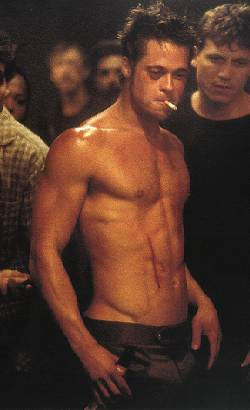
Tyler is a destructive guru. He looks awesome. He reeks of confidence. He is too good to be true. That is the first clue we really get... from the ease with which he acts out his pretty misguided anarchic views all the way to his impossibly ripped physique. From his mind to his body he is almost too perfect. And in a film which is keen to press that nobody is perfect, that should be a warning that he might, just might, not be real.
He is also wonderfully nihilistic. He is true punk. He compliments perfectly the suicidal over-thinking nature of Marla... Her morbid character is so different to Tyler, who embraces life to a dangerous degree, but yet is also very similar. Both seem to attach little value to material things. Both are happy living in squalor. Both just want to feel. Whether it is the feeling of death for Marla (her own or someone else's) or the exhilaration of violence for Tyler (whether personal or vandalism) - it is all about having a genuine connection. It is probably also why they have so much sex throughout.

Norten's character is as entranced by him as we are, and soon the two join forces and the titular Fight Club is born. Surely everyone watching when Brad Pitt swaggers into the middle of his bloodlusting punters, and booms out the now immortal rules of fight club, is transfixed. I can't show you his performance... but even the script is perfect. Just wonderful.
What is interesting about the actual fight club is that it manages to show two contradictory things... at the same time. Firstly, the fights are horrible, savage and brutal. Secondly, those fights are wonderful; almost aspirational. The way that it's filmed and the reactions from the characters show how free they are. How happy. It makes me want to get into a fight - and I'm a fat cowardly pacifist.

What this film begins to show is how an idea can go too far. How the freedom of being in a fight and letting off steam (if somewhat violently) turns into a breeding ground for nihilistic terrorists. It shows how easily people are led by charismatics with a different view. It show how dangerous people can be and how dangerous organised societies can be. The cinematic portrayal of Project Mayhem is as much of an attack on corporations and capitalism as it is an attack on fundamentalist religion. For Project Mayhem could easily be considered a fundamentalist religion. This is a film that is far more intelligent than its title implies... This is a film which makes you think. If you go in expecting a film about a club where people get into fights you'll be sorely disappointed, as the actual club only features for the briefest moments.
This is a film about introspection, about our own personal demons and our own little misanthropic tendencies. It is a film about embracing who we are before we suppress it too far and snap. This is a film about violence. Just not always the punchy punchy kablammo kind.

So we come to the reveal... the twist... Ed Norton's narrator IS Tyler Durden. Of course he is. Tyler Durden is what any suppressed white collar depressed individual would want to be. A gorgeous bastard who could beat you up and doesn't care what anybody thinks. Of course he is an aspiration.

And yet he is still there and he is still very dangerous.

I think the reveal is great, and whilst it was beginning to twig as the events unfurled, I had never figured out the twist before the reveal (unlike, say... The 6th Sense) - and yes there are moments which become farcical (see the scenes in which Ed Norton fights himself) but the danger is still there - how do you kill off your other personality?

The film ends with the last of Tyler's plans coming to fruition. As the Pixies sound up, the skyscrapers fall and there is a joyous uplifting vibe to the whole thing. I haven't felt this happy watching terrorism since V for Vendetta.

It is a celebration of the little bastard in all of us that just wants to break things. And it is a warning that maybe we shouldn't always listen to it.

Thursday, 28 January 2010

Do you find us beautiful, magical? Our white skin, our fierce eyes? "Drink" you ask me, do you have any idea of the thing you will become?

No 281 - Interview with the Vampire
Director - Neil Jordan

I like the way the cinematic vampires are varied beasts. The punks of The Lost Boys are nothing compared to the monsters of From Dusk Till Dawn. There are the strange bat like Nosferatu or the incredibly human Eli. Even Dracula himself has flitted through different versions and completely different styles.
There is no definitive vampire, but I find them fascinating - for me, the most fascinating is the Anne Rice vampire. I love the passion, the glamour and he danger of her vampires. It has been said time and time again that the Vampire story is a thinly veiled allegory for sex. Nowhere is that more evident than in Interview with the Vampire.

The vampires in this film are beautiful creatures that bristle with a dangerous sexual lust. Their skin is white and smooth and their eyes are fierce and unnatural. Almost feline. Maybe it plays to the part of me which yearns to be a dandy, but they are just fabulous. If I were to create a vampire myth, that is the direction I'd have taken.
Our protagonist for this story is Brad Pitt's Louis de Pointe du Lac, a plantation owner from New Orleans who develops one hell of a death wish and who is turned into a vampire by Tom Cruise's Lestat de Lioncourt. We then follow Louis' story as he becomes used to being a vampire and as he lives out a life of endless youth.

Louis is our 'in' to the vampiric world. He is the character that we follow, he is the character that we see as both mortal and immortal, he is our narrator. However he is not the most interesting of characters. Despite having been a vampire for almost 200 years (by the time we meet him in the early 90's) he is not happy with his lot. He doesn't feel comfortable killing people and frequently complains.
No, the most interesting and fun characters are those that relish in the bloodshed. Those that are truly callous and wicked. That is why I love Lestat so much. His character is a lavish and decadent evil. A man who has embraced his demonic blessing and ran with it. He cackles maniacally as people attack him. He flits and he flys, he maims an he kills but always with a smile and an appreciation of the finer things in life.
Lestat killed two, sometimes three a night. A fresh young girl, that was his favorite for the first of the evening. For seconds, he preferred a gilded beautiful youth. But the snob in him loved to hunt in society, and the blood of the aristocrat thrilled him best of all.

Though, what I think I like best about Lestat is that it is Tom Cruise. I can only think of 3 films where Cruise has been an obvious good guy and one he was an arrogant prick that eventually mellow and the second is a comedy cameo. This is the only film (that I can think of) where Cruise is all out malicious, manipulative and horrible. He seems to relish it as well. Each sneer, each giggle, each time he spikes a wrist to drink the blood is met with a look of sheer enjoyment. Hell, the brief ominous sinister moments which he shares with (the beautiful beautiful) Thandie Newton's slave girl have more chemistry then their ENTIRE relationship in MI2.

It is with Lestat that we also see one of the films most striking features, the sexualisation of everything. It seems that blood is more than mere food for the vampires. It is a passion, a yearning, a physical torturous desire. Any exposed area of flesh becomes fetishised by the film. So we get long lingering shots of the rise and fall of a heaving bosom, or the curve of a neck, or a delicate exposed wrist. The sexualisation is continued with the kill, as it nearly always begins with a playful seduction. By the time the vampires are feeding it looks more like they are locked in a passionate and highly sensual embrace. Nearly everything in this film is somewhere on the sexual spectrum. It is either flirty and mischievous or dangerously erotic.

However, anything that the two men do is easily overshadowed by Claudia. A vampire taken as a child. Therefore with the immortal, never changing body of a child but with the mind of an adult killer. It must be tough being Kirsten Dunst, knowing that you played your greatest role aged 11. She is phenomenal in this. I was 9 when this film came out so I don't know of the controversy, or even if there was any, however the idea of a child being so cruel, so sensual, so wicked is a bit uncomfortable.
She isn't a young vampire like Eli, who is much more sage, practical and world-weary. She relishes in the carnage. She makes me think of the few clips I've seen of Chloe Moretz in the upcoming Kick Ass.

Claudia's defining moment is when she realises she will never become a woman. That she is doomed to be a child forever. Here you see the oddest part of the vampire curse. Their bodies will stay the way they are forever. You can't even cut your hair, as it will instantly grow back. Her attempt to rebel against this involves 'killing' Lestat and fleeing - and this is where the film changes completely. It takes a step back from the fripperies and opulence that I so adore and becomes something a bit darker.
I always thought this movie was really long (it isn't, it is under 2 hours) but I think that stems from the fact that is changes, into a second film when they arrive in Paris and meet Antonio Banderas' Armand.
- Before I speak about the next bit, I just want to say that if you take Armand, and trickle in a splash of Zorro you have all the evidence you need to prove that Banderas would make an EXCELLENT Gomez Addams (much fucking better than Tim Curry).

Armand's show - Theatre Des Vampires is fabulous both in its post modernism (vampires pretending to be people pretending to be vampires) but also in how brazen it is as the show's grand finale is the killing of a woman live on stage - which, I assume, everyone thinks is part of the act.
The entire Theatre Des Vampires troupe are just dark. Far more feral and violent (and at times insane) than the refined Lestat, Louis and Claudia. It is here that a lot more dark and savage stuff happens which truly and deeply affects Louis and leaves him hollow and empty for the final parts of the film. Though the montage of cinematic sunrises, and the way the effect Louis as he goes to see them (having not seen a sunrise in decades, if not centuries) is beautiful and brings us up to date.

And then it ends.
This film doesn't really have a conclusion as Louis' story is in no way concluded. It has just reached modern day. He will continue and his story will continue.

We just leave, much like Christian Slater's interviewer, fascinated, transfixed and scared. Lucky to have met such wonderful and dangerous characters. However briefly.